Why African lenders need connected tools to price risk, protect capital and widen sustainable finance
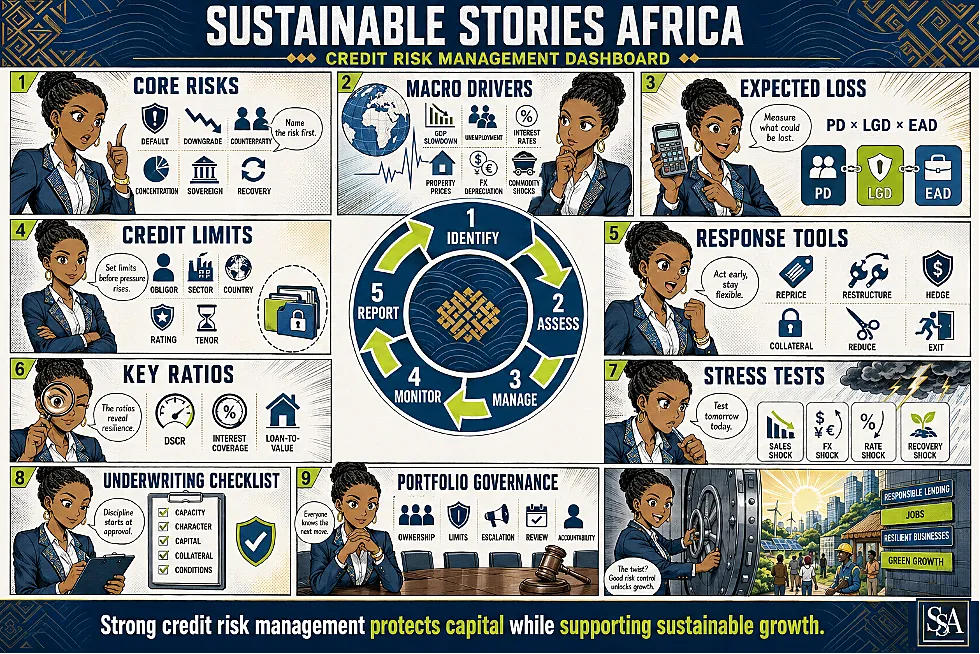
FinPolNomics presents credit risk as a connected system rather than a single approval decision. Default and concentration risks, macroeconomic pressures, expected loss, exposure limits, financial ratios, stress tests and disciplined underwriting must work together to protect capital.
For African lenders, suppliers and investors, stronger credit tools can improve risk pricing, portfolio resilience and sustainable access to finance—especially where currency volatility, inflation and sector concentration can quickly weaken repayment capacity.
Credit Risk Demands System-Wide Discipline
Credit risk becomes visible when a borrower misses a payment, but the decisive mistakes often occur much earlier.
A weak assessment, an oversized exposure, an untested currency mismatch or a poorly designed covenant can turn a manageable loan into a capital problem long before default.
The FinPolNomics Credit Risk Management Tools framework therefore treats credit management as a cycle: identify, assess, manage, monitor and report.
It connects portfolio strategy, risk appetite, credit assessment, exposure management and capital monitoring rather than allowing approval to stand alone.
That systems view matters across African markets. Currency depreciation can inflate foreign-currency obligations, high interest rates can weaken debt-service capacity, commodity shocks can squeeze exporters, and fiscal stress can affect sovereigns, banks and contractors simultaneously.
Credit discipline must be analytical enough to detect these links and practical enough to influence pricing, limits and remedial action.
Six Risks Define the Exposure Landscape
The framework identifies six core risk categories: default, downgrade or migration, counterparty, concentration, sovereign or country, and recovery risk.
Each asks a different question.
- Will the borrower repay?
- Could its credit quality deteriorate?
- Might a trading counterparty fail?
- Is the portfolio overexposed to one borrower, sector or country?
- Could political or sovereign conditions interrupt payment?
- How much can ultimately be recovered after default?
The distinction is important because a borrower can continue paying as risks still rise.
A rating downgrade may increase capital needs; concentration can magnify losses across otherwise sound loans; and weak collateral or enforcement conditions can reduce recovery after a default.
Effective management watches the whole chain rather than waiting for arrears.
Macroeconomic Shocks Travel Through Borrowers
GDP slowdown, unemployment, interest-rate increases, falling property prices, foreign-exchange depreciation and commodity shocks are not background statistics.
They transmit directly to customer demand, debt-servicing costs, collateral values, import bills, cash flows and sovereign revenues.
For example;
- A local-currency borrower with foreign-currency debt may appear healthy until depreciation sharply raises scheduled payments.
- A property-backed facility may remain current even as collateral values fall.
- A commodity-dependent borrower may meet today’s covenant while becoming increasingly exposed to the next price shock.
The credit process must translate macro signals into borrower-level and portfolio-level consequences.
Expected Loss Gives Exposure a Price
Expected loss converts credit risk into a monetary estimate.
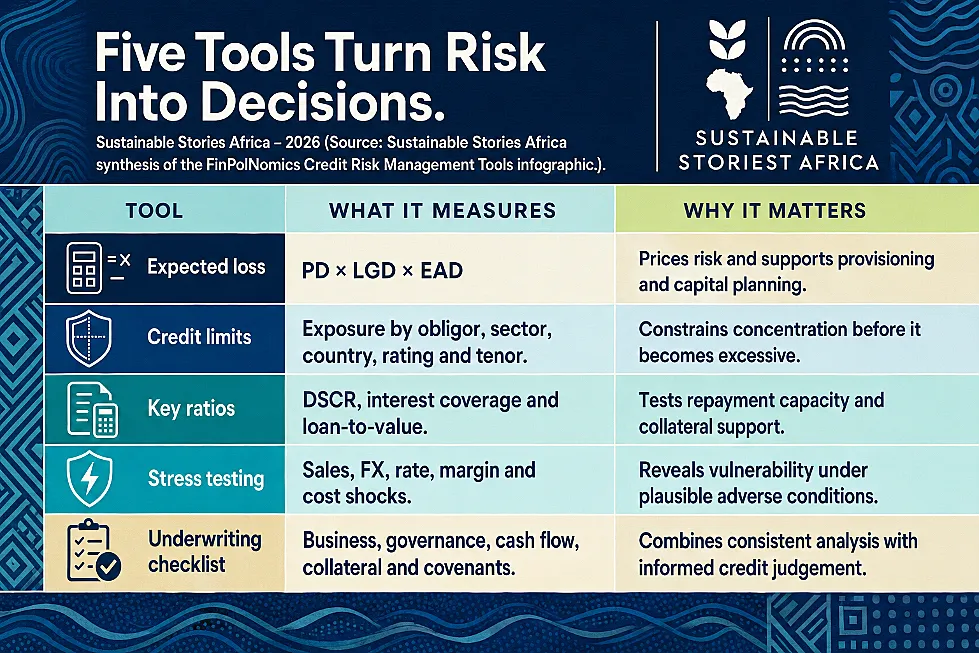
The formula is EL = PD × LGD × EAD, where PD is the probability of default, LGD is the proportion likely to be lost after recoveries, and EAD is the exposure outstanding when default occurs.
In the FinPolNomics illustration, a 5% probability of default, 40% loss given default, and N20 million exposure at default results in an expected loss of N400,000.
The lesson is not that this amount predicts the precise loss. Rather, even a seemingly modest default probability can become material when exposure is large, or recoveries are weak.
Expected loss can support pricing and provisioning, but it should not be confused with the full range of unexpected losses or with regulatory capital.
Its assumptions require regular review, credible data and sensitivity testing.
Limits Stop Concentration Before It Compounds
Credit limits place boundaries around exposure to a single obligor, connected group, sector, country, rating band or tenor.
- They can also address wrong-way risk, where exposure increases precisely when the counterparty’s credit quality deteriorates.
This is especially important in concentrated economies, where banks and suppliers may depend heavily on a small number of sectors, large corporates or public institutions. Limits are not administrative obstacles.
- They are portfolio guardrails designed to prevent one borrower, industry or macroeconomic shock from overwhelming the institution.
Ratios Test Capacity, Not Just Profit
- The debt service coverage ratio tests whether operating cash flow can cover scheduled principal and interest.
- The interest-coverage ratio measures the ability to service interest from earnings, while loan-to-value compares exposure with collateral value.
Broadly, stronger coverage ratios and a lower loan-to-value ratio provide more protection, although thresholds must reflect the borrower, sector and facility structure.
Ratios should be interpreted, not merely ticked.
- A profitable borrower may still generate weak cash flow.
- A low loan-to-value ratio may offer false comfort where collateral is illiquid, overvalued or difficult to enforce.
Trend, quality and context matter as much as the reported number.
Stress Tests Expose Hidden Repayment Weakness
Stress testing asks what happens when the base case fails.
- FinPolNomics highlights scenarios such as a 10% sales decline, foreign-exchange depreciation, a 200-basis-point interest-rate shock, margin compression and cost inflation.
The most useful tests connect each shock to cash flow, covenants, collateral and expected loss.
For African lenders, foreign-exchange rate is often essential when borrowers earn local currency but owe foreign-currency debt.
Combined scenarios are also critical because inflation, rate increases and currency depreciation rarely arrive in isolation.
Underwriting Blends Evidence With Credit Judgement
A disciplined underwriting review examines the business model and industry outlook, management quality, cash-flow sustainability, financial statements, collateral, customer concentration, governance, stress results, covenants and monitoring triggers.
No single metric can replace this assessment.
This is where evidence and judgement meet. Strong revenue growth may conceal poor cash conversion. Valuable collateral may not offset weak governance.
A borrower with credible management may still face a structural sector decline. Good underwriting explains the source of repayment, identifies vulnerabilities and defines what the lender will monitor after approval.
Response Tools Must Follow Early Warning
Monitoring has little value without a response plan.
The framework points to tools including hedging, diversification, restructuring, tighter or adjusted lending limits, stronger collateral or guarantees, higher pricing and revised capital allocation.
The response should match the risk.
A temporary cash-flow disruption may justify restructuring; an unmanaged currency mismatch may require hedging or reduced exposure; sector concentration may require portfolio diversification.
Clear triggers, escalation routes and accountability help institutions act before deterioration becomes default.
Path Forward – Price Risk, Protect Capital
African lenders, suppliers and investors should manage credit as a living portfolio discipline.
That means linking macroeconomic signals, borrower analysis, expected loss, limits, ratios, stress testing, monitoring and remedial action within a single governance system.
The objective is not to eliminate risk or restrict finance indiscriminately.
It is to price exposure more accurately, detect weakness earlier and protect capital so that finance can remain available through changing economic conditions.