Africa’s industrialisation challenge is inseparable from its energy question.
An analysis from the Brookings Institution asks whether the continent should leapfrog fossil fuels altogether or adopt a transitional mix to power factories, processing zones, and value-added industries.
The answer, researchers argue, is not ideological. It is strategic, rooted in cost, reliability, competitiveness, and development sequencing.
Energy Choices Shape Industrial Competitiveness
Africa accounts for less than 3% of global energy-related emissions; however, it faces acute energy poverty.
More than 600 million people lack reliable access to electricity. Industrial electricity consumption per capita remains a fraction of global averages.
At the same time, governments are pursuing industrial policy agendas, including special economic zones, mineral beneficiation strategies, agro-processing corridors, and manufacturing expansion. These ambitions require firm, affordable, and scalable power.
The Brookings paper frames the debate starkly: should Africa replicate historical fossil-fuel-intensive development pathways, or leapfrog directly into renewable-powered industrialisation?
The stakes are economic. Energy costs directly influence export competitiveness, job creation, and fiscal stability.
Energy Poverty Constrains Industrialisation
Reliable electricity underpins industrial growth. Steel, cement, textiles, food processing, and digital services all depend on a stable power supply.
However, across many African economies:
- Grid reliability remains inconsistent.
- Industrial tariffs are high relative to global peers.
- Backup diesel generation inflates production costs.
- Transmission infrastructure is limited.
Energy deficits create a competitiveness penalty. Firms absorb higher input costs, reducing margins and discouraging investment.
The question is not only about emissions. It is about industrial viability.
Leapfrogging Is Not Binary
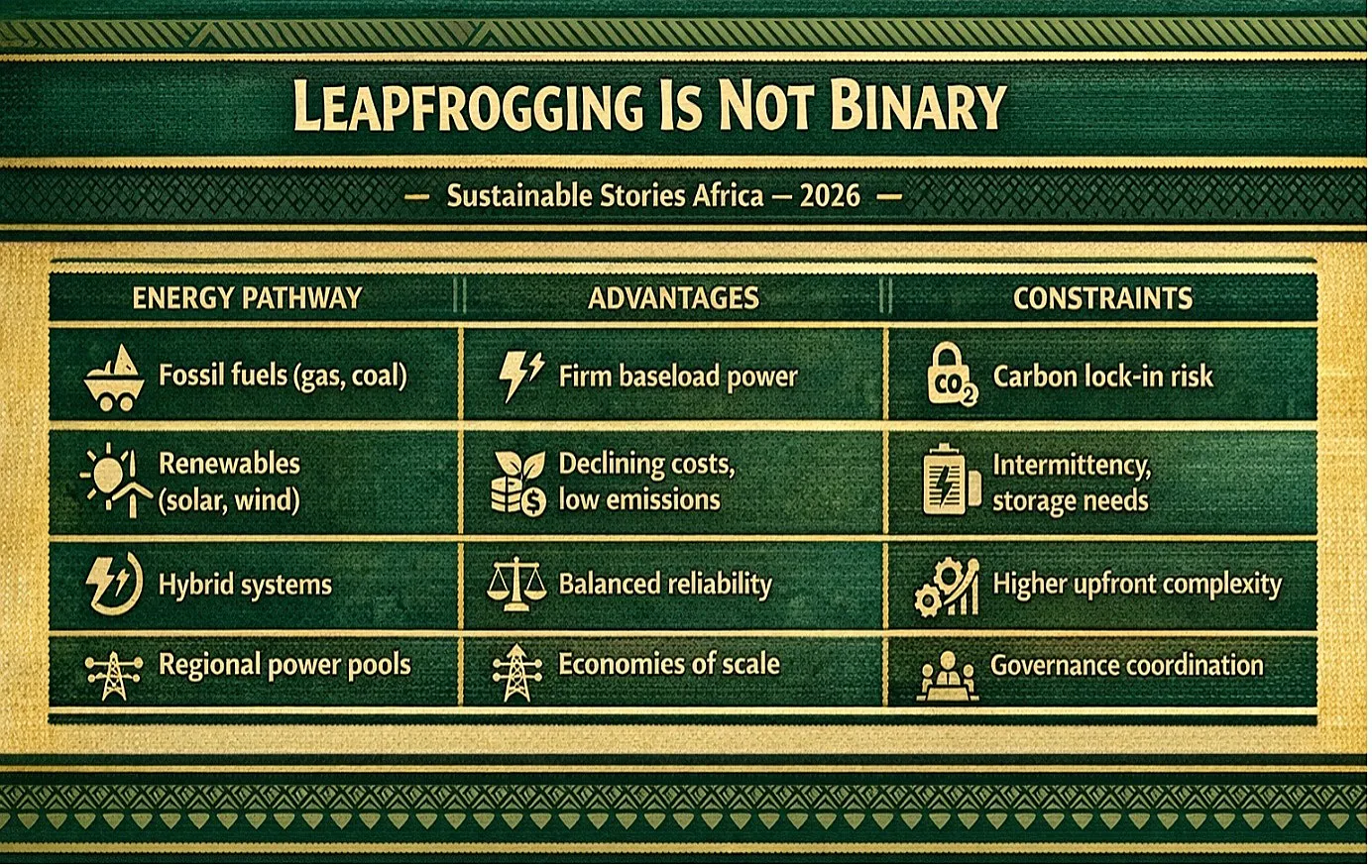
The Brookings analysis argues that leapfrogging is not an all-or-nothing proposition.
Instead, policy must weigh trade-offs between speed, reliability, cost, and carbon intensity.
Energy Pathway | Advantages | Constraints |
|---|---|---|
Fossil fuels (gas, coal) | Firm baseload power | Carbon lock-in risk |
Renewables (solar, wind) | Declining costs, low emissions | Intermittency, storage needs |
Hybrid systems | Balanced reliability | Higher upfront complexity |
Regional power pools | Economies of scale | Governance coordination |
Natural gas is often positioned as a transition fuel, offering lower emissions relative to coal while providing dispatchable power. However, infrastructure lock-in may delay deeper decarbonisation.
Renewables, by contrast, are increasingly cost-competitive. Solar PV and wind projects have scaled rapidly across parts of North and Southern Africa. However, intermittency and storage costs remain technical constraints for energy-intensive industries.
Hybrid models, combining renewables, gas, storage, and grid interconnections, may offer a pragmatic methodology in sequencing.
Cost Trends and Investment Gaps
Renewable energy costs have declined sharply over the past decade. Solar PV in several African markets is now among the lowest-cost new-generation options.
However, capital costs, grid upgrades, and storage deployment require significant upfront financing. Industrial-scale power demand also necessitates grid stability beyond the predominant distributed mini-grids.
Meanwhile, global climate finance flows remain insufficient relative to Africa’s industrial energy needs. Financing conditions often favour smaller renewable projects over large-scale industrial baseload systems.
The Brookings argument emphasises sequencing:
- Expand renewable capacity where cost-competitive.
- Deploy transitional fuels strategically where necessary.
- Invest in transmission and regional integration.
- Align energy planning with industrial policy.
Without integrated planning, energy transitions may occur in isolation from industrial strategy.
Integrate Energy and Industrial Policy
Industrial power strategy must balance developmental urgency with climate responsibility.
Policy priorities include:
- Grid Modernisation – Upgrade transmission networks to absorb renewable capacity.
- Regional Power Pools – Enhance cross-border electricity trade to smooth variability.
- Blended Finance Mechanisms – Reduce the cost of capital for large-scale energy projects.
- Clear Carbon Roadmaps – Avoid stranded asset risk through long-term planning.
Africa’s industrialisation cannot stall. However, it can not replicate high-emissions pathways without future adjustment costs.
The Brookings analysis ultimately rejects ideological binaries. Leapfrogging is feasible in some contexts; transitional mixes may be necessary in others.
The objective is to increase competitiveness through sustainability, rather than trade-offs between them.
Path Forward – Pragmatic Sequencing Drives Sustainable Industrial Power
Africa’s energy transition must be anchored in an industrial strategy. Renewable expansion, transitional fuels, grid investment, and regional coordination should advance in phased alignment.
By integrating energy planning with competitiveness objectives, African economies can industrialise without replicating carbon-intensive trajectories. Strategic sequencing, not rigid doctrine, will define success.