The world has crossed six of nine planetary boundaries. However, prosperity and environmental protection need not remain in conflict.
In its new flagship report, the World Bank argues that safeguarding land, air and water is no longer an environmental aspiration; it is the central economic imperative of this century.
Economic Choices for a Finite Planet
The development model that lifted billions from poverty is now destabilising the systems that sustain prosperity.
In Reboot Development: The Economics of a Livable Planet (pp. 1–34), the World Bank presents a stark proposition: maintaining a livable planet is not a distant environmental concern, but a present economic necessity.
Land, air and water, the foundational natural assets of growth, are degrading at a pace that threatens long-term productivity, health and resilience.
Around 90% of the global population lives exposed to degraded land, polluted air, or water stress.
In low-income countries, nearly 80% are simultaneously living with all three stressors. Humanity has already crossed six of nine planetary boundaries, including climate change, biodiversity loss and the use of freshwater.
The report frames the moment not as environmental alarmism, but as economic reckoning.
Humanity’s Expanding Ecological Footprint
The scale of transformation is unprecedented.
Wild mammals now represent only 5% of global mammalian biomass. Humans and livestock account for the remaining 95%.
Anthropogenic mass, such as concrete, plastics and infrastructure, now outweighs all living biomass on Earth.
The environmental burdens fall unevenly. In Sub-Saharan Africa, 66% of the population is exposed to all three stressors: degraded land, unsafe air and water risk.
In high-income countries, by contrast, 43% of residents face none.
Air pollution alone causes at least 7 million premature deaths annually, exceeding mortality from violence. Unsafe water and sanitation contribute to another 1.4 million deaths.
The old paradigm, “grow now, clean later”, no longer holds. Many countries that are most exposed to environmental degradation have not yet industrialised.
Nature as Productive Capital
The report reframes ecosystems as economic infrastructure.
Natural capital: forests, soils, rivers and atmosphere, underpins food systems, energy supply, urban resilience and trade.
Its degradation directly reduces GDP growth, agricultural yields and labour productivity.
Three insights stand out from the opening chapters:
- Forests as Economic Rainmakers – Forests regulate rainfall and buffer drought shocks. Natural forests can reduce GDP growth losses during droughts by more than half.
Deforestation-induced rainfall loss in the Amazon Valleys costs an estimated $14 billion annually in lost growth.
Globally, forest-linked moisture recycling contributes nearly half of rainfall. This is economic hydrology, not merely conservation.
- Nitrogen’s Double-Edged Sword – Nitrogen fertiliser more than doubled global yields; however, half of global food production now occurs in regions where excessive nitrogen diminishes productivity.
The economic costs of nitrogen pollution have reached approximately $3.4 trillion annually.
- Air Pollution and Productivity – Air pollution depresses cognitive performance, increases sick days and reduces GDP growth.
China’s “war on pollution” demonstrates decoupling is possible: PM2.5 concentrations fell even as GDP expanded.
The message is structural: environmental integrity and economic growth are intertwined, not opposing forces.
Decoupling and Development Pathways
The report examines whether growth must inevitably lead to incremental degradation.
Evidence suggests partial decoupling in high-income economies through efficiency gains:
| Environmental Indicator | Efficiency Reduction Impact |
|---|---|
| Water withdrawals | -50% |
| Land use | –69% |
| Air pollution (PM2.5) | –59% |
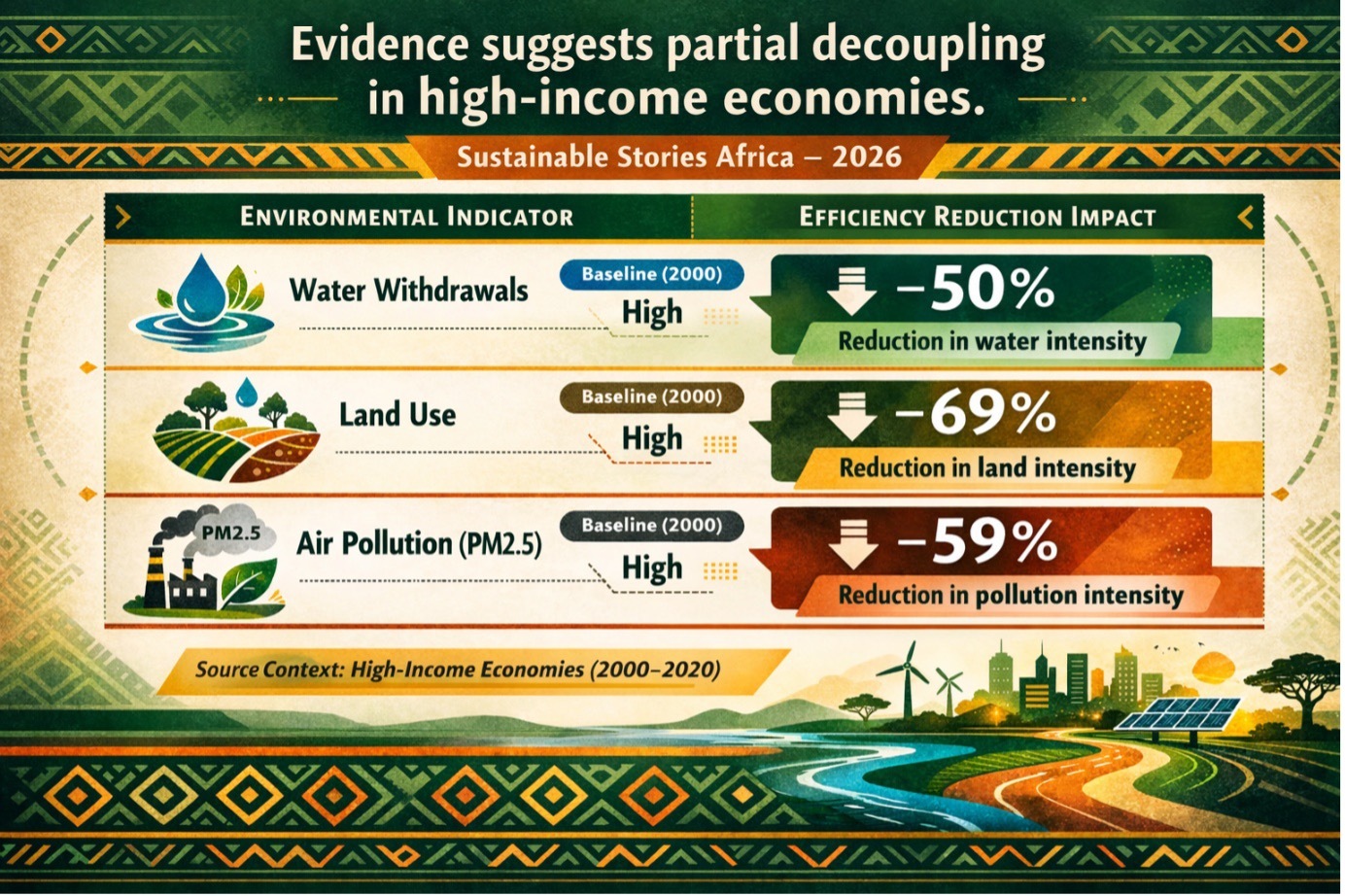
However, efficiency alone will not suffice. As scale effects grow, systemic transformation, producing better goods, not simply more efficiently, becomes essential.
A second structural pattern emerges:
| Exposure to Environmental Stressors | Low-Income Countries | High-Income Countries |
|---|---|---|
| Exposed to all three stressors | 79% | 1% |
| Exposed to none | <1% | 43% |
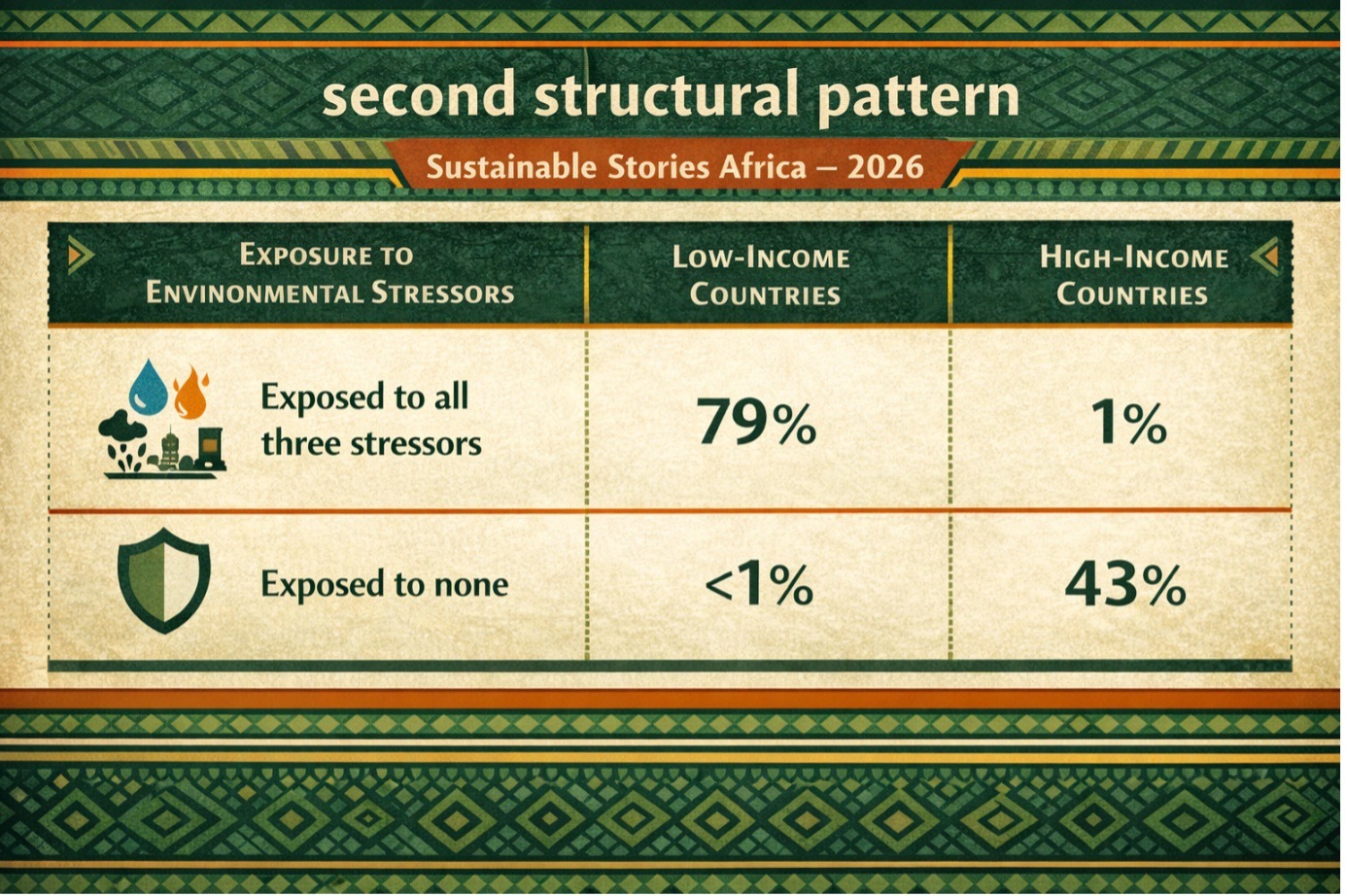
Environmental degradation compounds poverty, reinforcing development traps.
Policy as Systems Design
The report’s opening chapters emphasise a systems approach.
Policies must move beyond siloed environmental reforms toward integrated economic governance. Three pillars define the proposed strategy:
- Inform – Invest in real-time monitoring; air sensors, satellite data, environmental accounts, to empower citizens and guide policy.
- Enable – Align cross-sector policies to avoid unintended consequences. Environmental, fiscal and trade systems must reinforce rather than undermine one another.
- Evaluate – Embed rigorous evaluation frameworks to scale what works and adapt to shocks.
This approach rejects piecemeal reform. It calls for redesigning development architecture around preserving natural capital.
PATH FORWARD – Embed Nature into Economic Systems
Protecting land, air and water must become a core macroeconomic strategy, not environmental add-ons.
Governments should integrate natural capital accounting, strengthen environmental monitoring and align fiscal policy with planetary boundaries.
Development can reboot. But it requires deliberate structural reform that treats ecosystems as productive assets, preserving growth while restoring ecological resilience.