Africa’s transition to a circular economy is no longer conceptual policy language; it has been mapped as an industrial strategy.
A 2017 continental assessment identified five sectors, including food systems, packaging, the built environment, electronics, and fashion, as high-impact entry points capable of unlocking green jobs, industrial competitiveness, and long-term economic resilience.
Africa’s Circular Growth Moment
Africa stands at an economic inflexion point.
Between 2015 and 2017, global resource extraction increased by 9.52% from 84 to 92 billion metric tonnes, while global waste generation rose by 68.42% from 19 to 32 billion metric tonnes.
The linear model of “take–make–dispose” has proved incompatible with climate targets, supply chain resilience and resource security.
For Africa, home to the world’s fastest-growing youth population and many extractive-dependent economies, this model is especially fragile.
However, within this vulnerability lies opportunity. The Five Big Bets for the Circular Economy in Africareport identified five strategic sectors capable of driving economic growth while reducing waste and emissions.
The circular economy, the report argues, is not an environmental side-project. It is an industrial redesign.
Linear Limits, Circular Imperative
The assessment applied four criteria: circularity potential, economic significance, transformative impact and momentum, to prioritise sectors.
Agriculture, manufacturing and construction emerged as the strongest foundations for circular reform, which led to five thematic “big bets”:
- Food systems
- Packaging
- Built environment
- Electronics
- Fashion and textiles
Africa’s demographic trajectory intensifies urgency. By 2050, 51% of the continent’s population will be under the age of 24. Rising middle-class consumption without systemic redesign risks replicating the resource-heavy growth pathways of industrialised economies.
Circularity offers an alternative, capturing value from waste streams while strengthening domestic production.
Where Circular Value Concentrates
- Food Systems: From Loss to Regeneration – Agriculture contributes roughly 23% of Africa’s GDP and employs close to 60% of the active population. However, post-harvest losses in sub-Saharan Africa range between 30 and 50%, with grain losses alone estimated at $4 billion annually.
The report identifies high-impact circular opportunities:
- Climate-smart agriculture
- Solar-powered irrigation and productive appliances
- Cold-chain sharing logistics
- Waste-to-compost and waste-to-energy conversion
Food waste accounts for approximately 49% of Africa’s total waste stream, positioning organic waste recovery as a vital point of leverage.
By 2030, Africa’s food market is expected to reach $1 trillion. A circular redesign could ensure that growth is resource-efficient and employment-rich.
- Packaging: PET as Immediate Entry Point – Plastic production globally has risen from 15 million to over 350 million metric tonnes in 50 years. Approximately 95% of plastic packaging, with a value worth of between $80 and $120 billion annually, is lost after a single use.
PET, which accounts for approximately 20% of plastic packaging waste, is identified as the most commercially viable focus for recycling.
Recycling offers:
- Industrial feedstock substitution
- Job creation in collection and processing
- Reduced urban flooding and marine pollution
- Domestic manufacturing reinforcement
Sixteen African countries have already banned single-use plastics, signalling regulatory momentum.
- Built Environment: Low-Carbon Construction Pivot – Only 30% of Africans can afford formal housing. Rapid urbanisation increases pressure on cement, steel and water-intensive construction.
The circular pathway includes:
- Modular housing
- Design for deconstruction
- Green building systems
- Exploration of mass timber alternatives
Construction redesign can deliver both housing affordability and emissions reduction, turning infrastructure expansion into a climate-aligned growth engine.
- Electronics: Formalising E-Waste Value Chains – Global e-waste generation has increased by 21% since 2014. Informal processing exposes workers to hazardous materials.
Circular reforms include:
- Formal recycling facilities
- Extended Producer Responsibility (EPR) frameworks
- Design for longevity and repairability
Rwanda’s e-waste facility created 400 green jobs; Kenya’s similar initiative generated 2,000 jobs within four years.
This sector exemplifies the employment multiplier effect.
- Fashion & Textiles: From Second-Hand to Regenerative – The effects of fast-fashion imports are increasing environmental pressure. The report highlights:
- Upcycling second-hand clothing
- Green textile manufacturing
- Regenerative cotton production
Circular fashion can reposition Africa from a dumping ground for an end-market to a sustainable production hub.
Strategic Levers Across Sectors
The report frames circular solutions under three structural categories:
Strategy | Function | Example |
|---|---|---|
Create Loops | Recycling, remanufacturing | PET recycling, composting |
Slow Flows | Design for durability | Climate-smart agriculture |
Narrow Flows | Resource efficiency models | Shared cold-chain logistics |
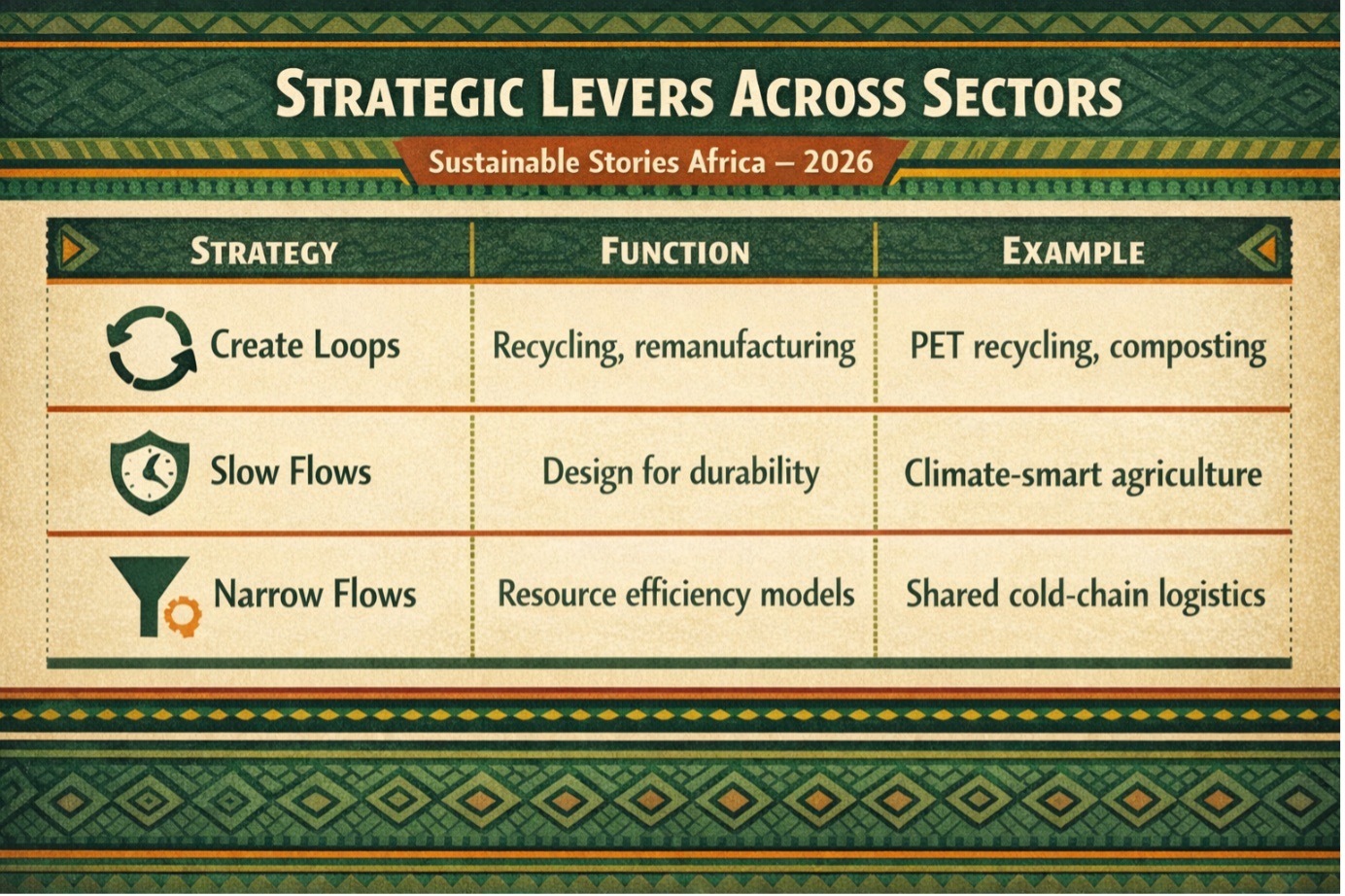
These levers are not isolated interventions; they form a systems transition architecture.
Enablers Determine Scale
Opportunity alone does not guarantee transformation.
The report identifies six enablers critical for scaling:
- Supportive policy and regulatory harmonisation
- Business development services
- Improved data and transparency
- Access to green technologies
- Increased financial inclusion for MSMEs
- Waste collection and treatment infrastructure
Regional standardisation, particularly under AfCFTA, could unlock feedstock markets for recycling plants and enable cross-border circular supply chains.
Without infrastructure and financing reform, circular pilots will remain fragmented.
PATH FORWARD – Align Policy, Capital, Infrastructure
Africa’s circular transition requires coordinated regulatory reform, catalytic capital and cross-border standards to scale recovery infrastructure and regenerative production.
Governments must embed circularity into industrial policy while investors redirect financing toward material recovery and green manufacturing ecosystems.
The objective is structural: build economies that retain value domestically, generate inclusive employment and reduce climate vulnerability, positioning Africa as a circular innovation frontier rather than a resource extraction periphery.