Nigeria’s green economy is no longer an abstract promise for 25 young Lagosians; it is a timetable, a toolkit and a three‑month internship contract.
The Nigeria Climate Innovation Centre, in collaboration with the Oando Foundation-backed Green Youth Upskilling Programme, has transitioned this first cohort from theory to tools, from application funnel to factory floor, and from job seeker to potential green entrepreneur in just 12 weeks of intensive training and structured industry placements.
Powering futures through green skills
Nigeria’s Green Youth Upskilling Programme (GYUP) has graduated its first cohort of 25 trainees after a 12-week intensive boot camp in solar energy and waste management, signalling a concrete step toward building a climate-ready workforce.
Delivered by the Nigeria Climate Innovation Centre (NCIC) in partnership with the Oando Foundation, the pilot combines classroom instruction, factory simulations and enterprise coaching with structured internships across Lagos’s recycling, solar energy and circular economy sectors.
By linking youth employment directly to Nigeria’s Energy Transition Plan, the initiative positions green skills as a strategic solution to unemployment, energy deficits and escalating waste challenges.
Performance outcomes highlight strong technical progress and engagement. Post-assessment scores ranged between 68% and 90% in renewable energy and between 60% and 90% in waste management, with training providers reporting an over 95% improvement in core competencies such as solar installation, inverter configuration and recycling equipment operations.
Attendance remained consistently high, and the programme achieved full retention, including nine women who excelled in technical and machinery-based roles.
Participants interned with companies including Quadloop, MadeCore Solar, Wecyclers, and PAKAM. This now represents the critical pathway from training to employment and enterprise development.
The significance of the programme extends beyond individual trainees. Nigeria generates approximately 32 million tonnes of waste annually while recycling less than 10% of plastics, despite energy access gaps and youth unemployment persisting.
By embedding trainees within operational green-economy firms, GYUP is testing a scalable model for climate-aligned workforce development. If successful, it could transform climate action into a catalyst for job creation, industrial resilience and inclusive green growth.
Headline impact and why it matters
Nigeria’s Green Youth Upskilling Programme has progressed rapidly from concept to execution, completing its first full training cycle and placing all 25 participants into structured green-sector internships within six months.
From 8,134 applications, a rigorous digital screening process narrowed candidates to a balanced cohort of youths aged 18–35 across renewable energy and waste management tracks.
Designed as a direct response to Nigeria’s energy access deficit, mounting waste volumes and persistent youth unemployment, the programme aligns skills development with the Energy Transition Plan and climate targets, positioning green jobs as essential infrastructure for economic resilience, workforce transformation and long-term climate stability.
Inside the training engine room
Behind its high-visibility media rollout, Nigeria’s Green Youth Upskilling Programme has been anchored in a deliberately rigorous technical and enterprise training architecture.
NCIC partnered with Lihon Energy and Ivarest Global to deliver specialised solar and waste-management instruction, complemented by business-development modules led by its green enterprise faculty.
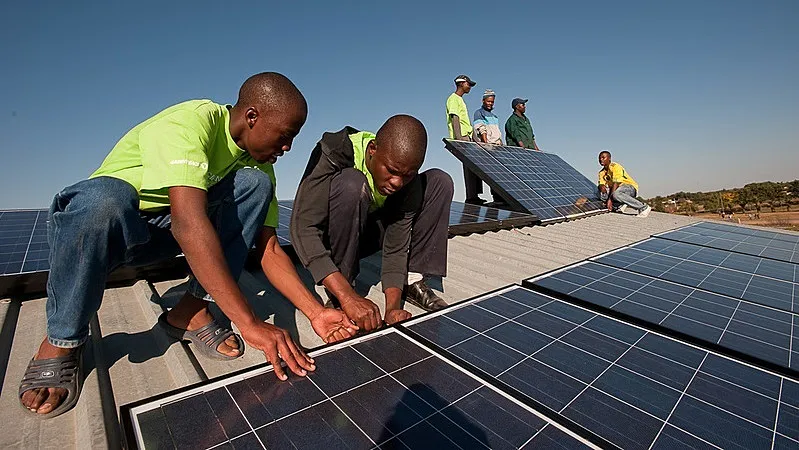
Over 12 weeks, trainees completed structured coursework that spanned photovoltaic systems, battery storage, hydraulics, recycling machinery and live field simulations, supported by site visits, practical labs and final assessments.
Attendance remained consistently strong, reinforced by continuous performance tracking and evaluations.
Parallel enterprise sessions equipped participants with skills in business design, branding, finance and regulatory compliance, ensuring graduates emerged not only as technicians but as potential founders capable of driving climate-aligned ventures.
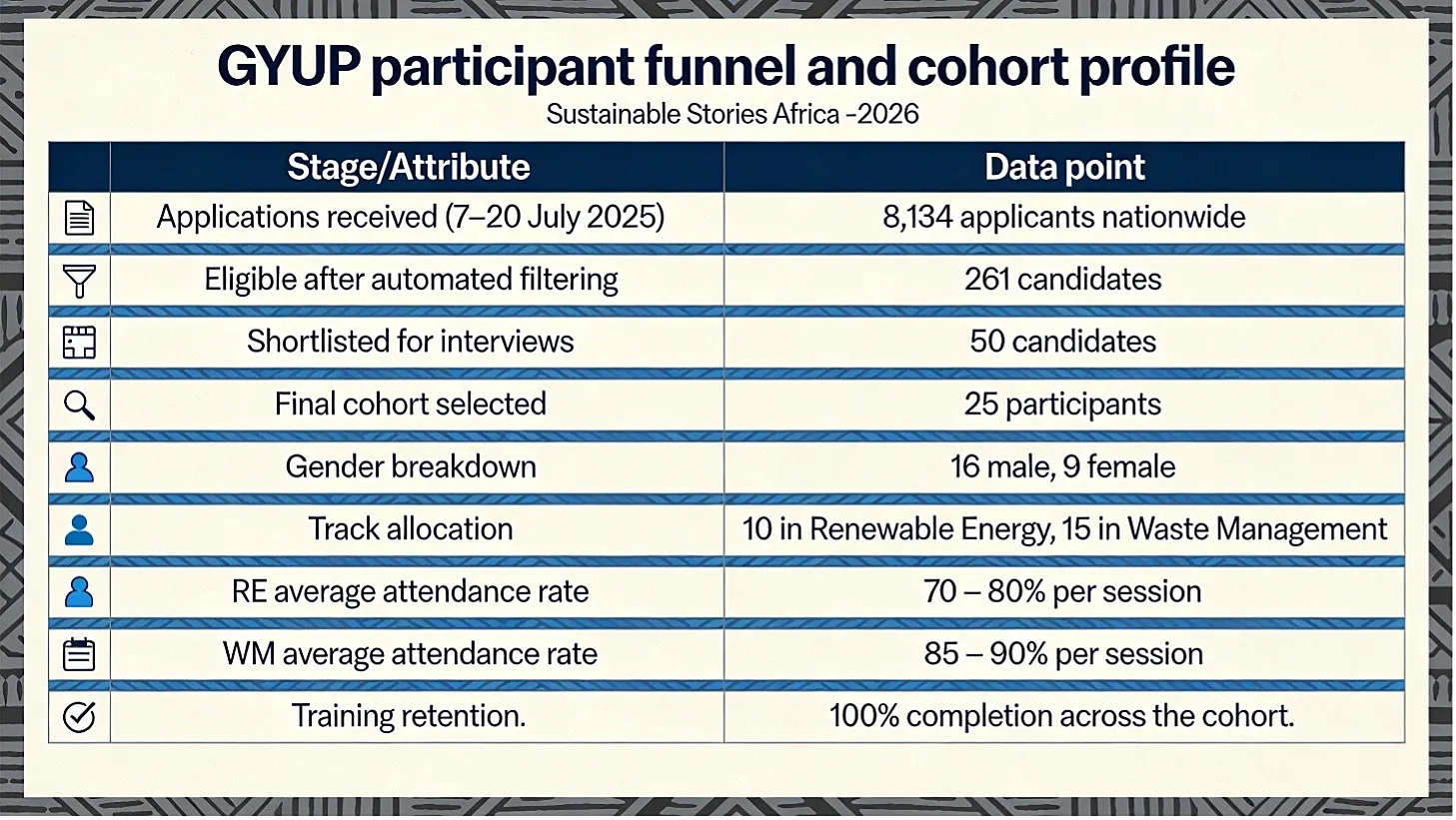
GYUP participant funnel and cohort profile
| Stage/Attribute | Data point |
|---|---|
| Applications received (7–20 July 2025) | 8,134 applicants nationwide |
| Eligible after automated filtering | 261 candidates |
| Shortlisted for interviews | 50 candidates |
| Final cohort selected | 25 participants |
| Gender breakdown | 16 male, 9 female |
| Track allocation | 10 in Renewable Energy, 15 in Waste Management |
| RE average attendance rate | 70 – 80% per session |
| WM average attendance rate | 85 – 90% per session |
| Training retention | 100% completion across the cohort |
Demand, delivery and early outcomes
Nigeria’s Green Youth Upskilling Programme is beginning to address a critical mismatch between the country’s vast 427 GW solar potential and its shortage of skilled technicians, its lack of capacity in recycling facilities, and a shortage of trained machine operators.
Early results show trainees advancing from foundational knowledge to independently installing solar systems and operating industrial recycling equipment, signalling progress toward closing workforce gaps across renewable energy and circular economy sectors.
Training partners report the enhancement of over 95% measurable skills, with post-assessment scores reaching employable entry-level thresholds. Female participants often led in technical performance, challenging gender barriers in industrial trades.
Despite logistical constraints, including transport and safety challenges at training sites, adaptive delivery models and targeted support sustained attendance and preserved hands-on exposure to industrial-grade machinery and real-world operating conditions.
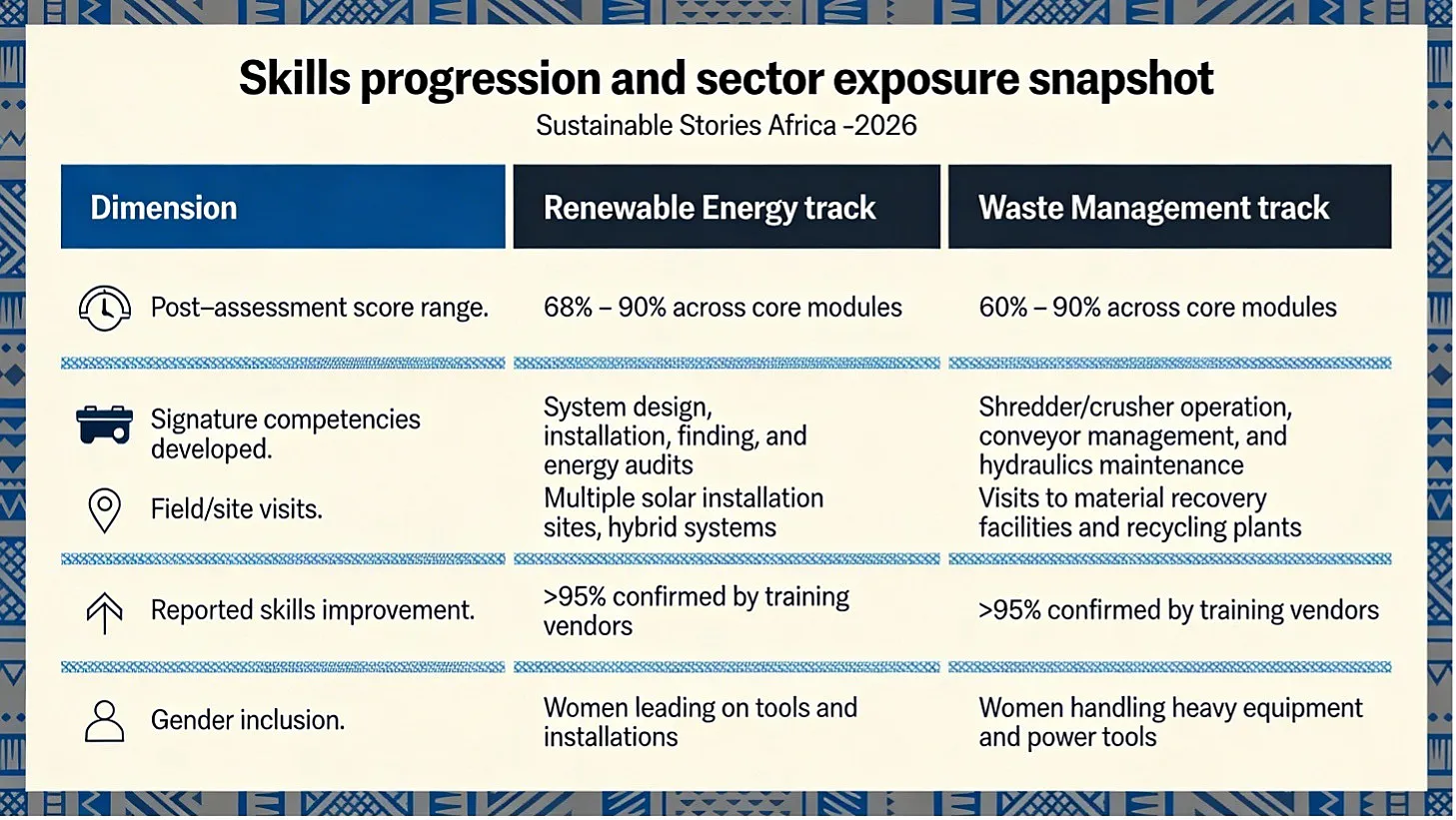
Skills progression and sector exposure snapshot
| Dimension | Renewable Energy track | Waste Management track |
|---|---|---|
| Post‑assessment score range | 68% – 90% across core modules | 60% – 90% across core modules |
| Signature competencies developed | System design, installation, finding, and energy audits | Shredder/crusher operation, conveyor management, and hydraulics maintenance |
| Field/site visits | Multiple solar installation sites, hybrid systems | Visits to material recovery facilities and recycling plants |
| Reported skills improvement | >95% confirmed by training vendors | >95% confirmed by training vendors |
| Gender inclusion | Women leading on tools and installations | Women handling heavy equipment and power tools |
Action in the field and next moves
NCIC has established a robust monitoring framework to ensure internships translate into measurable workforce outcomes and credible impact evidence. Host companies submit weekly attendance and activity logs, while supervisors provide monthly evaluations on technical competence and professionalism.
These are reinforced by bi-weekly site visits and consolidated performance reports, ensuring continuous tracking of trainee development. Beyond validation, the internship phase is structured to generate documented case studies, testimonials and field narratives, culminating in a comprehensive impact report and a programme film expected in early 2026.
Financial incentives form the programme’s final transition layer. Ten top-performing participants will receive grants to support employment pathways or green enterprise launches, selected through a transparent, performance-based scoring system.
Combined with industry exposure and professional networks, these grants are designed to catalyse new solar and circular-economy ventures while encouraging host companies to absorb interns into long-term technical and operational roles.
Path Forward – Scaling a just green transition
Nigeria’s green transition faces a complex workforce challenge, particularly in areas such as rising youth unemployment, increasing waste volumes and urgent needs for expansion of renewable energy.
The Green Youth Upskilling Programme offers a practical, evidence-based model. It combines a rigorous selection, industry-aligned training, structured internships and grant-backed pathways to build climate-ready talent.
Ultimately, the programme demonstrates that climate policy delivers real impact when it creates tangible livelihoods, technical competence and sustainable economic opportunities for young Nigerians.