Nigeria’s biodiversity crisis is unfolding faster than its media can keep up with. A decade-long analysis of 967 stories reveals that while biodiversity appears regularly in news cycles, most coverage remains reactive, event-driven, and detached from deeper governance failures and economic drivers.
This imbalance risks weakening public accountability at a moment when ecological decline is accelerating across Nigeria’s forests, wetlands, and coastal ecosystems—threatening livelihoods, food security, and climate resilience nationwide.
Nigeria’s biodiversity crisis lacks sustained scrutiny
Nigeria’s biodiversity loss is accelerating, but the country’s media coverage remains largely episodic, reactive, and structurally shallow.
Despite increasing ecological degradation, biodiversity stories continue to be framed primarily as isolated events rather than systemic risks tied to governance, economic planning, and development priorities.
A comprehensive analysis of 967 biodiversity-related reports published by Dataphyte Research, across seven major Nigerian media outlets, reveals that while biodiversity receives visibility, the depth and accountability required to drive policy reform remain limited.
Straight news reporting dominates, accounting for nearly three-quarters of all biodiversity coverage, while investigative journalism accounts for just 3.6 per cent.
This imbalance underscores a critical gap: Nigeria’s biodiversity crisis is being reported, but not fully interrogated, at a time when ecological decline increasingly threatens national stability, economic resilience, and climate security.
Biodiversity reporting remains reactive, not investigative
Nigeria’s media ecosystem is covering biodiversity; however, largely in ways that prioritise immediacy over accountability.
Of the 967 biodiversity stories analysed, 74.7% were conventional news reports, while features accounted for 15.1%, opinions six%, and investigative journalism 3.6%.
This pattern reflects a newsroom culture shaped by event-driven triggers, such as workshops, policy announcements, and international observance days, rather than proactive investigation into structural causes of biodiversity loss.
Distribution of Biodiversity Reporting Formats
News Type | Share of Coverage (%) | Strategic Implication |
|---|---|---|
News reports | 74.7% | Reactive, event-driven coverage dominates |
Feature stories | 15.1% | Limited contextual storytelling |
Opinion pieces | 6.0% | Minimal interpretive analysis |
Investigations | 3.6% | Weak accountability journalism |
Other formats | <1% | Negligible specialised reporting |
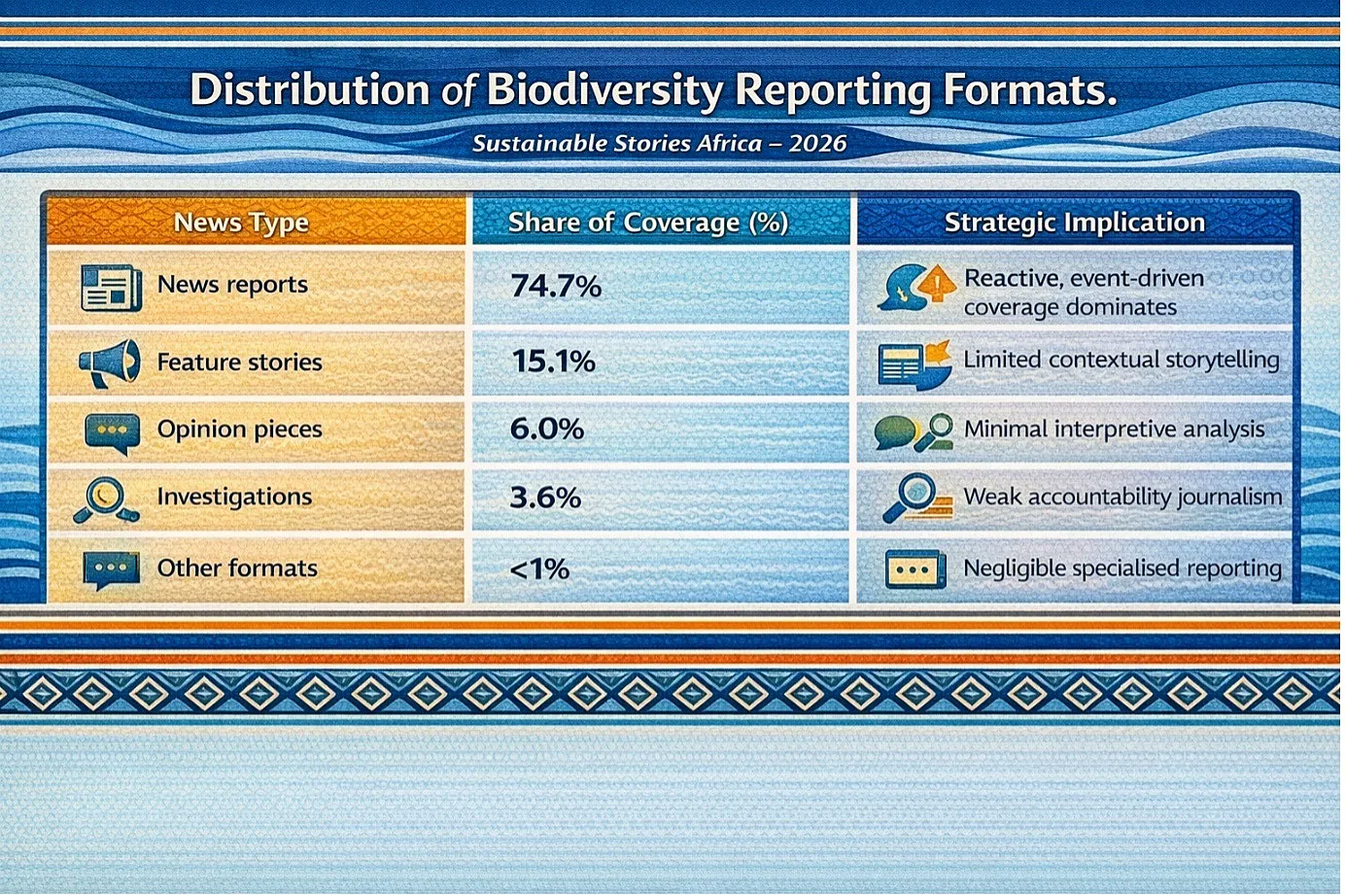
This structural imbalance limits journalism’s ability to investigate root causes such as illegal wildlife trade, extractive industry expansion, and governance failures.
Conservation narratives dominate editorial priorities nationwide
Biodiversity reporting in Nigeria remains heavily skewed toward conservation and environmental degradation themes, often shaped by institutional narratives rather than systemic political economy analysis.
Three themes dominate national biodiversity discourse:
- Biodiversity and ecosystem conservation: 23.27
- Environmental degradation: 18.82%
- Wildlife conservation: 18.82%
Together, these themes account for more than 60% of all biodiversity reporting.
By contrast, critical structural drivers such as governance failures, policy enforcement gaps, and economic accountability receive far less attention, appearing in fewer than 10% of stories.
Geographic visibility reinforces systemic reporting gaps
Nearly half of all biodiversity reporting, 44.47%, is framed at the national level, with limited depth in the subnational level.
Geographic Distribution of Biodiversity Reporting
Geographic Focus | Coverage Share (%) | Structural Insight |
|---|---|---|
National coverage | 44.47% | Centralised narrative framing |
Lagos | 5.79% | Media hub visibility bias |
Cross River | 5.17% | Conservation hotspot attention |
Other states combined | <5% each | Significant underreporting |
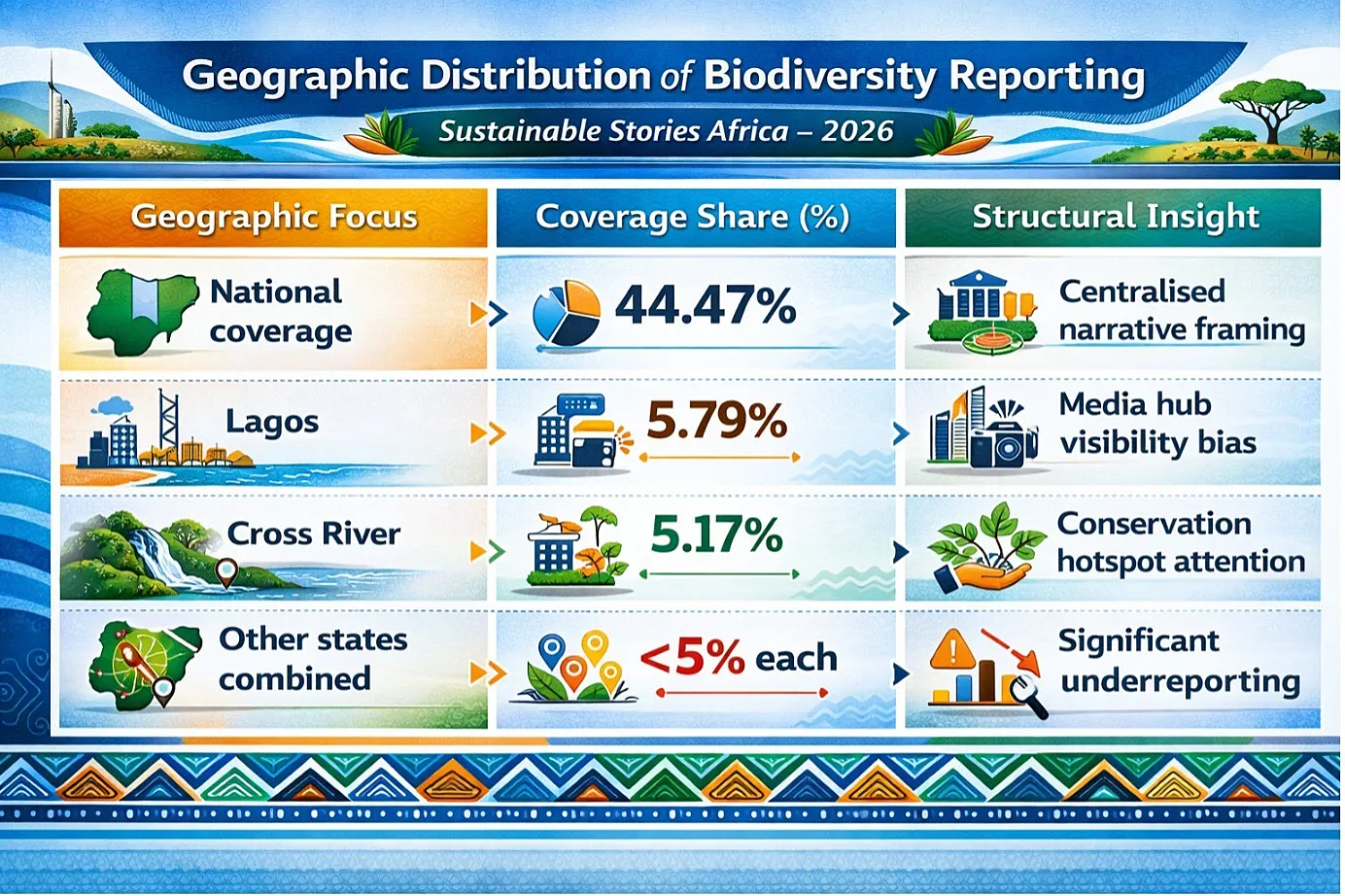
States facing severe biodiversity threats, including desertification zones and wetland ecosystems, remain largely invisible in national discourse.
Stronger biodiversity journalism can reshape environmental governance
More accountable biodiversity reporting can significantly strengthen Nigeria’s environmental governance and climate resilience.
Outlets such as The Cable and Premium Times demonstrate that more balanced reporting models, combining investigative journalism, opinion, and policy analysis, can elevate biodiversity from a marginal environmental concern into a national development priority.
This shift carries far-reaching implications:
- Improved policy accountability
- Stronger regulatory enforcement
- Increased public awareness
- Better environmental governance outcomes
By linking biodiversity loss to food security, economic stability, and climate resilience, the media can reshape national priorities and accelerate reform.
Nigeria’s media must shift toward accountability reporting
Nigeria’s biodiversity crisis is no longer solely an ecological issue; it is a governance, economic, and national security challenge.
Media institutions must transition from reactive reporting to investigative, policy-driven journalism capable of interrogating land use, corporate accountability, and regulatory enforcement.
Critical actions include:
- Investing in investigative environmental journalism
- Expanding subnational and community reporting
- Strengthening newsroom environmental expertise
- Including scientific and policy expert voices
Without this shift, biodiversity loss risks remaining invisible in the policy arena, undermining Nigeria’s climate resilience and development trajectory.
Path Forward – Strengthening biodiversity journalism requires structural newsroom reform
Nigeria’s biodiversity reporting must evolve beyond event-driven coverage to investigative journalism that can examine governance failures, corporate accountability, and implementation of ecological policy.
This requires significant investment in areas such as training and stronger integration of scientific expertise.
Building robust biodiversity journalism will enhance public accountability, strengthen environmental governance, and position biodiversity protection as a central pillar of Nigeria’s climate resilience and economic sustainability strategy.
SSA’s Final Word: Nigeria’s biodiversity crisis demands media transformation
Nigeria’s biodiversity crisis is no longer emerging; it is unfolding. However, journalism, one of the country’s most powerful tools for accountability, remains structurally constrained by reactive reporting models.
Transforming biodiversity journalism into a governance-focused discipline will be essential to ensuring environmental protection, economic stability, and climate resilience.
The future of Nigeria’s ecological security may depend on how effectively its media can tell and investigate the full story.