Nigeria’s third Voluntary National Review reveals a development paradox: ambitious reforms and institutional progress are advancing Sustainable Development Goals (SDGs); however, poverty, food insecurity, and climate vulnerability continue to deepen structural risks.
While infrastructure investments and policy integration have strengthened institutional capacity, the worsening of multidimensional poverty affecting 133 million Nigerians highlights the urgency of accelerating implementation and financing reforms to achieve sustainable and inclusive national development.
Nigeria’s development reforms confront structural vulnerabilities
Nigeria’s progress on its Sustainable Development Goals (SDGs) stands at a critical turning point. Nearly a decade after adopting the 2030 Agenda, the country has established comprehensive institutional frameworks, integrated SDGs into national planning, and executed large-scale infrastructure and social interventions.
However, deep structural vulnerabilities continue to constrain progress.
Nigeria has achieved measurable progress in 34.6% of key SDG indicators, while stagnation and regression affect the remaining two-thirds, reflecting uneven implementation outcomes and persistent systemic challenges.
This paradox, of institutional momentum coexisting with rising poverty, food insecurity, and climate vulnerability, highlights the complexity of Nigeria’s development transition as it seeks to align economic growth, social inclusion, and environmental resilience.
Nigeria accelerates reforms amid development risks
Nigeria has deeply embedded the SDGs into national development frameworks, including the Economic Recovery and Growth Plan, National Development Plan (2021–2025), and Nigeria Agenda 2050, creating a coordinated architecture to drive sustainable development.
Institutional strengthening has been the centre point of its implementation. The Office of the Senior Special Assistant to the President on SDGs coordinates national reporting, financing frameworks, and stakeholder engagement through integrated governance platforms and monitoring systems.
Major infrastructure interventions implemented between 2016 and 2023 illustrate the scale of institutional commitment.
Nigeria’s SDG Infrastructure and Institutional Achievements
Sector | Intervention | Scale of Implementation |
|---|---|---|
Education | Classroom construction | 8,008 new classrooms |
Healthcare | Health facility construction | 195 facilities built |
Energy | Solar streetlights installation | 19,266 installed |
Water | Borehole infrastructure | 973 boreholes drilled |
Housing | IDP housing and transit homes | 643 homes constructed |
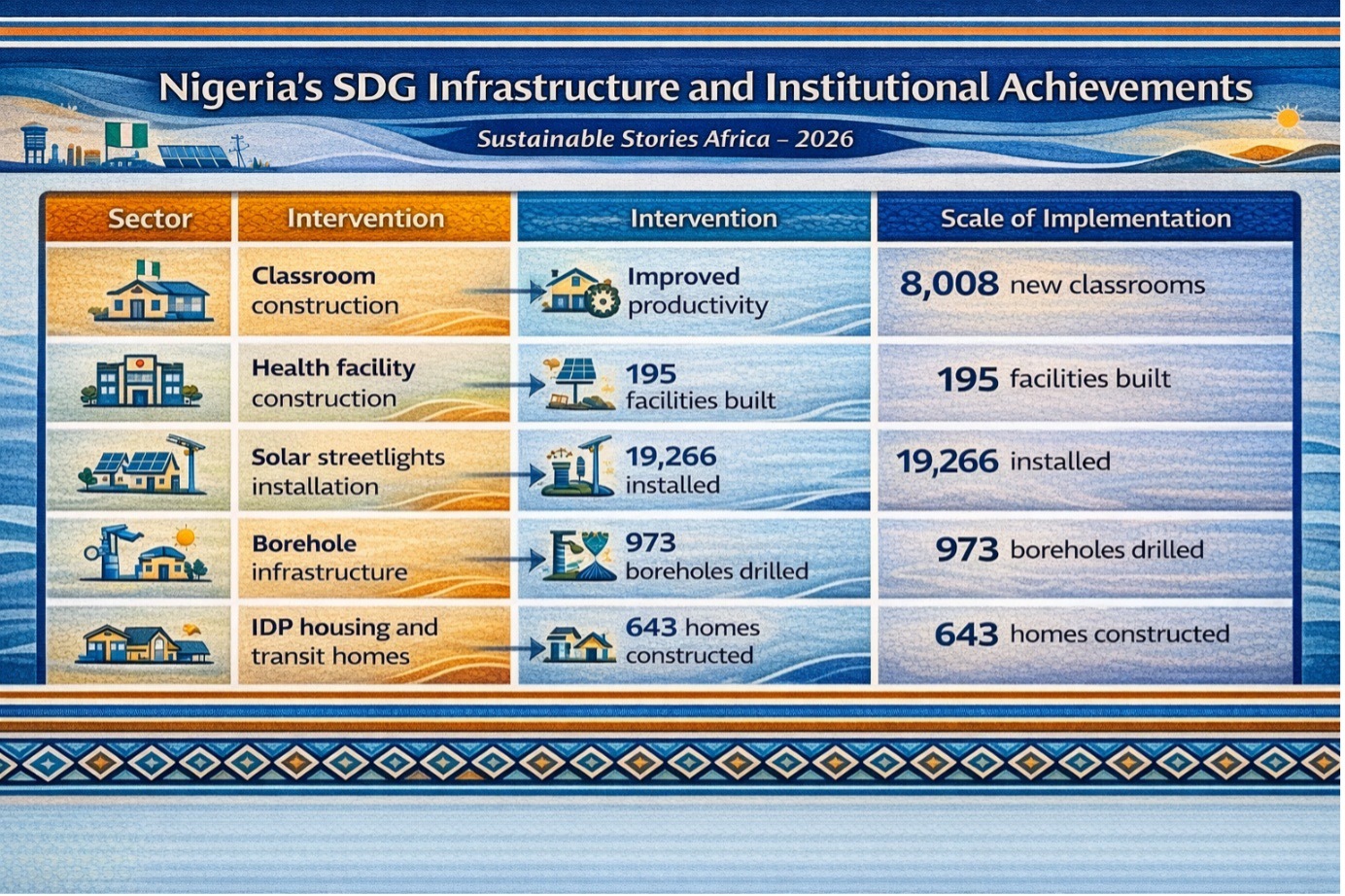
These interventions demonstrate measurable institutional progress, positioning Nigeria among African countries that are actively mainstreaming the SDGs into national planning.
Poverty and inequality threaten development momentum
Despite policy advances, Nigeria’s progress in the SDGs is constrained by worsening socio-economic conditions.
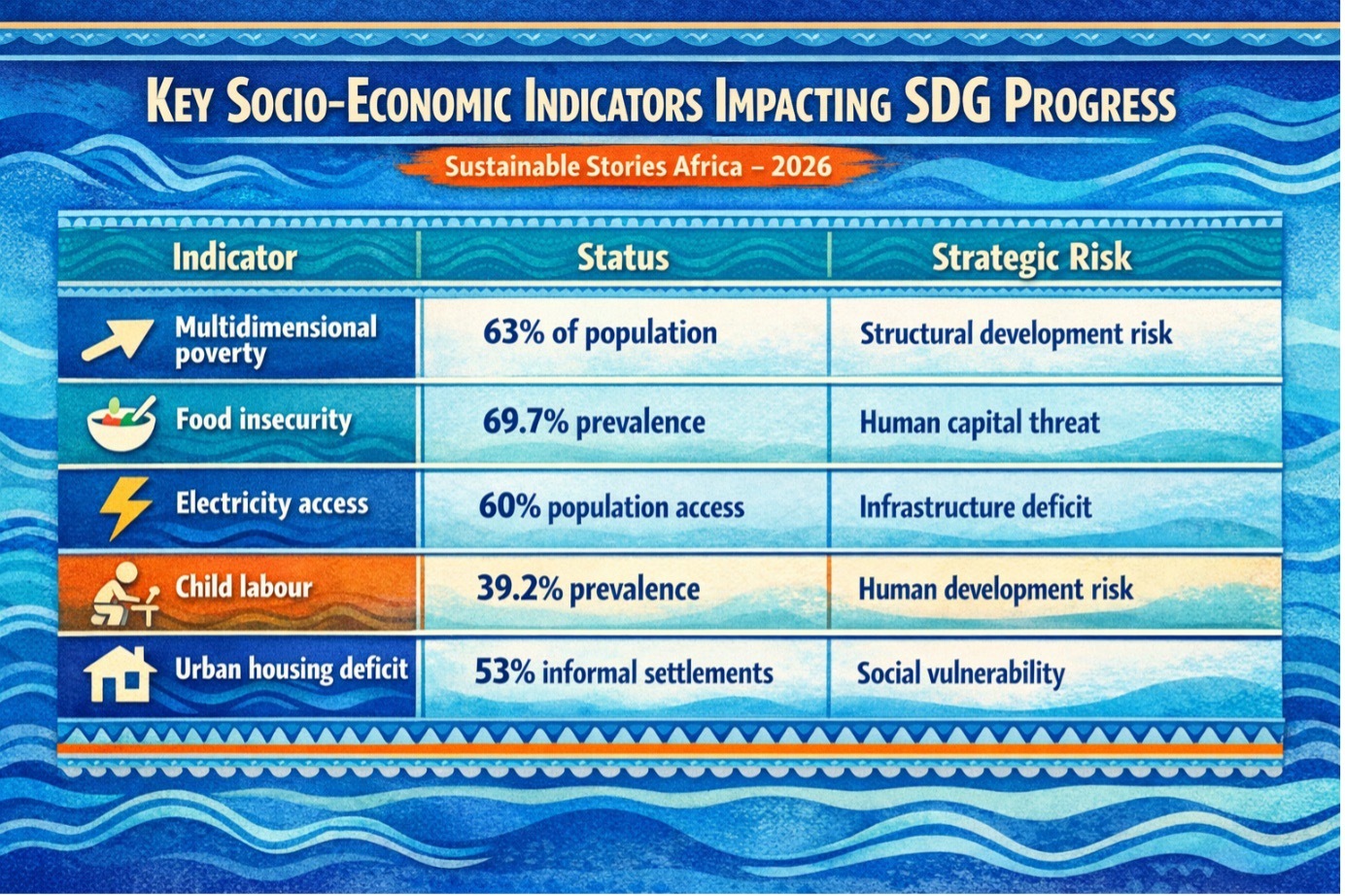
The 2022 Multidimensional Poverty Index reveals that 63% of Nigerians, approximately 133 million people, live in multidimensional poverty, with children disproportionately affected.
Food insecurity has also intensified sharply. Between 2015 and 2021, the proportion of Nigerians facing moderate or severe food insecurity has doubled from 34.7% to 69.7%.
Key Socio-Economic Indicators Impacting SDG Progress
Indicator | Status | Strategic Risk |
|---|---|---|
Multidimensional poverty | 63% of population | Structural development risk |
Food insecurity | 69.7% prevalence | Human capital threat |
Electricity access | 60% population access | Infrastructure deficit |
Child labour | 39.2% prevalence | Human development risk |
Urban housing deficit | 53% informal settlements | Social vulnerability |
Meanwhile, Nigeria’s economic resilience remains fragile. GDP per capita has declined from $2,679 in 2015 to $1,621 in 2023, reflecting structural economic challenges despite policy reforms.
Climate vulnerability further compounds these risks, with Nigeria ranked among the most climate-vulnerable countries globally, facing floods, erosion, and environmental degradation affecting millions.
Institutional reforms create a pathway toward sustainable development
Despite structural challenges, Nigeria’s institutional reforms provide a credible pathway toward accelerating SDG progress.
Financial reforms, including sustainable finance taxonomies, debt restructuring strategies, and improved investment frameworks, are strengthening economic resilience and improving fiscal governance.
Digital transformation is also emerging as a major driver of development. Nigeria’s ICT sector contribution to GDP rose significantly, while fintech innovation has expanded financial inclusion and attracted substantial investment.
Renewable energy adoption further emphasises the sustainability momentum for the long term. Solar capacity increased dramatically from 4 megawatts in 2014 to 112 megawatts in 2023, strengthening Nigeria’s energy transition pathway.
These reforms position Nigeria to unlock demographic and economic potential if implementation gaps are addressed.
Financing and governance reforms critical to SDG acceleration
Nigeria’s ability to achieve SDGs by 2030 will depend heavily on accelerating financing mobilization, strengthening institutional accountability, and improving social investment targeting.
Fiscal constraints, weak inter-agency coordination, and limited statistical capacity continue to impede implementation effectiveness.
Strengthening financing frameworks such as the Integrated National Financing Framework (INFF) and expanding public-private partnerships will be essential to close SDG financing gaps.
Improved investment in education, healthcare, infrastructure, and climate resilience will be critical to reversing poverty trends and unlocking long-term economic growth.
Without accelerated implementation, Nigeria risks missing its SDG targets despite significant institutional progress.
Path Forward – Accelerating SDG progress requires systemic reforms
Nigeria must strengthen financing frameworks, enhance governance accountability, and accelerate infrastructure investment to achieve SDG targets.
Institutional reforms and stakeholder coordination provide a strong foundation but require faster implementation.
Expanding social protection, climate resilience, and economic diversification will be pivotal to reducing poverty, strengthening economic resilience, and securing Nigeria’s sustainable development trajectory before the 2030 deadline.
SSA’s Editorial Final Word: Nigeria’s SDG future hinges on execution
Nigeria has built one of Africa’s most comprehensive SDG institutional frameworks. However, achieving sustainable development will depend less on policy design and more on the speed of implementation, the scale of financing, and the effectiveness of governance.
The next five years will determine whether Nigeria’s reforms translate into measurable improvements or whether structural risks will continue to constrain Africa’s third-largest economy.