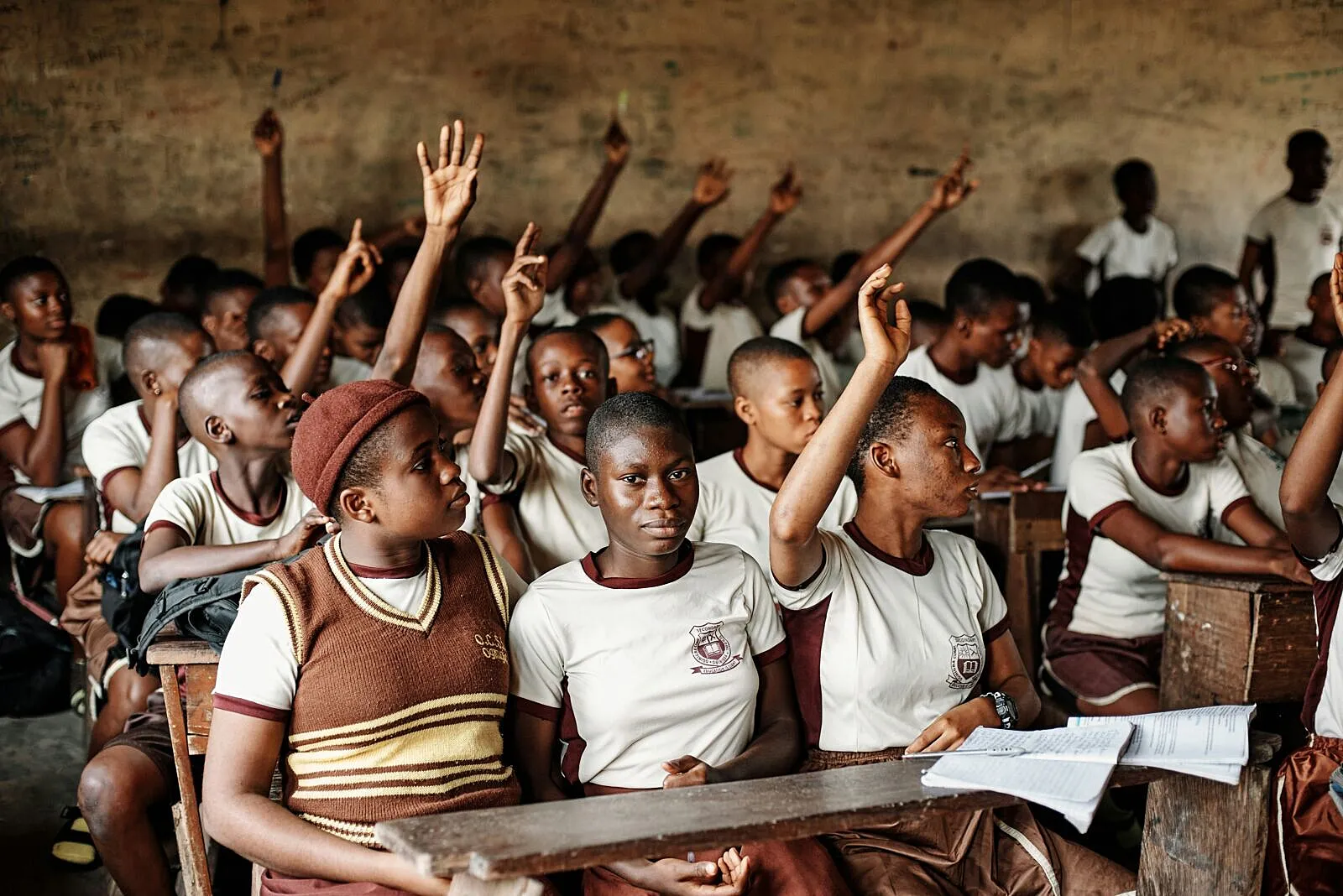
In a crowded classroom in northern Ghana, 10-year-old Kwame struggles to read a basic sentence. His teacher worries, not just about his future, but about the country’s economic prospects. Without foundational skills, children like Kwame face limited opportunities in adulthood.
Africa’s human capital crisis is not simply an education problem. It reflects deeper structural gaps in homes, neighbourhoods, and workplaces, where health, skills, and economic opportunity are shaped long before people enter formal employment.
Where Human Capital Is Built Determines Economic Destiny
At dawn in Kampala, Sarah prepares her children for school before heading to work at a small tailoring shop.
She never completed secondary school, and her workplace offers little training. Her children attend an under-resourced school in a crowded neighbourhood. Despite their determination, structural constraints limit their opportunities.
This story reflects a broader development challenge. Human capital, the health, skills, and knowledge people accumulate, is the foundation of economic growth, productivity, and poverty reduction.
However, in many low- and middle-income countries, including across Africa, human capital accumulation has stagnated or declined over the past two decades.
This insight and data article examines Africa’s human capital challenge through a settings lens: how homes, neighbourhoods, and workplaces shape skills and economic potential and what policy solutions can unlock Africa’s demographic and economic future.
Human capital progress has stalled in developing economies
Human capital refers to the skills, education, health, and experience people accumulate over their lives. It is a primary driver of productivity, innovation, and income growth.
However, progress has slowed or reversed in many developing countries. According to the World Bank report Building Human Capital Where It Matters, two-thirds of low- and middle-income countries have experienced stagnation or decline in key human capital outcomes over the past 15 years.
Learning outcomes have worsened in several countries.
As shown in the learning trends chart on page xxiii, many countries, including South Africa, Cameroon, and Côte d’Ivoire, recorded lower harmonised learning scores in 2025 compared with 2010.
Health indicators also show troubling patterns. In several Sub-Saharan African countries, average adult height, a proxy for long-term health, has declined, signalling worsening nutrition and living conditions.
This stagnation becomes a significant threat to Africa’s ability to achieve economic transformation.
Human capital drives income, productivity, and economic growth
Human capital is the single most important determinant of long-term economic development.
Globally, differences in human capital account for roughly two-thirds of income gaps between rich and poor countries.
Each additional year of schooling increases individual earnings by about 10%, while additional work experience raises earnings by approximately 2.5% per year.
For Africa, home to the world’s youngest population, human capital will determine whether demographic growth translates into economic opportunity or unemployment.
The stakes are particularly high for women and youth. Only about 40% of women in low- and middle-income countries participate in paid employment, while only 20% of young people are neither working nor studying.
Without stronger human capital investment, Africa risks missing its demographic dividend.
Structural barriers limit human capital development
Africa’s human capital challenge reflects structural constraints across multiple environments.
Traditional policies have focused primarily on expanding access to schools and healthcare. While these efforts are essential, the report highlights that human capital is built not only in formal institutions—but also in homes, neighbourhoods, and workplaces.
Poverty limits family investment in education, nutrition, and healthcare. As shown in the skill development chart on page xxv, children of less-educated mothers consistently perform worse in literacy and mathematics from early childhood through adolescence.
Neighbourhood conditions also shape outcomes. Poor infrastructure, weak schools, pollution, and violence reduce learning and economic opportunity.
Workplace conditions further constrain skill development. Approximately 70 percent of workers in low- and middle-income countries are employed in agriculture, informal work, or micro-enterprises with limited opportunities for skill development.
These structural factors reinforce inequality and limit economic mobility.
Three key settings shape outcomes
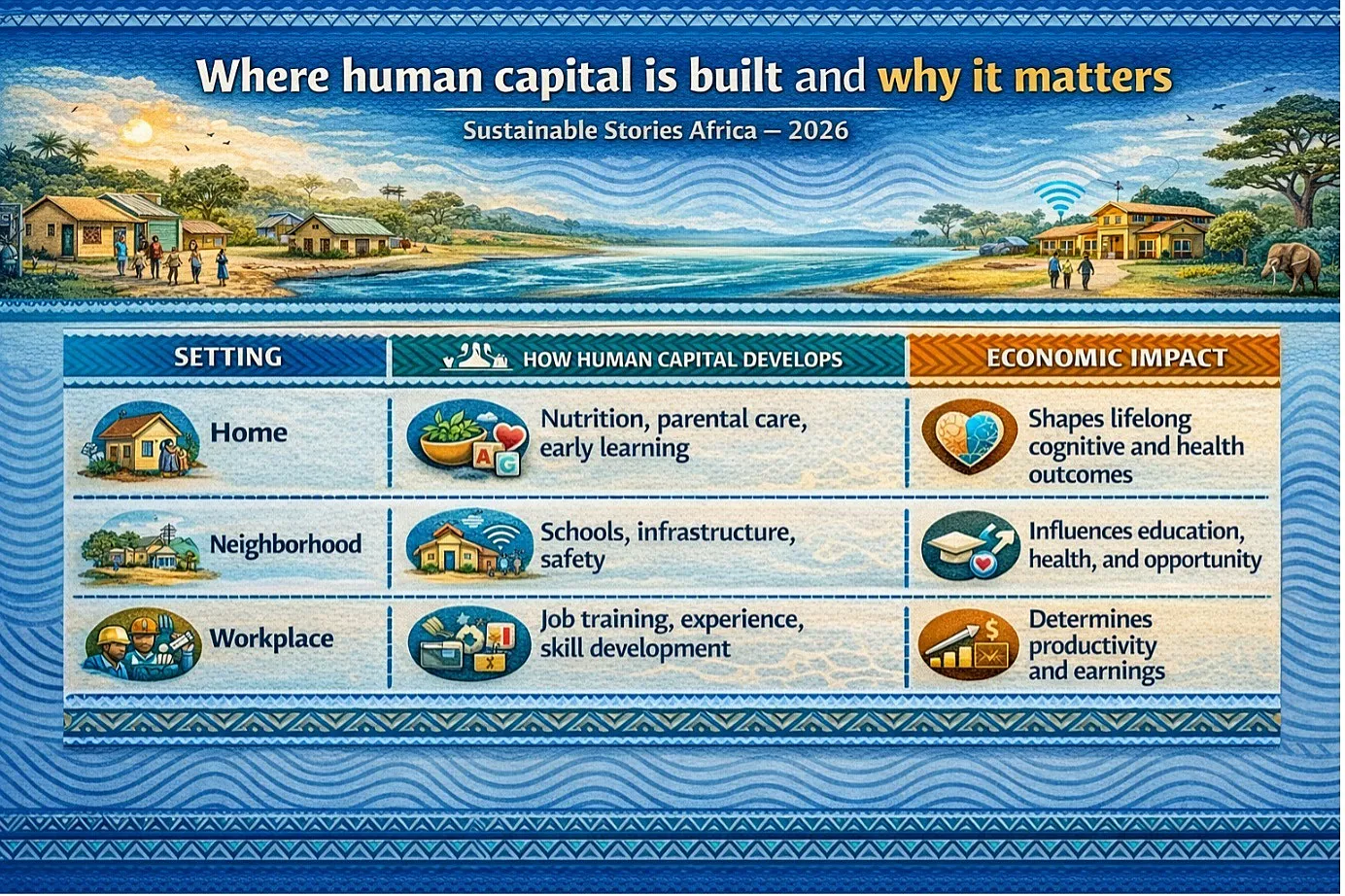
The World Bank report identifies three core environments where human capital is built:
Where human capital is built and why it matters
Setting | How human capital develops | Economic impact |
|---|---|---|
Home | Nutrition, parental care, and early learning | Shapes lifelong cognitive and health outcomes |
Neighborhood | Schools, infrastructure, safety | Influences education, health, and opportunity |
Workplace | Job training, experience, skill development | Determines productivity and earnings |
Early childhood conditions are particularly important. Skill deficits that emerge before age five often persist throughout life.
Neighbourhood quality influences education and employment outcomes. For example, children growing up in disadvantaged neighbourhoods earn significantly less in adulthood than those in better environments.
Workplaces also play a critical role. Nearly half of lifetime human capital accumulation occurs on the job through learning and experience.
However, many African workers lack access to jobs that require training or skill development.
Governments, the private sector, and communities shape human capital
Human capital development requires coordinated action across multiple stakeholders.
- Governments – Governments design education, health, and labour policies that shape human capital accumulation.
- Private sector – Employers provide job opportunities, training, and skill development.
- Families and communities – Family environments shape early childhood development, nutrition, and education outcomes.
- Development partners – International organisations provide financing, technical assistance, and policy support.
Human capital development depends on coordination across these actors.
Poverty, inequality, and structural transformation challenges
Africa faces significant trade-offs in human capital development.
- Informality vs skill development – Most workers are employed in informal sectors with limited training opportunities.
- Access vs quality – Expanding education access has not always improved learning outcomes.
- Demographics vs job creation – Africa’s growing youth population requires rapid expansion of high-quality jobs.
Without structural transformation, education gains may not translate into economic opportunity.
Policy reforms focus on integrated human capital investment
The report proposes a “settings-based” approach to human capital development.
Key policy priorities include:
- Strengthening home environments – cash transfers, parenting programs, and improved education access help families invest in children.
- Improving neighbourhood conditions – Investments in schools, sanitation, infrastructure, and safety improve human capital outcomes.
- Expanding skill-building workplaces – Apprenticeships, job training, and support for firm growth increase learning opportunities.
Apprenticeship programmes in Nigeria, Côte d’Ivoire, and Colombia have successfully increased skills and earnings among participants.
These integrated approaches improve productivity and economic opportunity.
Africa’s economic future depends on human capital investment
Human capital is Africa’s most valuable economic resource.
Without stronger investment in health, education, and workplace learning, economic growth and poverty reduction will remain constrained.
However, Africa also has a historic opportunity. With strategic investment, Africa’s young population could drive economic transformation, innovation, and prosperity.
Human capital development is not just a social priority; it is Africa’s economic future.
Path Forward – Investing In People To Unlock Africa’s Growth Potential
Africa must adopt integrated human capital strategies that strengthen homes, neighbourhoods, and workplaces simultaneously.
Governments, private sector actors, and development partners must align investments to improve education, health, and job opportunities.
By investing in people, not just infrastructure, Africa can unlock productivity, reduce poverty, and achieve sustainable economic transformation driven by its growing and dynamic population.