In markets from Lagos to Nairobi, Africa’s waste is quietly becoming a new form of capital.
Plastic bottles, discarded electronics, and food waste, once symbols of environmental strain, are increasingly becoming inputs for new industries, opportunities for job creation, and exports.
However, unlocking that value depends on whether Africa can redesign its production systems fast enough.
Circular economy investments could help the continent address unemployment, climate risks, and supply chain shocks, if policy, finance, and industry align at scale.
Waste Becoming Africa’s Next Industrial Resource
In Accra’s Agbogbloshie district, young workers dismantle discarded computers by hand, extracting copper wires and metal fragments to sell.
What resembles survival labour is also an early glimpse of Africa’s circular economy in action: recovering value from what others throw away.
The circular economy, where materials are reused, recycled, and regenerated rather than discarded, is emerging as one of Africa’s most promising pathways to sustainability.
Instead of the traditional “take–make–dispose” model, circular systems aim to extend product lifecycles, reduce waste, and unlock new economic value.
This explainer examines five industries: plastics, food waste, electronics, textiles, and construction, where circular models could reshape Africa’s economy.
It explores why circularity matters now, how Africa arrived at this point, and what must happen next for these opportunities to scale.
Circular economy becomes an industrial strategy
The circular economy represents a shift from linear production toward systems that keep materials in use longer through reuse, recycling, refurbishment, and regeneration.
For Africa, this transition is less about environmental idealism and more about economic necessity. Rapid urbanisation, population growth, and import dependence are increasing waste volumes while exposing supply vulnerabilities.
Five industries illustrate the continent’s immediate opportunities:
Circular Industry | Core Opportunity | Economic Impact Potential |
|---|---|---|
Plastic recycling | Recover packaging waste for reuse | Job creation and reduced imports |
Food waste conversion | Transform waste into fertiliser | Improve soil health and food security |
E-waste recycling | Recover metals and electronics components | Unlock billions in material value |
Textile recycling | Upcycle clothing into export garments | New manufacturing and export markets |
Mass timber construction | Replace carbon-intensive building materials | Lower emissions and create forestry jobs |
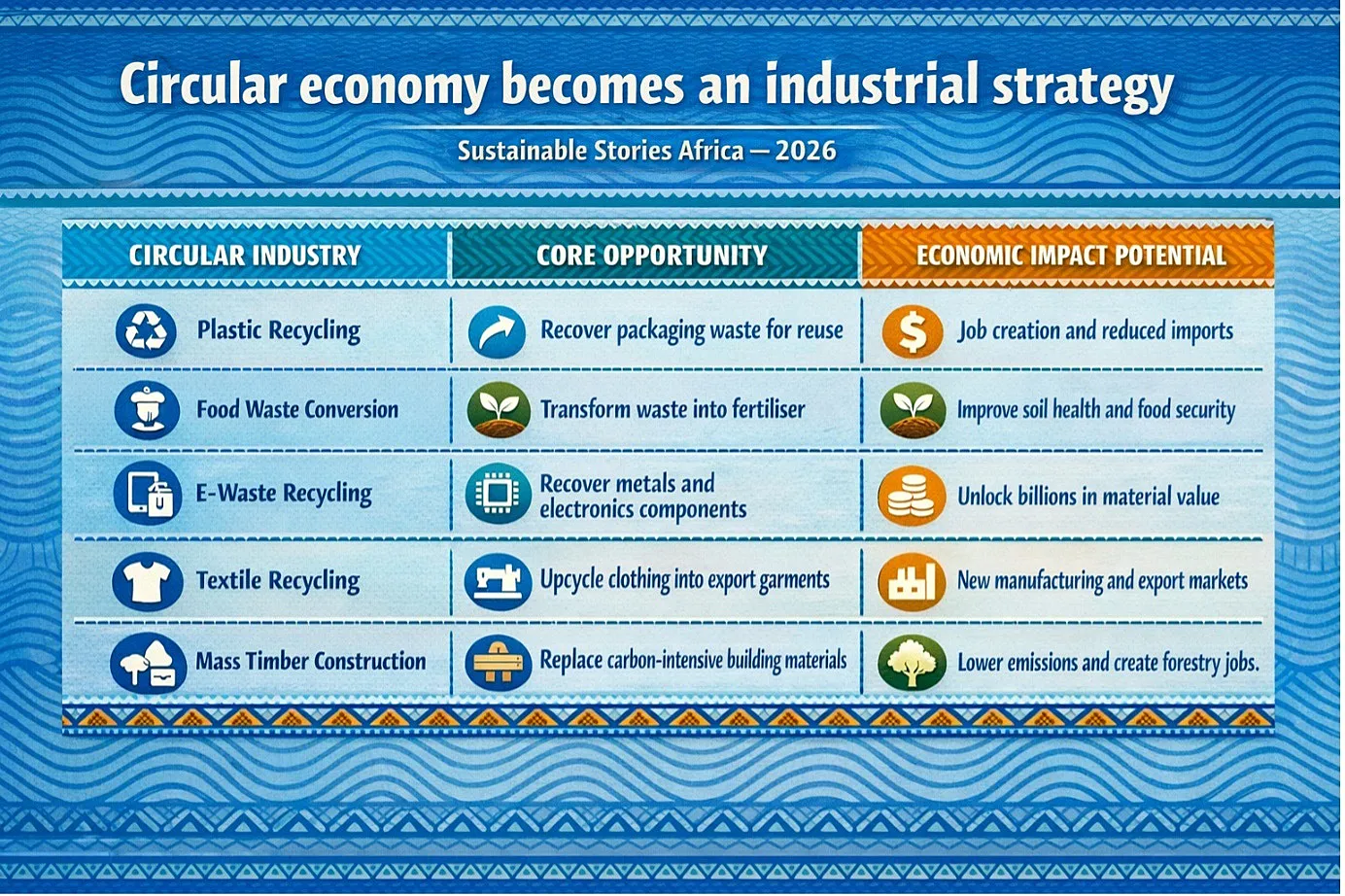
These sectors can transform waste streams into productive supply chains while improving resilience.
Jobs, resilience, and competitiveness
Africa’s circular economy opportunity is fundamentally about economic transformation.
Agriculture alone accounts for 23% of the GDP and employs 60% of the workforce in Sub-Saharan Africa, making efficiency and resource sustainability critical for the people’s livelihoods.
Meanwhile, food waste conversion into organic fertiliser could create thousands of green jobs while improving soil productivity and reducing import dependence.
Plastic waste is equally significant. Approximately 90% of waste in African countries is disposed of in uncontrolled dumpsites rather than recycled, representing both an environmental risk and lost economic value.
Recycling infrastructure could cut energy use by up to 75% in manufacturing and generate thousands of jobs, as demonstrated by Ghana’s plastics recycling sector.
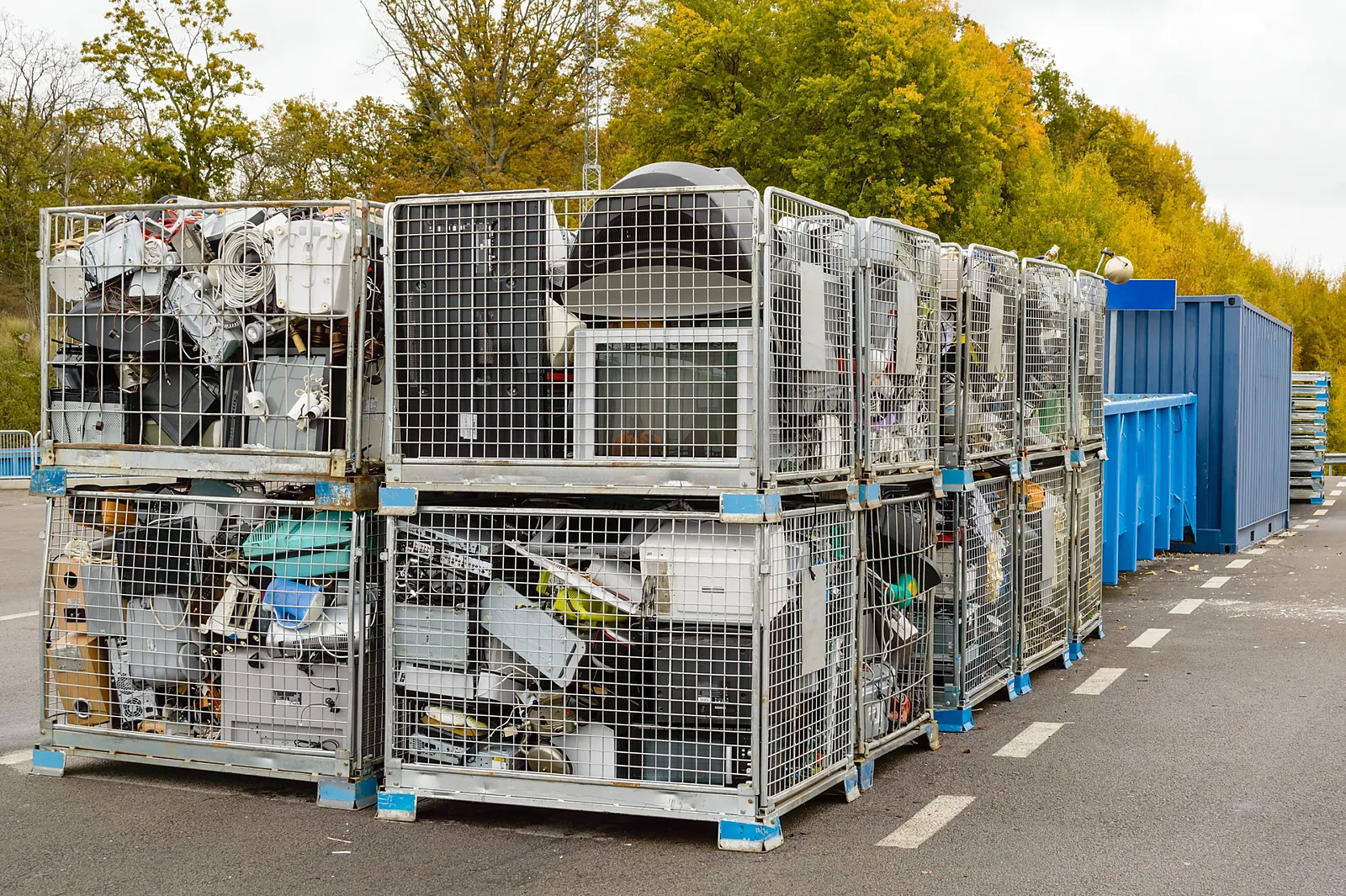
The electronics sector offers another clear opportunity. Africa’s e-waste contains an estimated $3.2 billion worth of raw materials, but limited recycling infrastructure means most of that value is lost or recovered informally.
Circular economy investments, therefore, address three urgent priorities simultaneously:
- Job creation in labour-intensive sectors
- Climate mitigation through emissions reduction
- Industrial competitiveness through domestic resource recovery
Linear systems met rapid growth
Africa’s circular economy challenge is rooted in structural shifts that have transformed over the past three decades.
Rapid urbanisation, projected to reach 59% urban population by 2050, has dramatically increased consumption, construction, and waste generation.
At the same time, industrialisation and population growth have intensified demand for materials, energy, and food.
However, most production systems remain linear, relying on imported raw materials and discarding products at the end of their lifecycle. This has led to an increase in economic leakages, environmental degradation, and supply vulnerabilities.
The COVID-19 pandemic exposed these weaknesses sharply. Supply disruptions threatened between $1 and $5 billion in agricultural export value and jeopardised the livelihoods of millions of farmers.
Circular economy models, particularly local recycling and regenerative production, offer a way to reduce dependence on fragile global supply chains.
Turning waste into new value chains
Circular systems operate by creating new industrial loops that recover and reuse materials.
In food systems, waste can be converted into organic fertiliser, reducing reliance on imported synthetic inputs while restoring soil health. Even small waste-processing plants can employ more than 200 people while supporting thousands of farmers.
In electronics, structured collection systems enable recycling facilities to extract valuable metals such as gold and copper.
Nigeria’s informal e-waste sector already employs around 100,000 workers, demonstrating the employment potential of scaling formal recycling infrastructure.
In construction, circular materials such as mass timber and recycled aggregates can replace emissions-intensive materials like cement and steel. This shift could significantly reduce the carbon footprint of Africa’s rapidly expanding cities.
The circular economy, therefore, creates interconnected industrial loops rather than isolated recycling activities.
Governments, businesses, and informal workers
Africa’s circular transition involves a diverse ecosystem of actors.
Governments play a central role by setting recycling standards, introducing tax incentives, and regulating waste flows.
Only 25% African countries currently have national e-waste legislation, highlighting the importance of regulatory reform.
Private sector companies, including recycling firms, manufacturers, and construction companies, have become instrumental in investing in circular infrastructure and integrating recycled materials into supply chains.
Informal workers are also critical participants. Waste collectors and recyclers form the backbone of existing circular activities but often operate without formal protections or support.
Investors, development banks, and international partners provide the financing needed to scale infrastructure and technology deployment.
Growth, infrastructure, and financing gaps
Despite its promise, Africa’s circular economy faces structural constraints.
Financing remains a major barrier. Recycling infrastructure requires significant upfront investment, while returns depend on stable supply chains and supportive policy frameworks.
Consumer behaviour is another challenge. Circular systems require shifts toward reusable packaging, recycled materials, and longer product lifecycles—changes that require awareness and incentives.
Policy fragmentation also limits progress. Harmonised regional standards and regulations are needed to support cross-border trade in recycled materials and enable economies of scale.
Without coordinated action, circular economy initiatives risk remaining small-scale and fragmented.
Africa-led circular innovation accelerates
Encouragingly, circular economy solutions are gaining momentum across Africa.
Governments are introducing tax incentives and recycling regulations to attract investment. Businesses are developing circular product designs and waste recovery systems. International institutions are supporting capacity building and financing.
Circular fashion industries, for example, are enabling recycled garments to enter global export markets, creating jobs and reducing waste. Similarly, mass timber construction offers a low-carbon alternative that supports forestry employment and sustainable urban development.
Africa’s circular economy is therefore not just an environmental initiative; it is a strategy for industrialisation.
Circular economy could reshape Africa’s development trajectory
Africa’s circular economy represents a shift in how the continent creates and captures value. Instead of treating waste as an unavoidable cost, circular systems transform it into a resource for economic growth.
The success of this transition will depend on policy reforms, infrastructure investment, and behavioural change.
Governments must establish enabling regulations, businesses must adopt circular models, and investors must finance long-term infrastructure.
If successful, Africa’s circular economy could create millions of jobs, reduce environmental risks, and enhance economic resilience, turning one of its biggest sustainability challenges into one of its most powerful development opportunities.
Path Forward – Scaling Africa’s Circular Economy Transition
Africa’s circular economy future depends on aligning policy, finance, and industry incentives.
Governments must introduce recycling standards, tax incentives, and invest in infrastructure to enable circular industries to scale.
Private sector innovation, supported by development finance and regional coordination, will determine whether circular economy initiatives evolve into major industrial sectors, unlocking jobs, resilience, and sustainable growth across the continent.