Africa’s race into artificial intelligence is gathering pace, but leading policy thinkers warn that speed without sequencing could deepen inequality rather than accelerate development.
An analysis from the Brookings Institution argues that African governments should prioritise foundational investments, such as electricity, data governance, digital infrastructure, and human capital, before scaling advanced AI deployment.
Sequencing AI Before Scaling Ambition
Artificial intelligence is rapidly reshaping global productivity, defence, health systems, and finance. However, for Africa, the question is not whether to adopt AI, but how.
Across the continent, governments have launched AI task forces, innovation hubs, and national strategies.
Rwanda and Kenya are positioning themselves as gateways to digital services. Nigeria is expanding its startup ecosystems.
South Africa is deepening its research capacity. But the Brookings analysis cautions that premature scaling, without strong enabling conditions, risks widening digital divides.
The economic stakes are significant. AI could contribute trillions to global GDP over the next decade.
However, countries lacking reliable electricity, broadband penetration, data regulation, and skilled talent may capture limited value while absorbing high transition risks.
In short: sequencing matters.
Infrastructure Gaps Shape AI Readiness
AI systems rely on three foundational pillars: data, computing power, and skilled labour. Across much of Africa, each remains unevenly distributed.
More than 40% of Africans still lack reliable access to electricity. Broadband affordability varies widely.
Data protection regimes are evolving but inconsistent. Without addressing these structural gaps, AI adoption risks concentrating benefits in already-connected urban enclaves.
AI readiness is therefore not purely technological; it is developmental.
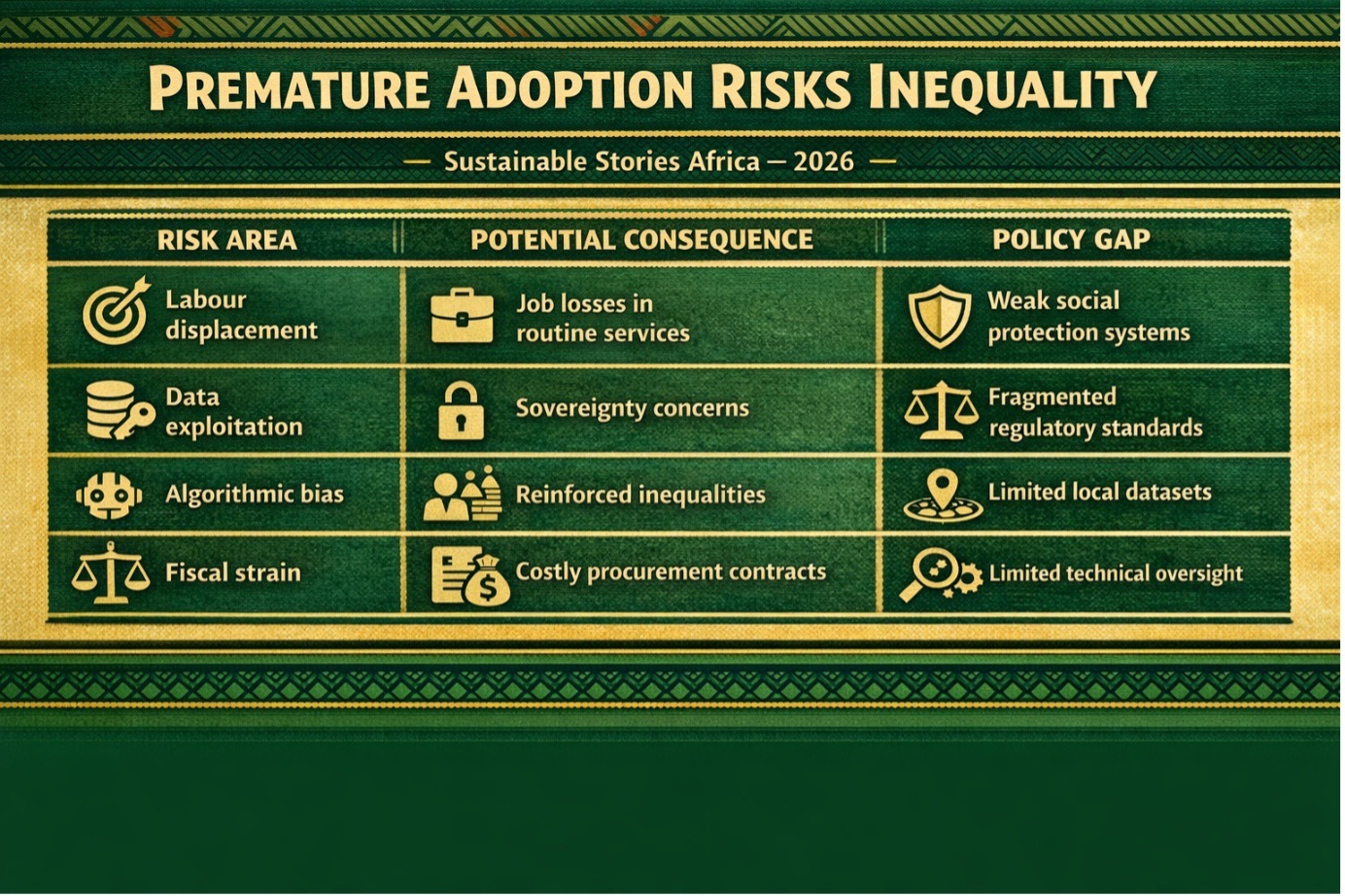
Premature Adoption Risks Inequality
Brookings researchers argue that rushing to deploy advanced AI tools without robust governance frameworks may expose countries to unintended consequences:
Risk Area | Potential Consequence | Policy Gap |
|---|---|---|
Labour displacement | Job losses in routine services | Weak social protection systems |
Data exploitation | Sovereignty concerns | Fragmented regulatory standards |
Algorithmic bias | Reinforced inequalities | Limited local datasets |
Fiscal strain | Costly procurement contracts | Limited technical oversight |
For labour markets already grappling with informality, automation shocks could deepen vulnerability.
Without upskilling pathways, displaced workers may struggle to transition into higher-value digital roles.
Similarly, reliance on foreign-developed AI systems can reduce domestic value capture and weaken data sovereignty.
Countries risk becoming consumers rather than producers of AI solutions.
Investment, Skills, Energy Constraints
While African AI startups are attracting venture capital, the funding base remains concentrated in a handful of markets, primarily Nigeria, Kenya, Egypt, and South Africa.
Meanwhile, electricity deficits increase operational costs for data centres and cloud services. AI training models require energy-intensive computing power, underscoring the importance of energy planning in digital strategies.
Human capital also presents a dual dynamic. Africa hosts one of the world’s youngest populations, offering long-term talent potential. However, tertiary enrolment in STEM fields remains limited relative to the population scale.
Brain drain further complicates retaining skilled researchers in that field
The sequencing argument, therefore, emphasises layered progression:
- Universal digital access.
- Foundational education and technical training.
- Clear regulatory frameworks.
- Strategic public-sector AI use cases.
- Scaled private-sector innovation ecosystems.
Build Foundations Before Acceleration
Rather than framing AI as a sprint, policymakers are encouraged to approach it as phased infrastructure development.
- First, invest in digital public infrastructure, including identity systems, interoperable payments, and secure data exchanges.
- Second, strengthen electricity reliability and expand renewable energy capacity to support digital growth.
- Third, adopt harmonised data protection laws to protect citizens while enabling innovation.
- Fourth, prioritise AI applications that address local challenges, such as agriculture yield optimisation, disease diagnostics, and urban traffic management, before pursuing frontier generative AI experimentation.
Sequencing does not mean delaying ambition. It means anchoring ambition in readiness.
Path Forward – Phased Strategy Anchors Sustainable AI Growth
Africa’s AI trajectory will be shaped less by hype cycles and more by institutional sequencing.
The priority is foundational investment in areas such as electricity, broadband, governance, and skills, which ensures inclusive value capture.
Governments are encouraged to align AI strategies with industrial policy, education reform, and regional cooperation. Done deliberately, AI can enhance productivity and resilience without amplifying inequality.