Across African cities and secondary towns, women are turning to digital platforms for income, flexibility, and financial autonomy.
However, recent analysis from the Brookings Institution warns that without stronger protections and policy reform, the gig economy could entrench vulnerability rather than expand opportunity.
The stakes are high: the continent’s digital labour platforms are expanding rapidly, but gender gaps in pay, protection, and access remain persistent.
Digital Platforms Reshape Women’s Work
Africa’s gig economy is no longer peripheral. Ride-hailing drivers in Nairobi, online freelancers in Lagos, e-commerce vendors in Accra, and delivery workers in Johannesburg form part of a rapidly expanding platform workforce.
For women, especially, digital platforms offer something traditional labour markets often do not: entry points.
However, as Brookings researchers emphasise, opportunity and precarity coexist.
Women’s labour force participation across Africa remains constrained by caregiving burdens, mobility limitations, safety concerns, and informality.
The gig economy appears to offer flexibility, remote work, self-scheduled hours, and mobile-based entrepreneurship.
However, beneath the surface lie structural inequalities that shape outcomes.
The central question is not whether women are entering gig work; they are. It is whether they are entering on equitable terms.
Flexibility Drives Female Participation
Digital platforms are attracting women for three core reasons:
- Flexibility: Remote freelancing and online sales allow work to align with caregiving responsibilities.
- Lower Entry Barriers: Smartphones and mobile money reduce the need for physical storefronts.
- Income Diversification: Platform work supplements unstable informal-sector earnings.
Across sectors such as online retail, content moderation, transcription, and digital marketing, women’s participation is visible and rising.
In some markets, women dominate online micro-entrepreneurship categories.
However, participation does not automatically translate into empowerment.
Structural Gaps Limit Earnings
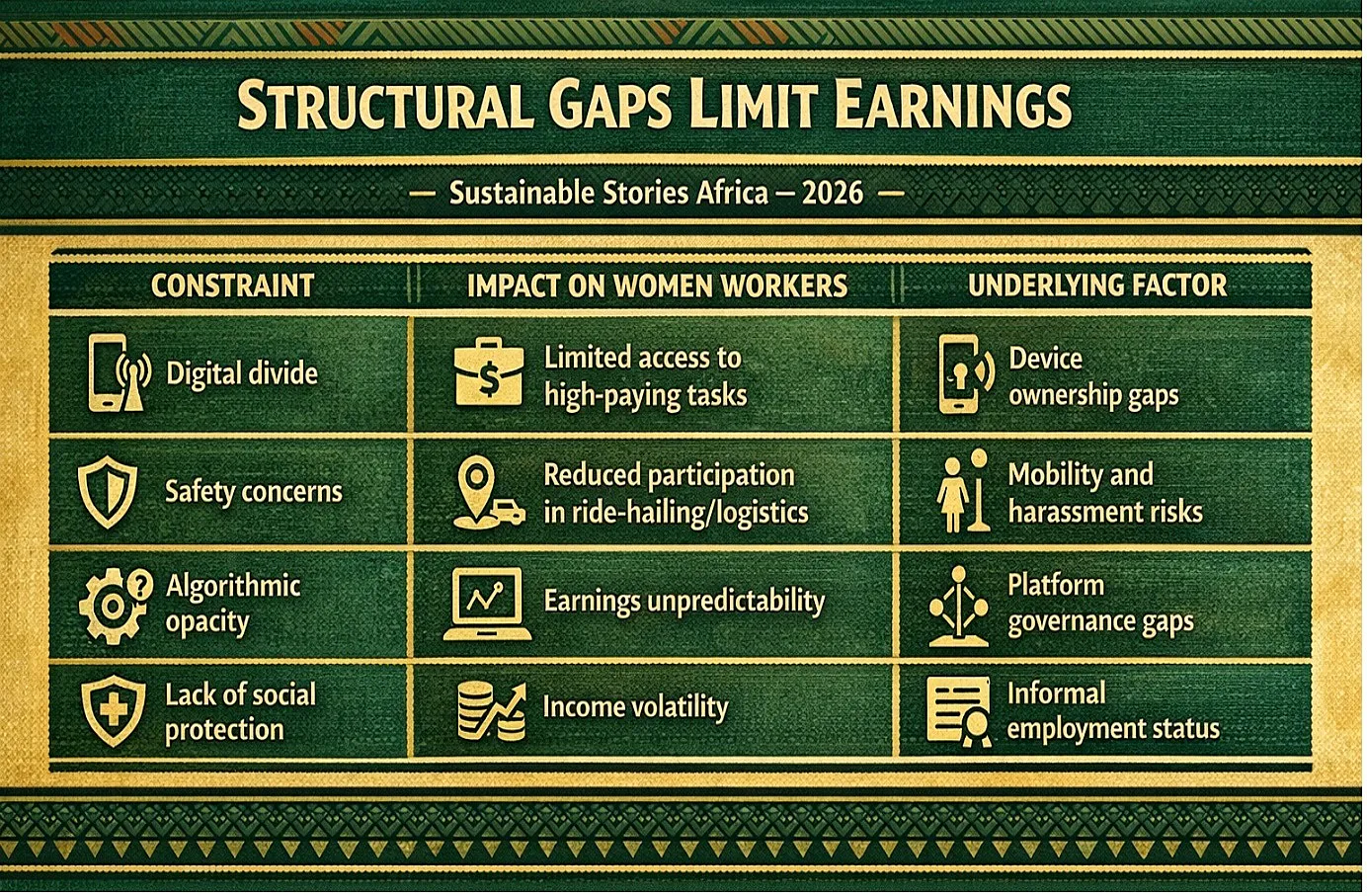
The Brookings analysis highlights several constraints that disproportionately affect women in Africa’s gig economy:
Constraint | Impact on Women Workers | Underlying Factor |
|---|---|---|
Digital divide | Limited access to high-paying tasks | Device ownership gaps |
Safety concerns | Reduced participation in ride-hailing/logistics | Mobility and harassment risks |
Algorithmic opacity | Earnings unpredictability | Platform governance gaps |
Lack of social protection | Income volatility | Informal employment status |
Women are more likely to cluster in lower-paying digital microtasks or online retail rather than capital-intensive gig roles such as ride-hailing or logistics.
Safety risks and disparities in vehicle ownership further restrict participation in transport-based platforms.
Additionally, algorithm-driven rating systems may embed bias, reinforcing unequal access to premium tasks.
Growth Trends, Protection Deficits
Africa’s platform economy is growing in tandem with rising smartphone penetration and mobile broadband access.
Countries such as Kenya, Nigeria, South Africa, and Egypt are hubs for digital labour marketplaces and e-commerce ecosystems.
However, formal labour protections lag.
Most gig workers operate as independent contractors, without access to health insurance, maternity benefits, or pension contributions.
For women, who already face disproportionate care responsibilities, the absence of safety nets increases vulnerability to shocks.
Brookings researchers argue that the regulatory vacuum risks normalising precarious employment structures. Without reform, platform work may replicate informality in digital form.
At the same time, the upside potential remains considerable. Digital labour exports, cross-border freelancing, and e-commerce integration with continental trade frameworks could significantly expand women’s earnings if access barriers are addressed.
Policy Can Enable Inclusive Platforms
Policy sequencing matters here as much as innovation.
Governments are encouraged to:
- Close Digital Access Gaps: Subsidised devices, digital literacy training, and affordable broadband improve access to higher-value work.
- Strengthen Platform Accountability: Transparent algorithms, grievance mechanisms, and fair contract standards protect workers.
- Expand Social Protection Portability: Flexible benefit schemes tailored to gig workers reduce income volatility.
- Promote Gender-Sensitive Design: Safety features, identity verification systems, and harassment reporting tools encourage broader participation.
Importantly, reform should avoid overregulation that stifles innovation. The goal is calibrated inclusion, ensuring flexibility does not come at the expense of fairness.
Private-sector platforms also have agency. Ethical data use, revenue transparency, and skill-building partnerships can differentiate responsible operators in a competitive market.
Path Forward – Inclusive Platforms Require Policy Alignment
Africa’s gig economy holds transformative potential for women’s economic inclusion.
Realising that potential requires coordinated reforms, including expanding digital access, gender-sensitive protections, and portable social benefits.
Policymakers, platforms, and civil society must align incentives to ensure growth translates into empowerment.
With deliberate action, digital platforms can become vehicles of resilience rather than reproductions of informality.