
Financial Planning and Analysis is becoming more than a back-office finance function. It is now a strategic discipline that helps organisations plan, forecast, measure performance and respond faster to uncertainty.
For African businesses navigating inflation, currency pressures, cost volatility and tighter capital conditions, FP&A can turn raw numbers into clearer decisions, stronger accountability and long-term value creation.
Financial Planning Turns Numbers Into Strategy
Financial Planning and Analysis, widely known as FP&A, is accelerating from spreadsheet work to strategic decision support as companies face increasing pressure to forecast better, spend smarter and explain performance more clearly.
A new FinPolNomics Green Finance and FinPolNomics Analytica educational brief presents FP&A as the finance function that helps businesses plan budgets, set targets, forecast future performance, analyse results and support better decisions for long-term value creation.
For African and emerging-market companies, this matters now because volatility has become a management condition, rather than a temporary disruption.
- Input costs can shift quickly. Consumer demand can weaken suddenly.
- Foreign-exchange pressure can reshape margins.
- Investors want clearer reporting.
- Boards want evidence, not optimism.
FP&A sits at that intersection, helping leaders understand what changed, why it changed and what should happen next.
Budget Gaps Can Change Strategy Quickly
A variance can reveal whether a business plan is working. In the FinPolNomics example, a company budgets sales of N10 billion, delivers N8 billion and records a variance of N2 billion.
On paper, it is a shortfall. In practice, it shows that assumptions around pricing, demand, execution, or market conditions may have failed.
That is where FP&A matters.
- Its role is to explain the gap, assess the impact on performance and recommend corrective action.
- Importantly, FP&A strengthens governance, resilience and sustainable performance by testing whether budgets were realistic, resources were allocated well, and management responded early enough.
In Africa’s economy, those answers shape payroll, inventory, expansion, investor confidence, debt servicing and customer affordability over the quarter.
FP&A Connects Forecasting With Accountability
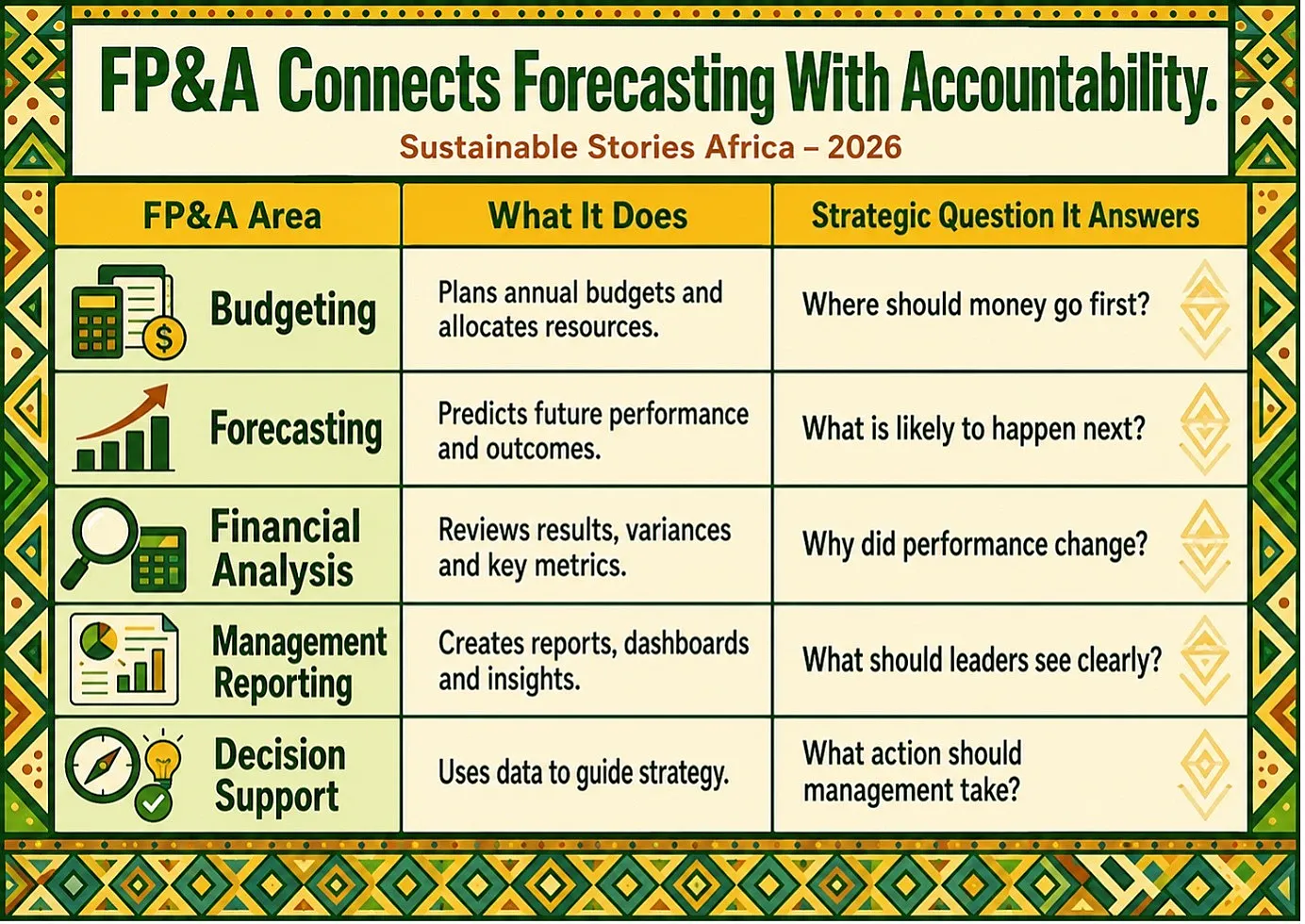
Financial Planning and Analysis (FP&A) carries five core responsibilities:
- Budgeting
- Forecasting
- Financial analysis
- Management reporting
- Decision support.
Together, they transform raw financial data into a strategic direction.
Where traditional accounting looks backwards, recording transactions, ensuring compliance, and protecting control, FP&A looks forward.
It uses financial information to forecast performance, guide planning, and support leadership decisions in real time.
Both functions remain essential. Accurate historical records are the foundation of credible forecasting.
However, in volatile markets, retrospective data alone is insufficient. Leaders need insight into what the numbers signal about tomorrow.
The FP&A skillset reflects this forward orientation.
- Professionals combine advanced Excel, financial modelling, and data analysis with strong communication and business acumen.
- Platforms like Power BI, Anaplan, and Tableau are expanding the toolkit beyond spreadsheets.
Ultimately, the strongest FP&A analysts do more than build models; they tell the business story behind them.
Better Planning Builds Market Resilience
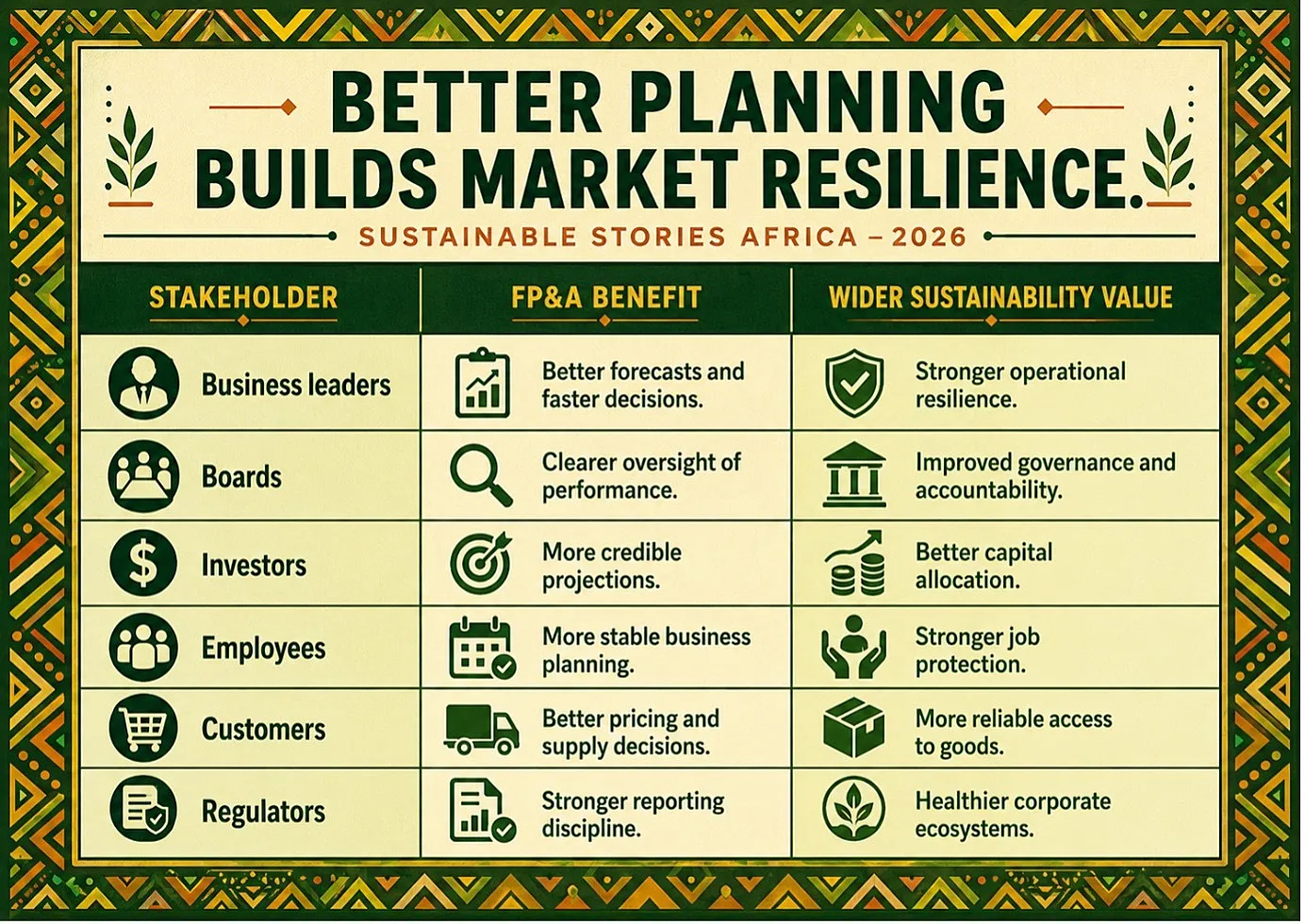
The core promise of Financial Planning and Analysis is better decision-making before problems become crises.
For companies, FP&A provides clearer visibility into revenue, cost, profit and cash.
- Businesses that detect variance early can adjust faster, reducing waste, protecting margins, reviewing pricing, or redirecting resources toward stronger growth areas.
For investors and lenders, credible forecasts linked to assumptions, scenarios and performance data build confidence.
- This is particularly relevant for businesses pursuing debt, equity, grants or strategic partnerships.
For boards, FP&A strengthens oversight and governance.
- It clarifies whether management is executing strategy, controlling risk and responding to shifting conditions, helping to make decisions more transparent, measurable and accountable.
The cost of weak FP&A is equally clear.
- Companies can grow revenue while destroying profit, expand without understanding working-capital pressure, or miss early warning signals in demand and liquidity.
In volatile markets, hope is not a strategy. FP&A replaces hope with disciplined planning.
Make Finance A Strategic Partner
Unlocking the full value of Financial Planning and Analysis requires deliberate change across culture, capability, technology and planning approach.
The first shift is cultural.
- FP&A must move beyond budget season and become embedded in strategic conversations year-round, informing decisions on expansion, hiring, pricing, capital expenditure and debt.
The second shift is capability.
- Businesses need professionals who combine finance, data and communication. Technical skill matters, but so does judgement. A model is only valuable when leaders understand what it means and how to act on it.
The third shift is technology.
- While Excel remains foundational, dashboards, enterprise planning systems and business intelligence platforms accelerate performance visibility. For smaller businesses, even simple dashboards improve financial discipline.
The fourth shift is scenario planning.
- Rather than treating a single fixed budget as certainty, companies must interrogate assumptions, such as what if sales fall, costs rise, or a major customer delays payment?
These shifts are especially relevant for African businesses across banking, technology, manufacturing, FMCG and startups, where decisions must be made quickly and explained clearly.
For young finance professionals, the opportunity is significant. The future of finance is not recording numbers; it is interpreting them.
Path Forward – Turn Dashboards Into Decisions
African businesses should treat FP&A as strategic infrastructure for resilience, governance and sustainable growth.
The priority is to connect budgets, forecasts, variance analysis, dashboards and decision support into a single management discipline.
The next step is practical: build finance teams that can model scenarios, explain performance clearly and guide timely action.
Better planning will not remove volatility, but it can help companies respond with evidence, accountability and confidence.