Global hard coral cover fell 8.9% between 2023 and 2024, the sharpest annual drop in a new worldwide assessment.
The full effects of the latest bleaching event are still not appearing in the data.
The report also shows recovery in parts of the Western Indian Ocean, thus making a case for both emissions cuts and stronger local reef protection.
A Record Decline Signals Less Recovery Time
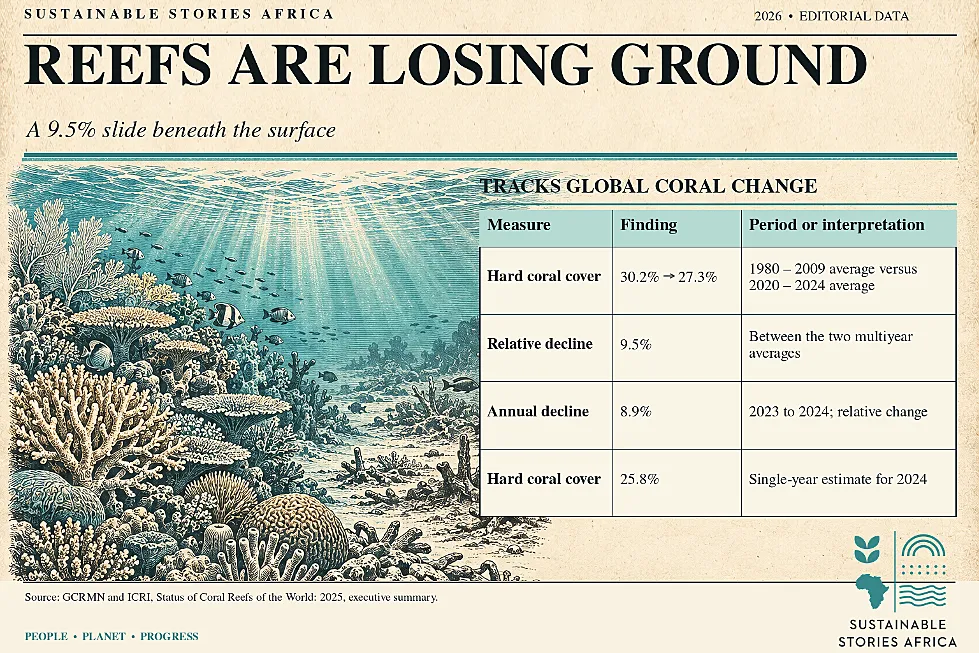
The world’s hard coral cover fell by an estimated 8.9% in relative terms between 2023 and 2024, the largest single-year decline in the Global Coral Reef Monitoring Network’s record.
Its Status of Coral Reefs of the World: 2025, published in 2026, puts average cover at 25.8% in 2024.
The assessment ends that year, so it cannot yet measure the full ecological effects of the fourth global bleaching event, which continued into 2025.
Drawing on 21.1 million observations from 87,299 surveys at 36,886 reef sites, the assessment offers a wider evidence base than previous editions.
It compares the 2020 – 2024 average with a 1980 – 2009 reference period: hard coral cover declined from 30.2% to 27.3%, a relative fall of 9.5%.
These are estimates of the share of the seabed covered by living hard coral, rather than a claim that 9.5 percentage points of all reefs disappeared.
Heat Stress Is Outpacing Reef Recovery
Four steep declines coincide with global bleaching events since 1998.
Each event was associated with a 6.5% to 9.9% relative loss of hard coral cover. Satellite records in the report show sea-surface temperatures above reefs rose 0.81°C from 1985 to 2025.
The authors identify marine heatwaves, intensified by climate change, as the principal driver of the global decline.
The difficulty is the time available between shocks.
- Following the third bleaching event, global coral cover recovered by about 6% from 2017 to 2019 relative to its post-disturbance level.
However, it never returned to the historical reference level.
- Major disturbances that were roughly a decade apart have recurred every four to six years in many regions since 2010, leaving less time for coral colonies to regrow and reproduce.
Regional Differences Show Where Protection Matters
The global average conceals markedly different regional paths.
- The report finds strong evidence of long-term decline in the Caribbean, the ROPME Sea Area, Australia and the Pacific.
- It records strong recovery from already degraded reference states in South Asia and the Western Indian Ocean. For countries around East Africa, that recovery offers evidence of resilience, but it should not be read as immunity to hotter seas.
Coral reefs support fisheries, buffer coasts from waves and sustain tourism and cultural practices.
- If repeated bleaching reduces living cover, households and local businesses can face costs even when a global average still looks substantial.
The report also warns that the earlier reference period probably already contained degraded reefs and that monitoring coverage remains uneven.
- Its global estimate may therefore understate the longer history of loss.
The Western Indian Ocean’s reported 43.0% relative recovery compares a recent multiyear average with an already depleted reference state.
- It is therefore evidence that coral cover can improve in some settings, not a return to pristine conditions across East Africa.
In the same comparison, the Caribbean declined 43.4% and the ROPME Sea Area 48.7%.
- Local conditions and the timing of heat stress are essential to interpreting those divergent numbers.
The report also finds global macroalgal cover rose 44.1% relative to the reference period but remained only 6.8% in 2024; a rising trend does not establish worldwide algal takeover.
Local Management Supports Wider Climate Action
The assessment recommends cutting greenhouse-gas emissions while reducing pressures that managers can influence locally, including pollution, harmful coastal development and unsustainable use of marine resources.
- Those local measures can improve resistance and recovery, but the authors stress that they cannot replace climate mitigation.
- The distinction matters for coastal authorities choosing between immediate reef care and national energy policy: the two decisions reinforce one another.
Monitoring needs investment as well.
- The report calls for better coverage in vulnerable regions, common survey methods, accessible data and indicators that reach beyond coral cover.
- Linking ecological measures with the livelihoods dependent on reefs would show where restoration, fisheries management or coastal protection delivers the most value.
- Claims of recovery should be checked against the age and condition of the local reference data.
The assessment’s credible intervals also help show what can be asserted.
- For the 9.5% long-run relative decline, its 95% credible interval is 4.0% to 14.5%; for the 2023 – 2024 annual decline, it is 6.4% to 11.3%.
- These ranges reflect uncertainty in the model rather than identical outcomes at every site.
This makes using local surveys especially important when allocating conservation money or assessing a coastal development proposal.
Path Forward – Requires Cooling Seas And Evidence
Governments should pair emissions reductions with enforceable local protection and sustained reef monitoring.
Coastal communities and researchers need usable data to target interventions and test whether reefs recover between heatwaves.
The 2024 fall is a warning based on an incomplete view of the latest bleaching event.
Updating observations through 2025 and beyond will show whether recovery windows are narrowing further.