Global energy transition investment reached a record $2.3 trillion in 2025; however, the headline number hides a more complicated shift: growth is slowing, capital is moving unevenly, and grids and electric transport are now shaping the next phase.
For Africa and emerging markets, the question is no longer whether clean energy is attracting capital.
It is whether that capital can reach power systems, industry, transport and households fast enough.
Clean Investment Enters Harder Growth Phase
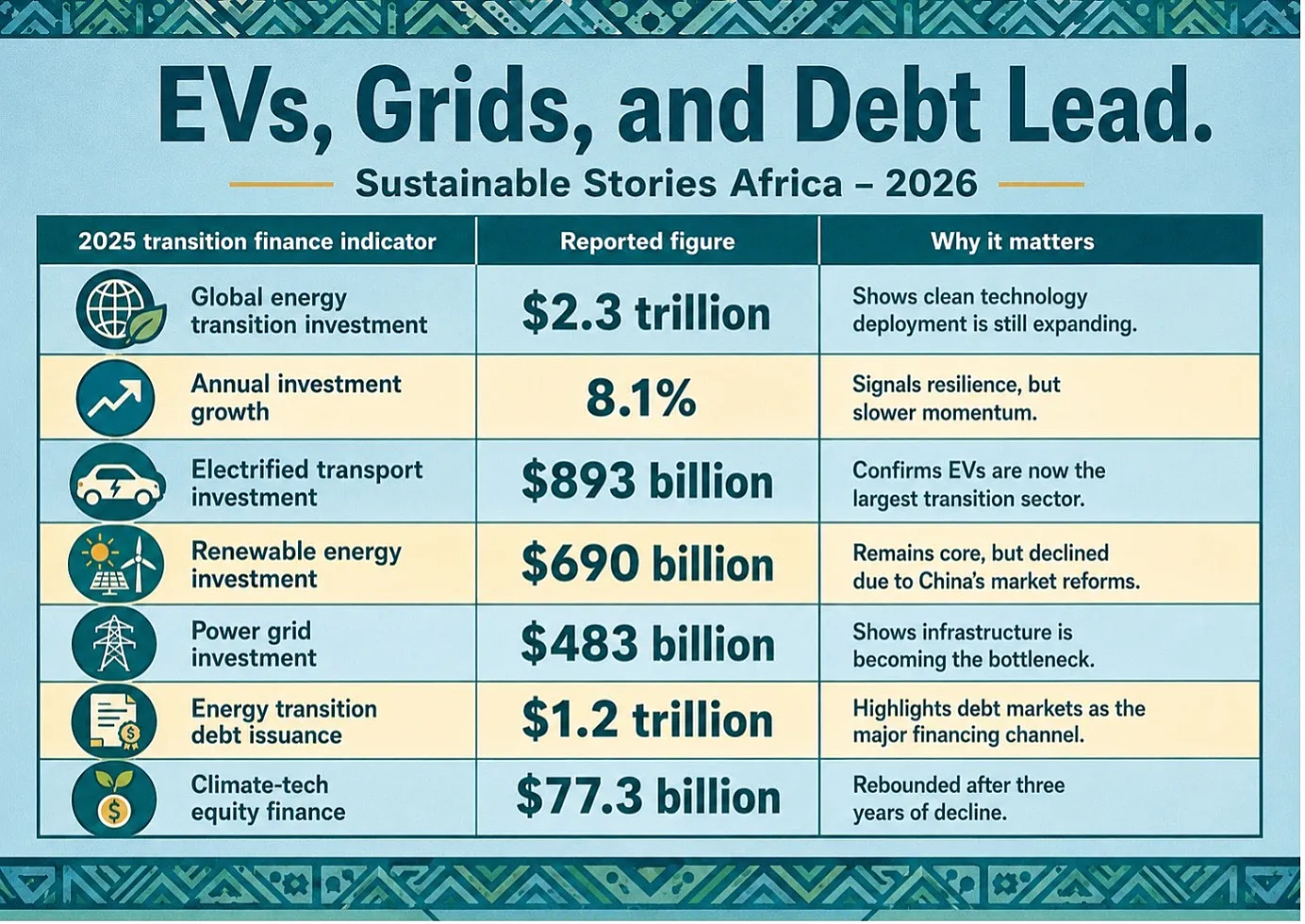
Global investment in the energy transition climbed to a record $2.3 trillion in 2025, rising 8.1% despite disruptions to trade, policy uncertainty and geopolitical tension, according to BloombergNEF’s Energy Transition Investment Trends 2026 abridged report.
The spending covered clean technology deployment across power, transport, buildings, industry and grids.
The strongest message is resilience. Electric vehicles, charging infrastructure, renewables and power grids now account for the largest share of transition spending. But the second message is caution: annual growth has steadily reduced from 27% in 2021 to single digits in 2025.
For African markets, this matters because global capital is moving, but not automatically toward the places with the largest energy access gaps.
The transition is becoming less about ambition alone and more about bankable infrastructure, credible regulation, local supply chains and power systems that can absorb new investment.
Record Spending Meets Slower Momentum
The world is spending more on the energy transition than ever before, but the pace of growth is weakening.
BloombergNEF estimates that energy transition investment reached $2.309 trillion in 2025, up from $2.136 trillion in 2024 and $1.906 trillion in 2023. That is a historic high; however, the growth rate has slowed to its weakest level since 2019.
The investment story is now concentrated around three pillars.
- Electrified transport attracted $893 billion in 2025, making it the largest sector.
- Renewable energy followed with $690 billion, led by solar.
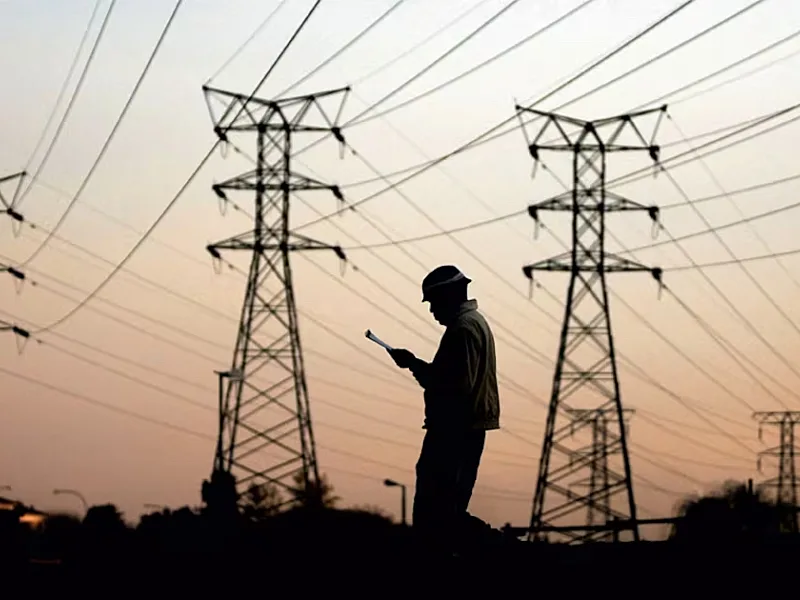
- Power grid investment jumped 17% to $483 billion as operators raced to connect new generation and rising demand.
That shift carries an important lesson for development. Clean energy is no longer only about building generation capacity.
It is increasingly about moving electricity, charging vehicles, managing demand, financing storage, and upgrading systems that were not designed for today’s scale of electrification.
For countries in Africa, where grid reliability, cost of capital and policy uncertainty remain persistent constraints, the trend is both a warning and an opening.
The capital exists globally. The challenge is turning local markets into destinations where that capital can be deployed at scale.
EVs, Grids, and Debt Lead
The 2025 global energy transition investment landscape signals a clear shift from early adoption to infrastructure expansion.
Electric transport emerged as the largest transition sector, with spending rising 21% as consumers, fleet operators, and governments accelerated backing for electric vehicles and charging infrastructure.
China alone invested $434 billion in electrified transport, representing more than half of its total energy transition spending.
Renewables remained central but faced headwinds. Global renewable energy investment declined 9.5% to $690 billion, as market reforms in China exposed wind and solar developers to volatile wholesale price signals, slowing project commitments in the world's largest clean energy market even as other economies increased spending.
Power grid investment emerged as the most critical structural signal, reaching $483 billion in 2025, driven by demand for renewable energy, growth in electric transport, data centre expansion and rising equipment costs.
For emerging markets, the lesson is clear: without stronger transmission and distribution networks, clean energy generation cannot deliver reliable power.
On the financing side, energy transition debt issuance rose 17% to $1.2 trillion, dwarfing the $77.3 billion raised through climate-tech equity markets, confirming that the transition is increasingly being funded as an infrastructure cycle rather than a venture-driven story.
China Slows, Others Fill Gap
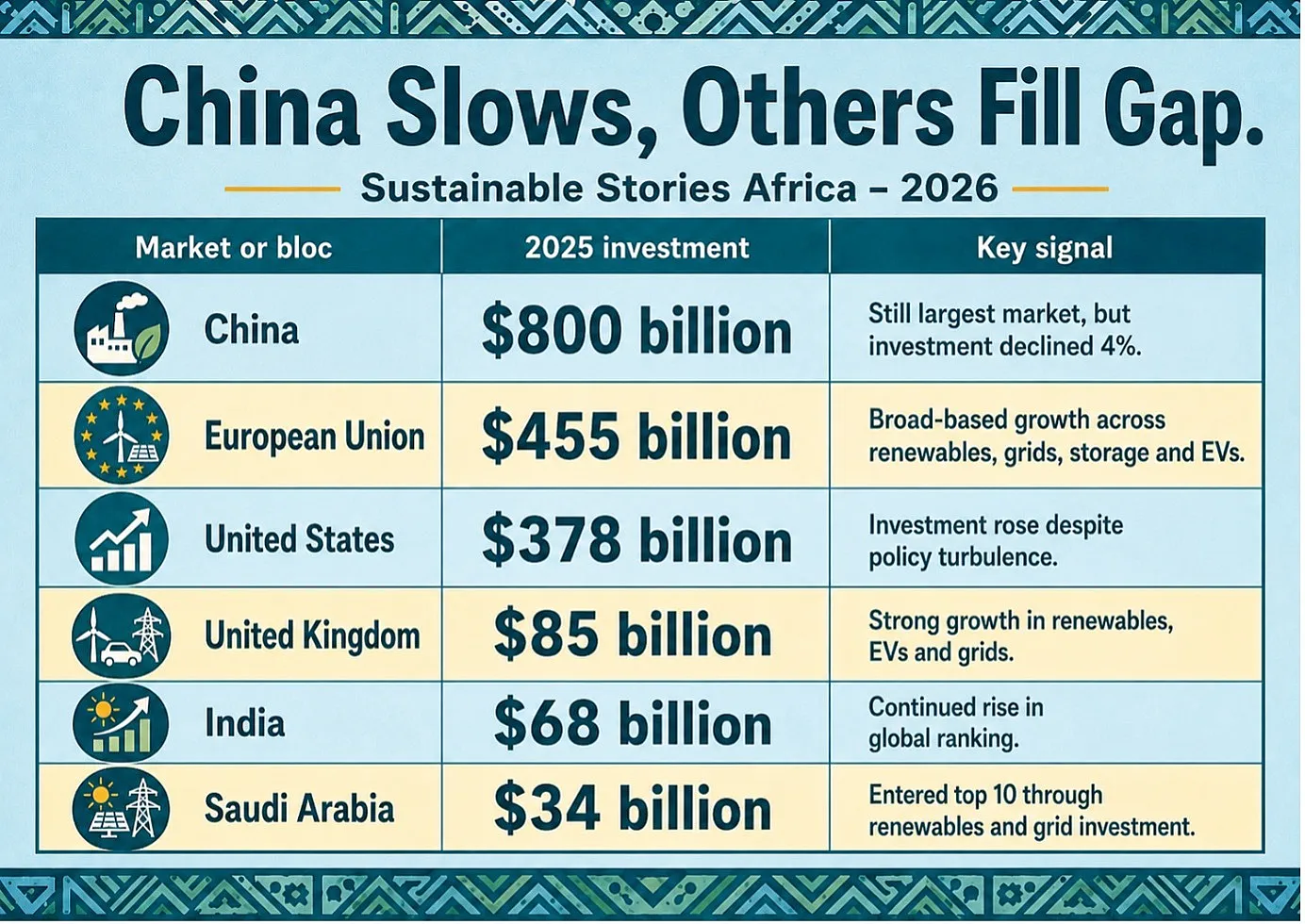
China remains the world's dominant energy transition market, investing $800 billion in 2025 and accounting for 34% of global spending.
However, the country recorded its first decline since 2013, falling 4% as sharp drops in renewable energy investment followed power market reforms that introduced revenue uncertainty for developers.
Other major economies partially offset China's decline. The European Union grew 18% to $455 billion, the United States rose 3.5% to $378 billion, the United Kingdom increased 36% to $85 billion, and India rose 15% to $68 billion.
Saudi Arabia entered the global top ten after investment surged 70% to $34 billion, driven by renewables and grid spending.
For African policymakers and investors, this redistribution carries a direct lesson: energy transition capital follows systems, not slogans. Markets that combine clear regulatory frameworks, infrastructure demand, viable projects and accessible financing channels are consistently better positioned to attract investment.
The supply chain dimension is equally telling.
Clean energy supply chain investment rose 6% to $127 billion in 2025, covering clean-tech manufacturing and battery metal production.
While China still dominates clean-tech manufacturing, its share of annual investment is gradually declining as the United States, European Union, India and other markets progressively localise parts of the clean energy value chain.
What Africa Can Gain Next
Africa's energy transition opportunity extends beyond replicating the investment models of China, Europe or the United States.
The continent's pathway must strategically link power access, industrial competitiveness, climate resilience and job creation into a coherent development agenda.
The enabling conditions are increasingly available. Cheaper solar modules, expanding battery manufacturing and deeper debt markets can lower the cost of clean power projects.
Strengthened grid infrastructure can improve reliability for homes, hospitals, factories and digital systems. Purposefully designed electric transport systems can meaningfully reduce fuel import exposure across public transport, logistics and two-wheeler markets.
The tangible benefits are significant, fewer diesel generators burdening small businesses, reliable cold storage for farmers, cleaner urban buses and lower long-term energy costs for manufacturers.
Africa could also build domestic value chains around solar assembly, battery services, processing critical minerals and clean industrial zones.
However, the risk is equally clear. Weak grids, high borrowing costs, fragmented regulation, and underprepared utilities will redirect global capital elsewhere, leaving Africa consuming the transition rather than producing it, importing equipment, missing out on industrial value and paying more for delayed infrastructure.
Build Bankable Systems, Not Announcements
Accelerating Africa's energy transition requires treating investment as a systems challenge rather than an exercise of project announcement.
Governments must prioritise bankable pipelines, credible procurement, enforceable contracts and tariff structures that balance consumer protection with cost recovery.
Critically, transmission and distribution upgrades must be prioritised, as grid capacity is now central to the investment case.
Renewable generation without adequate grid infrastructure leads to curtailment, weak reliability and investor frustration.
Regulators must reduce uncertainty through carefully sequenced reform. China's experience demonstrates how poorly managed revenue risk during market reform can significantly slow investment.
African markets need transparent rules governing tariffs, wheeling arrangements, power purchase agreements, mini-grids and distributed energy systems.
Financiers must shift from isolated project financing to platform-based approaches, deploying blended finance, guarantees, local-currency instruments and transition-focused debt products.
Globally, debt markets already dominate transition financing; Africa's challenge is to make the debt affordable, patient and infrastructure-aligned.
Businesses equally carry responsibility. Large energy users can anchor demand through corporate power purchase agreements, logistics companies can electrify fleets where charging economics are viable, and manufacturers can invest in energy efficiency, rooftop solar and cleaner industrial heat. Private demand visibility makes the transition more investable for all stakeholders.
Path Forward – Finance Must Meet Real Systems
The investment trend is clear: capital is growing, but it is becoming more selective. African markets must turn climate ambition into investable systems, stronger grids, clearer rules, credible project pipelines and financing tools that reduce risk.
The priority now is execution. Governments, financiers and businesses should align clean power, transport, industry and infrastructure planning so transition investment delivers jobs, resilience, lower energy costs and measurable ESG progress.