
Non-degree credentials are no longer just résumé extras. A new working paper finds they can lift wages, especially for workers without college degrees and those early in their careers.
However, the evidence carries a warning for Africa and other emerging markets: credentials only deliver real value when they are relevant, trusted and tied to jobs.
Credentials Must Now Prove Their Value
Non-degree credentials, including certificates, certifications, badges, licences and microcredentials, are becoming a major part of the global skills economy; however, their wage value depends heavily on one question: do they actually match the job?
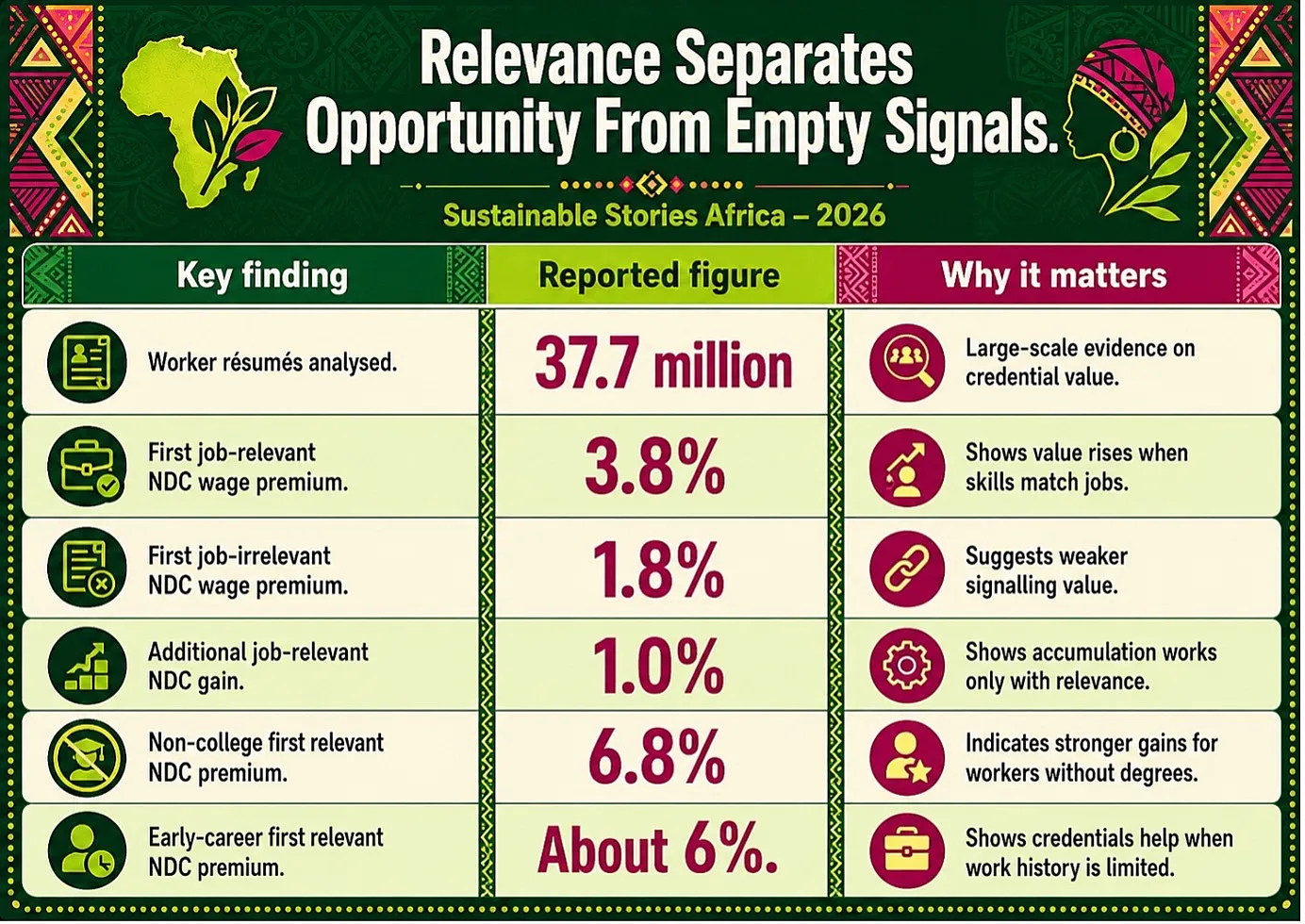
A December 2025 working paper, The Market Value of Non-Degree Credentials, by Eduardo Levy Yeyati, Ian Seyal and Sophia Henn, uses 37.7 million U.S. worker résumés to examine whether these credentials translate into higher wages.
The study finds that workers’ first job-relevant credential is associated with a 3.8% wage premium, more than double the 1.8% premium for a first job-irrelevant credential.
For African and emerging markets, the findings are timely. As economies face youth unemployment, rapid digitalisation, AI disruption and pressure to build green and technical skills, shorter credentials are increasingly being promoted as faster pathways into work.
The evidence suggests they can help; however, only if quality, relevance and labour-market trust are built into the system.
Relevance Separates Opportunity From Empty Signals
The report's central insight is clear: the value of non-degree credentials depends entirely on their relevance to actual jobs.
Research finds that each additional job-relevant credential is associated with a 1.0% wage increase. Credentials misaligned with a worker's occupation deliver no measurable earnings benefit and may even become a labour market liability.
This distinction carries growing urgency as workers navigate an expanding credential economy, from coding bootcamps and project management certificates to sustainability badges, data analytics microcredentials, and renewable energy training.
For young professionals in Lagos, Nairobi, Accra, or Johannesburg, the question is no longer simply whether to obtain a certificate, but whether it is recognised, job-linked, and credible enough to influence employer decisions.
To address the fragmentation in this space, the study standardised 54.3 million credential names from résumé data into a common taxonomy, exposing the uneven quality and unclear signalling that continues to challenge workers and employers alike.
Workers Without Degrees Gain The Most
The strongest wage returns from non-degree credentials accrue to those who need alternative pathways most.
Workers without a bachelor's degree see a 6.8% wage premium from their first job-relevant credential, nearly double the return for comparable college graduates.
Early-career workers gain approximately 6% higher wages with a first relevant credential, and an additional credential is linked to over 2% more per qualification.
For Africa's labour markets, where university access remains uneven, informal employment is widespread, and skills mismatch is a persistent employer concern, credible non-degree credentials could meaningfully widen opportunity.
The potential is especially visible in digital services, renewable energy, logistics, technical maintenance, health support, creative industries, and sustainability reporting, sectors where practical competence often matters more than academic tenure.
However, the research highlights a paradox: non-degree credentials are more prevalent among holders of formal degrees, even though workers without degrees benefit most.
Barriers, including cost, poor information, and limited employer sponsorship, restrict access for those who stand to gain the most.
Without deliberate policy intervention, the credential economy risks entrenching inequality rather than dismantling it.
Not All Credentials Work The Same
The research reveals that different credential types operate through distinct labour market mechanisms, with important implications for how training systems are designed.
Certifications function primarily as human capital investments, built on third-party validation, examinations, and renewal requirements. They signal verified competence in a defined area and deliver stronger returns when job-relevant and accumulated to deepen occupational skills.
Badges and certificates, by contrast, appear to operate as signalling tools: the first credential signals proactivity and trainability; however, additional badges yield diminishing returns regardless of job relevance.
Microcredentials may approximate certifications when modular and tightly aligned to job requirements, though the evidence remains limited given their relative novelty.
For African labour markets, this distinction is critical.
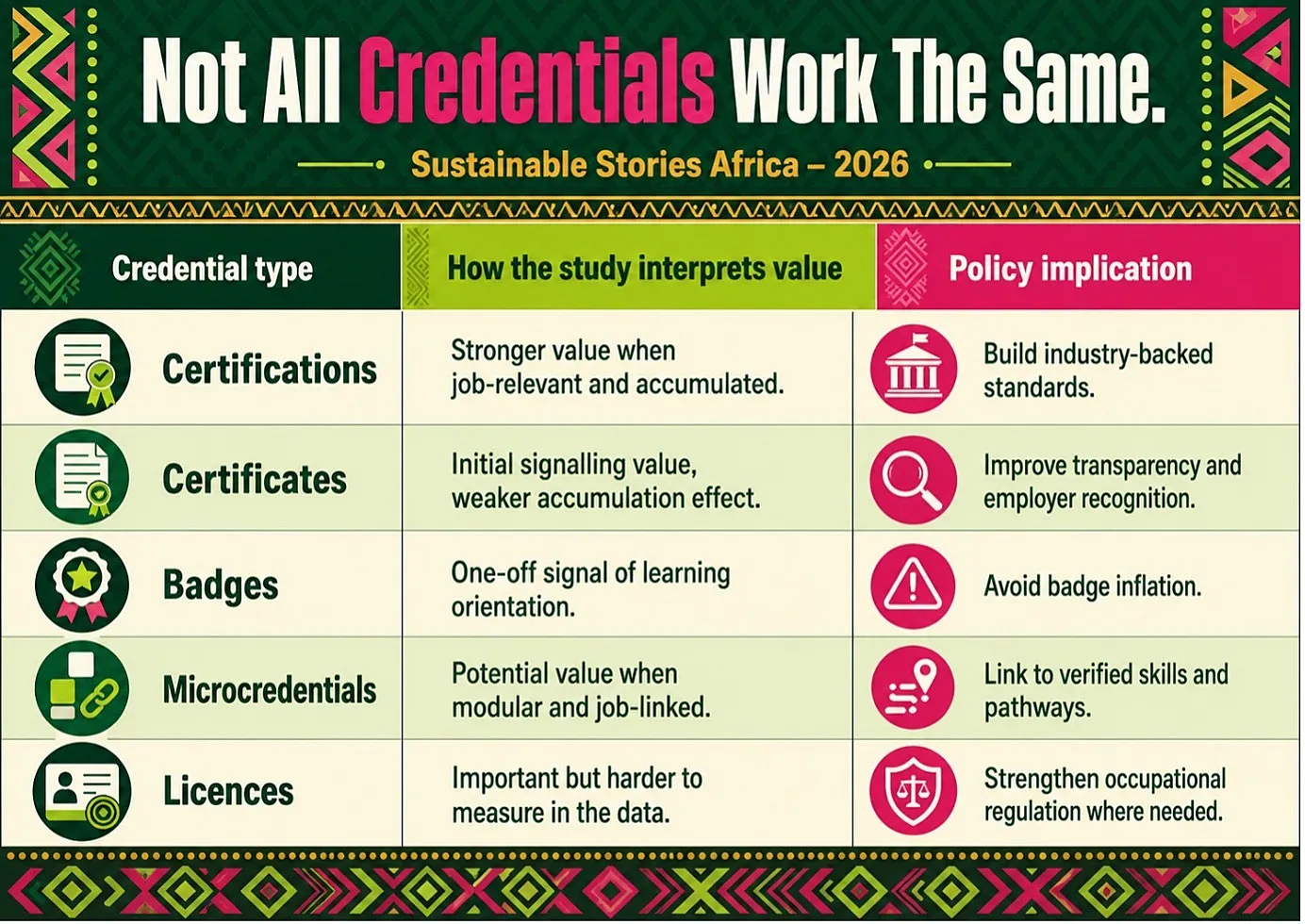
A renewable energy safety certification, a data analytics microcredential, a digital badge, and a professional licence do not carry equal weight with employers.
Policymakers, regulators, and training funders must recognise and communicate these differences to build credible, effective skills ecosystems.
Better Credential Markets Can Expand Inclusion
Well-designed non-degree credentials hold a genuine promise of development, offering workers a faster, more affordable route into better jobs, particularly where traditional degree pathways remain costly or inaccessible.
For governments, they provide a tool to align skills policy with industrial strategy; for employers, they reduce hiring uncertainty and support internal mobility. This relevance intensifies as artificial intelligence reshapes job tasks and green transition policies redraw labour demand.
Emerging roles in solar installation, battery maintenance, carbon accounting, cybersecurity, and climate-risk reporting require specific competencies that do not always necessitate a full degree.
If properly governed, credentials can strengthen workforce inclusion, support decent work, improve productivity, and help women, young people, and non-degree workers access portable proof of skill.
However, the risks are equally real. Without quality assurance and transparent market information, credential expansion could expose workers to low-value or exploitative programmes.
The research also cautions against shifting training responsibilities too far from employers, recognising that workplace learning remains essential for durable skill development.
Governance Must Match The Skills Promise
The core policy lesson is not to promote more credentials, but to build better credential markets.
- Governments and regulators must establish transparent registries detailing which credentials exist, who issues them, what skills they verify, and what employment outcomes they produce.
- Labour ministries, education agencies, and private sector bodies should collaborate to define quality standards, particularly in technology, clean energy, healthcare, logistics, agriculture, and sustainability services.
- Employers must also move beyond vague credential preferences toward clearer skills-based hiring, ensuring job descriptions reflect why specific credentials matter and avoiding the passive reward of irrelevant credential stacking.
- Development finance institutions and workforce funds should prioritise credentials with measurable employment and wage outcomes, not just enrolment figures.
For training providers, the standard is still sharper: relevance must be embedded in the design.
Programmes should be built with employers, anchored on occupational standards, rigorous assessments, and updated as technologies evolve.
A credential that does not map to real work ultimately becomes another financial burden on workers already navigating uncertain labour markets.
Path Forward – Make Skills Visible, Trusted, and Useful
Non-degree credentials can widen opportunity when they are job-relevant, affordable and trusted.
The priority is not credential proliferation for its own sake, but clear evidence on which credentials improve wages, mobility and productivity.
For African markets, the path forward is to connect credentials to industrial policy, employer demand and worker protection.
Well done, they can support inclusive growth, youth employment and a fairer transition into the future of work.