Africa's poverty challenge is often framed as dependent on aid, transfers, and subsidies. However, evidence is increasingly pointing to one solution that outperforms all others: JOBS.
Employment does more than raise incomes. It builds dignity, resilience, productivity, and long-term growth, especially when jobs are stable and formal.
As governments rethink development strategies, job creation is emerging not as a social add-on, but as the central economic imperative.
Jobs, Not Transfers, Change Lives
Jobs remain the single most powerful pathway out of poverty. While social protection cushions hardship, sustained employment fundamentally alters household income, resilience, and opportunities.
Data from developing economies confirms that labour income remains the most powerful driver of poverty reduction over time. This far outweighs the impact of cash transfers or remittances.
Nowhere is the urgency greater than in Africa, where the working-age population is expanding at an unprecedented pace. Each year, millions enter labour markets that struggle to absorb them productively.
The result is persistent informality, underemployment, and vulnerability, conditions that keep poverty entrenched despite growth.
The Employment Gap Holding Growth Back
Africa's labour challenge is not a shortage of effort, but a shortage of productive jobs. Most workers are employed, yet predominantly in low-paying, informal activities with little security or growth potential.
Women and young people are disproportionately affected, facing higher unemployment or concentration in subsistence roles.
Productivity gaps between formal and informal sectors remain wide. Small firms dominate employment; however, they lack access to finance, skills, infrastructure, and markets needed to scale.
At the same time, manufacturing and tradable services, which historically absorb large labour forces, have underperformed.
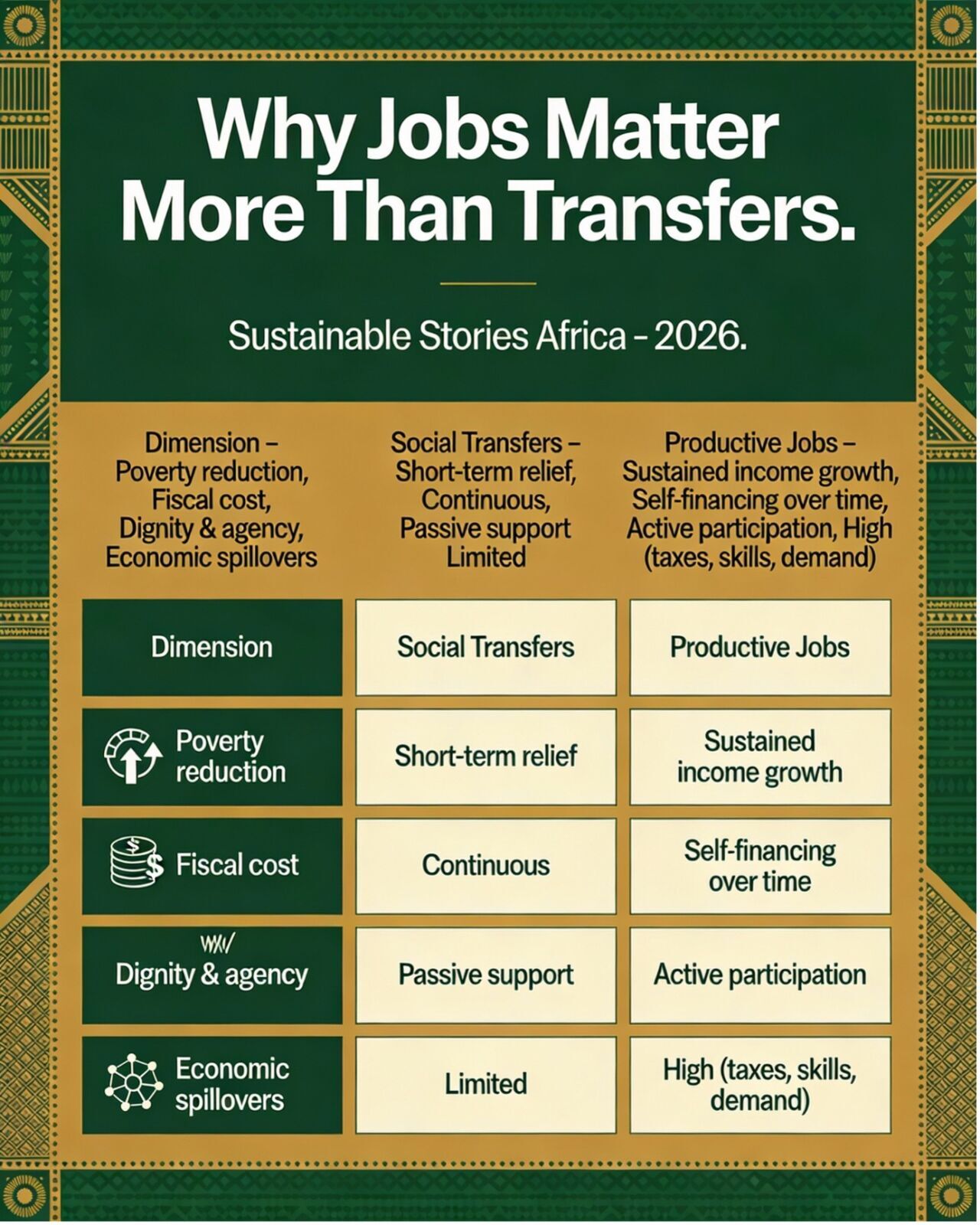
Why Jobs Matter More Than Transfers
| Dimension | Social Transfers | Productive Jobs |
|---|---|---|
| Poverty reduction | Short-term relief | Sustained income growth |
| Fiscal cost | Continuous | Self-financing over time |
| Dignity & agency | Passive support | Active participation |
| Economic spillovers | Limited | High (taxes, skills, demand) |
What Quality Jobs Unlock
When jobs are productive, the gains compound. Workers earn more, households invest in education and health, and firms innovate.
Governments benefit from broader tax bases and reduced dependency on subsidies. Economies diversify away from volatility-prone sectors toward manufacturing, agribusiness, construction, and modern services.
Crucially, jobs accelerate inclusion. Women's labour force participation rises with access to childcare, transport, and formal employment.
Youth employment reduces social instability while anchoring future productivity. Poverty declines more rapidly in regions integrated into labour-intensive value chains than in extractive-dependent economies.
Job-Rich Sectors With High Poverty Impact
| Sector | Employment Potential | Poverty Impact |
|---|---|---|
| Agribusiness & food systems | Very high | Rural income uplift |
| Manufacturing & light industry | High | Formal wage growth |
| Construction & infrastructure | High | Rapid job absorption |
| Services (logistics, ICT-enabled) | Medium–High | Youth employment |

Policies That Turn Growth Into Jobs
Turning growth into employment requires deliberate choices. Stable macroeconomic policy, competitive exchange rates, and predictable regulation reduce risk for labour-intensive firms.
Investment in power, transport, and digital infrastructure reduces operating costs. Skills systems must align with market demand, not credentials alone. This is equally critical in supporting small and growing businesses, the largest employers.
Access to finance, streamlined taxation, and formalisation incentives can unlock scale. Trade policies that integrate firms into regional and global value chains expand markets and demand for labour.
Jobs do not emerge automatically. They are the outcome of coordinated industrial, financial, and social policies, which are designed with employment as a primary metric of success.
PATH FORWARD – Making Jobs the Development North Star
Africa's development strategy is increasingly converging on a clear insight: poverty falls fastest when people work productively. The priority is shifting from fragmented interventions toward job-centred growth models.
Governments, investors, and development partners are aligning around sectors and reforms that maximise employment, productivity, and inclusion, thereby placing jobs firmly at the heart of prosperity.