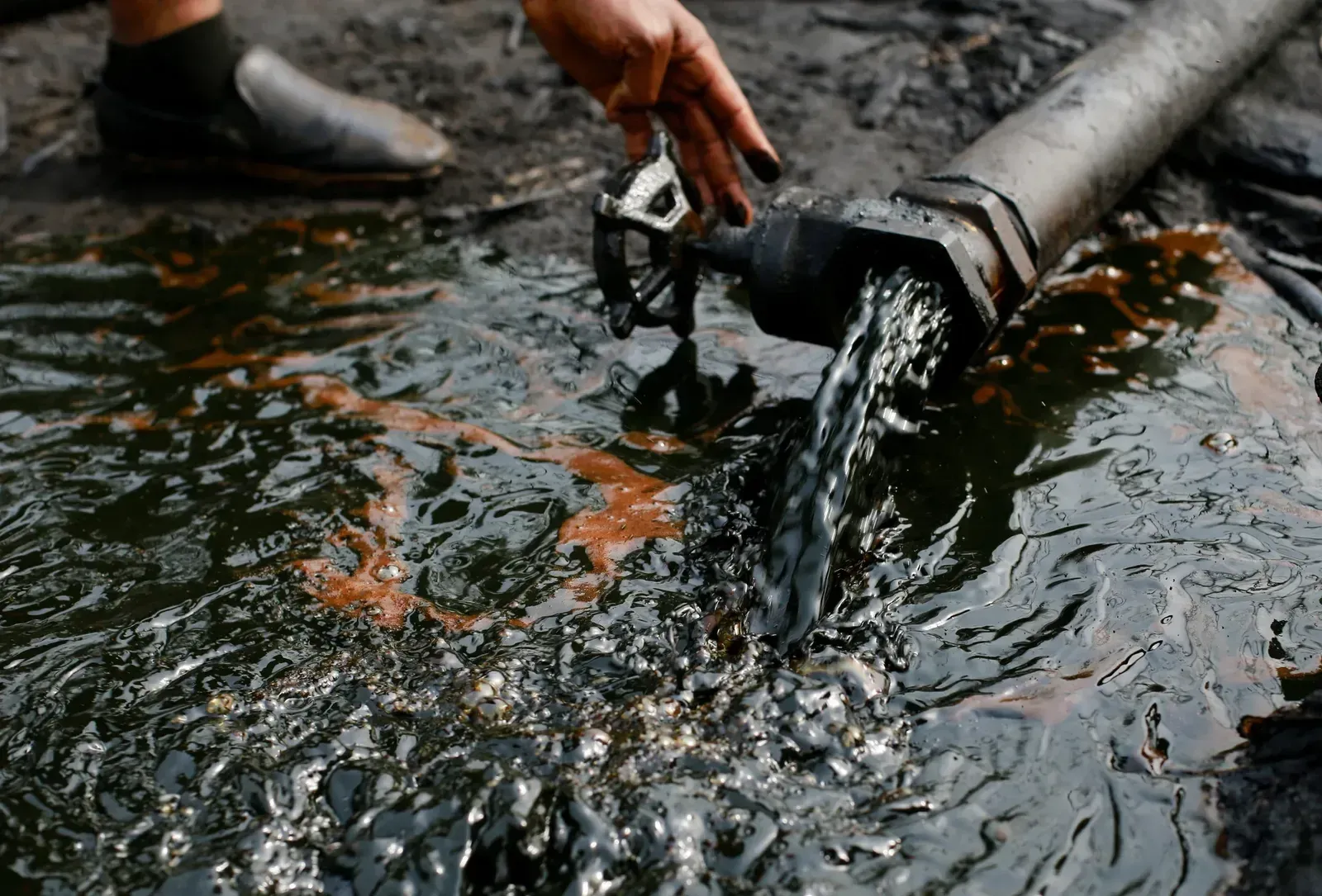
Nigeria reduced recorded crude losses from 37.6 million barrels in 2021 to about two million by July 2025, yet production remains well below its historic peak.
The country is simultaneously transferring assets to indigenous operators, expanding gas infrastructure and building more than one million barrels per day of theoretical refining capacity.
Its next test is to turn ownership and infrastructure into reliable output, affordable energy and responsible growth.
Nigeria’s Oil Recovery Has Two Speeds
Nigeria has regained control of more crude moving through its pipelines, but it has not regained its former production strength.
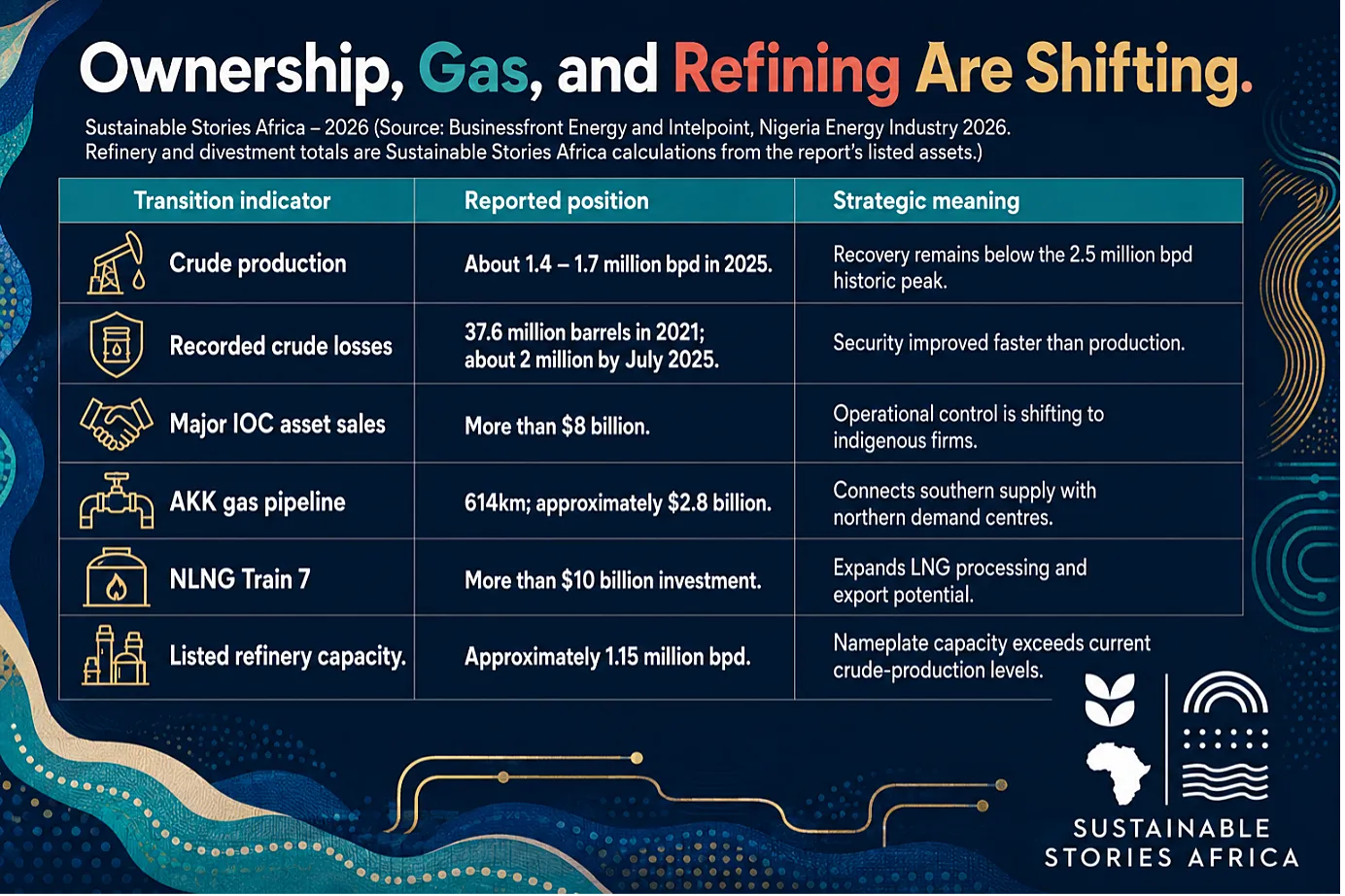
Output recovered to roughly 1.4 – 1.7 million barrels per day by 2025 after falling near 1.1 million in 2022; however, it remains far below the mid-2000s peak of about 2.5 million barrels per day.
That contradiction anchors Section 1 of Nigeria Energy Industry 2026, published by Businessfront Energy in partnership with Intelpoint.
The section examines upstream production and security, international oil company divestments, midstream gas infrastructure, refining capacity and deregulated petroleum-product pricing.
Together, the figures describe a sector moving through consolidation rather than full expansion.
Security has improved, private ownership is deepening and processing capacity is rising.
However, ageing assets, financing constraints, environmental liabilities, delayed infrastructure and volatile prices continue to separate installed potential from dependable energy supply.
Theft Fell Faster Than Production Rose
Recorded crude losses fell sharply from 37.6 million barrels in 2021 to 4.3 million in 2023 and roughly two million by July 2025, a reduction of about 95% from peak levels.
Expanded surveillance contracts, military operations, host-community participation and monitoring on trunk lines such as the Trans-Niger Pipeline appear to have made theft and vandalism harder.
The Petroleum Industry Act introduced host-community development funds and tighter production reporting, as well as the Nigerian Upstream Petroleum Regulatory Commission, which improved reconciliation and approvals, and meaningful governance gains in a sector where lost barrels once damaged public revenue and operator confidence.
However, production has responded only partially. The report places 2025 output at 1.5 – 1.7 million barrels per day, comparable to 2015 – 2019 levels but well below the historical peak of over 2.5 million bpd.
Lower theft protects existing production; it doesn't automatically repair ageing infrastructure or reverse years of deferred investment.
This distinction matters for public finance: with oil central to export earnings, sustained production gaps constrain foreign-exchange supply, meaning recovery now hinges on capital, technical execution and stable regulation.
Ownership, Gas, and Refining Are Shifting
The ownership map has changed almost as dramatically as the security picture.
Six large transactions identified in the report exceed $8 billion:
- Shell’s $2.4 billion sale to Renaissance Africa Energy
- ConocoPhillips’ $1.5 billion assets acquired by Oando
- ExxonMobil’s $1.28 billion transfer to Seplat
- Equinor’s $1.2 billion
- TotalEnergies’ $860 million sales to Chappal Energies
- Eni’s $780 million transaction with Oando.
The transfers advance local content and create Nigerian-controlled upstream champions, moving mature fields, community relationships, decommissioning obligations and environmental risks onto companies whose financing depth and operating capacity will now be tested.
Ownership is opportunity; production performance and credible remediation determine value.
- Midstream gas marks a second transition. The 614-kilometre, $2.8 billion Ajaokuta–Kaduna–Kano pipeline aims to connect southern supply with northern industrial demand.
- ANOH and AHL facilities could add over 500 million standard cubic feet per day, part of a combined potential of 1.4 billion.
Existing corridors are expanding too:
- The Escravos–Lagos system doubled capacity to 2.2 billion scf/day
- The Obiafu–Obrikom–Oben targets two billion scf/day
- NLNG Train 7 represents over $10 billion in investment.
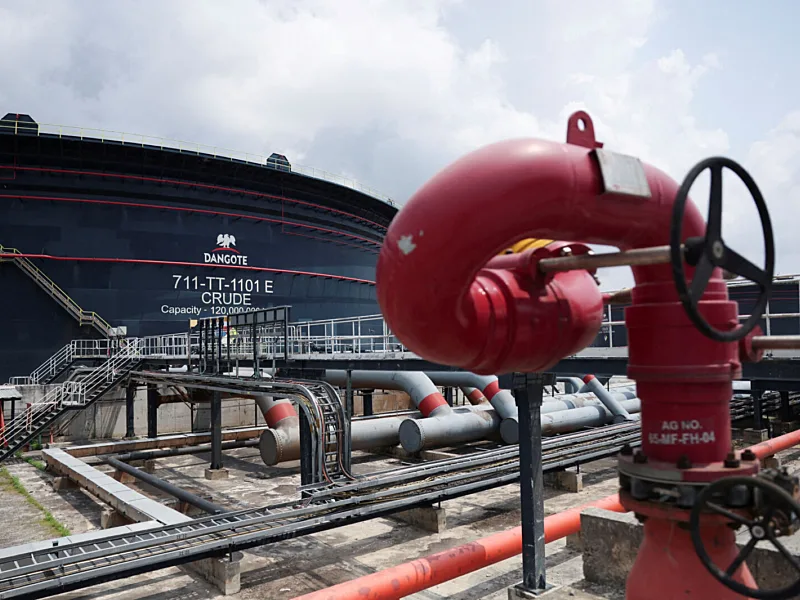
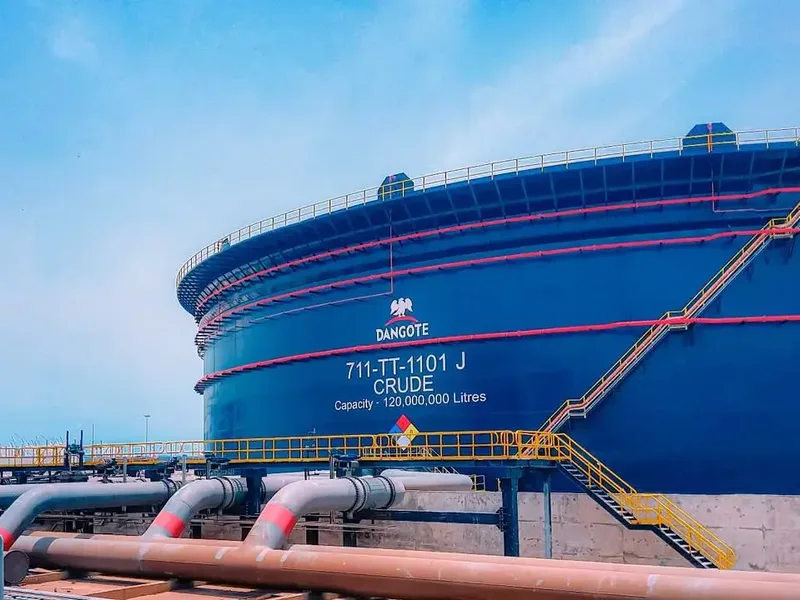
Downstream, Dangote's 650,000-bpd refinery dominates Nigeria's roughly 1.15 million bpd refining base, alongside Port Harcourt, Warri, Kaduna and modular units.
However, nameplate capacity isn't utilisation; state refineries' history of poor maintenance and weak governance means domestic crude supply, operating discipline and transparent pricing will decide whether capacity actually cuts imports.
A Domestic Energy Value Chain Emerges
If these pieces work together, Nigeria can retain more value from each barrel and molecule. Higher upstream output would support fiscal and foreign-exchange earnings, gas infrastructure could supply electricity to industrial users, and reliable refining could reduce product imports while deepening petrochemicals and creating logistics jobs.
The regional benefit could be significant: a consistently operated refining base above domestic requirements could serve West and Central African markets, while northern gas corridors widen Nigeria's industrial geography, and indigenous operators could build capacity to compete across Africa.
However, social outcomes depend on prices and environmental performance.
Following subsidy removal and exchange-rate liberalisation, 2025 averages show
- Petrol at N835.90 per litre
- Diesel at ₦2,597
- Kerosene above N1,100
- LPG around N1,550 per kilogram.
Fiscal reform reduced subsidy burdens, but households absorbed rapid cost adjustments before domestic refining stabilised.
Gas also demands transition discipline. Replacing diesel can lower local pollution; however, methane leakage and flaring erode climate gains, meaning emissions measurement and community engagement must be operational requirements, rather than peripheral ESG reporting.
Convert Capacity Into Reliable Market Supply
- The government should make production accounting transparent, sustain pipeline security and publish field-level restoration progress without weakening community protections.
- Regulatory approvals must be predictable, but asset transfers should remain conditional on financial capacity, technical competence, decommissioning plans and environmental liability provisions.
- Indigenous operators need to convert acquisitions into disciplined capital programmes: integrity testing, brownfield optimisation, emissions control and reliable contractor payment. Lenders should stress-test projects against production decline, oil price volatility, naira depreciation, community disruption and remediation costs rather than finance acquisitions on reserves alone.
In the midstream section;
- Midstream delivery requires bankable gas-supply and offtake agreements.
- Power plants and manufacturers must be able to pay for gas; producers need confidence that pipelines will be available and secure.
- Project milestones, actual throughput and flare-reduction results should be disclosed alongside construction announcements.
Downstream policy should prioritise;
- Competition, product quality and transparent pricing.
- Crude allocation cannot become an opaque subsidy, and refinery scale should not create private market dominance.
Targeted social protection and efficient public transport are more tools for sustainable affordability than restoring broad fuel subsidies.
Path Forward – Production, Trust, and Transition Discipline
Nigeria’s oil and gas recovery now depends less on new promises than on operating what it owns.
Priorities are sustained pipeline security, capital for mature fields, completed gas corridors, transparent crude supply and refineries that convert nameplate capacity into dependable products.
Success must also be responsible. Indigenous ownership should strengthen local capability while honouring environmental liabilities, community rights and methane commitments.
If the production, governance and transition disciplines advance together, consolidation can become durable energy and economic value.