Nigeria has drawn a decisive financial line in the sand: growth must now serve climate resilience, social equity, and national economic renewal at the same time.
Its Sustainable Bond Framework marks a historic shift from policy talk to capital deployment.
If successfully executed, this framework will not only finance solar power, climate adaptation, blue economy projects, resilient infrastructure, and social inclusion, it could also reset Africa's sovereign sustainability financing narrative.
Financing Growth Without Sacrificing Nigeria's Future
Nigeria has published one of the continent's most ambitious sustainable financing blueprints. More than a green-themed financial instrument, the Sustainable Bond Framework is a structural financing commitment that turns climate transition, social protection, energy reform, infrastructure resilience, and environmental stewardship into bankable public investment priorities.
Rooted in the National Development Plan (2021–2025) and Agenda 2050, the framework links borrowing discipline with measurable climate and social outcomes: renewable energy penetration, resilient cities, cleaner production, waste management, marine ecosystem protection, sustainable agriculture, coastal adaptation, affordable housing, inclusive infrastructure, and livelihood support. It aligns directly with Nigeria's NDC, Climate Change Act (2021) and international standards, including ICMA Green, Social, and Sustainability Bond guidelines.
However, the framework is more than eligibility lists and policy rhetoric. It defines institutional responsibility, impact reporting, governance integrity, exclusion rules, and accountability triggers.
In an era of global investor scrutiny, debt stress, climate pressure, and public trust fatigue, Nigeria is effectively saying: capital must now prove it works for people, climate, and prosperity simultaneously.
Nigeria Turns Debt Into Development Discipline
Nigeria's Sustainable Bond Framework represents a turning point, using sovereign borrowing not as a fiscal stopgap but as a disciplined engine for climate resilience, green growth, social protection, and infrastructure transformation.
It allows the Federal Government to issue Green Bonds, Blue Bonds, Social Bonds, and Sustainability Bonds to finance clearly defined eligible projects.
These include:
- Renewable energy (solar, mini-grids, EV-ready systems)
- Sustainable agriculture & nature-based climate solutions
- Forest and land conservation
- Waste, wastewater, and circular economy solutions
- Climate adaptation and coastal protection
- Marine ecosystem and blue economy investments
- Clean transport and energy transition
- Affordable housing and resilient urban infrastructure
- Social protection, health, jobs, SME finance, and human capital investments
This is sovereign climate and social finance, with enforcement logic, structure, and measurable national purpose.
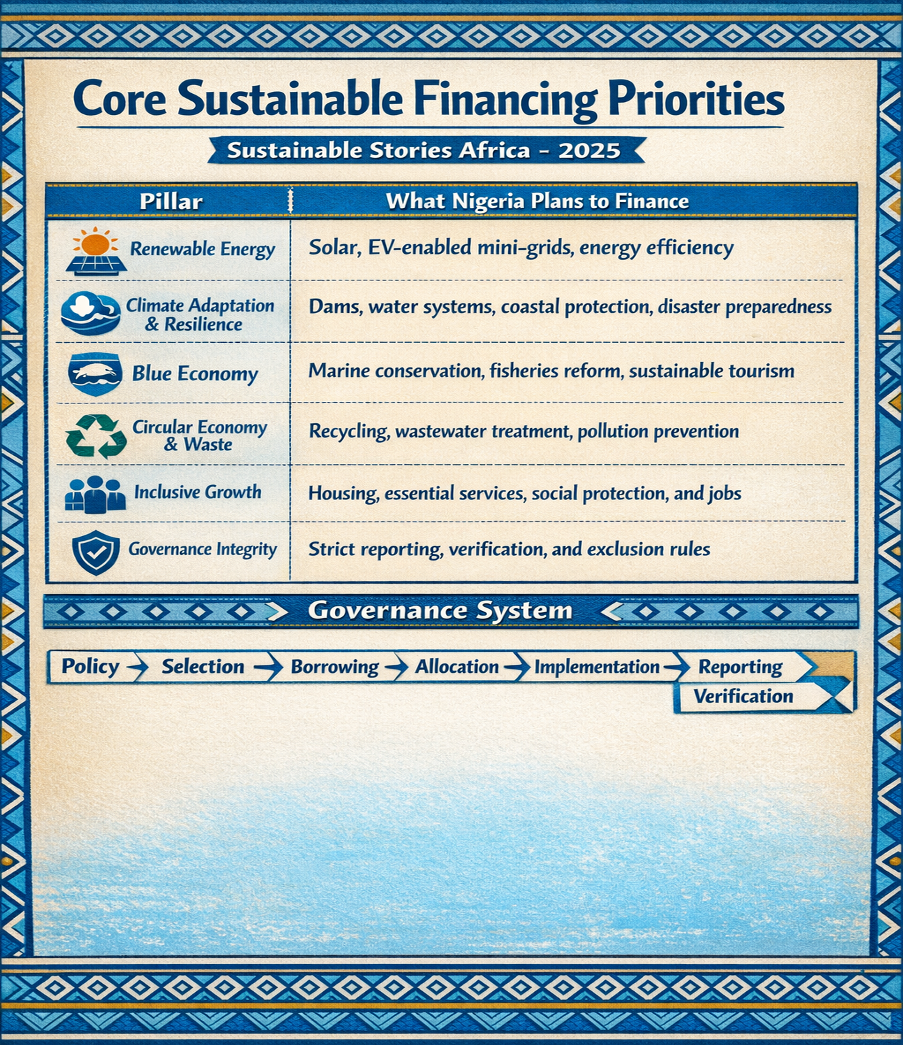
Core Sustainable Financing Priorities
| Pillar | What Nigeria Plans to Finance |
|---|---|
| Renewable Energy | Solar, EV-enabled mini-grids, energy efficiency |
| Climate Adaptation & Resilience | Dams, water systems, coastal protection, disaster preparedness |
| Blue Economy | Marine conservation, fisheries reform, and sustainable tourism |
| Circular Economy & Waste | Recycling, wastewater treatment, pollution prevention |
| Inclusive Growth | Housing, essential services, social protection, and jobs |
| Governance Integrity | Strict reporting, verification, and exclusion rules |
Projects must prove:
- Economic value
- Climate or social benefits
- National alignment
- GHG reduction or resilience impact
- Data availability for reporting
Critically, the framework complies with ICMA standards, recognises Climate Bonds Initiative alignment, and mandates external verification, independent assurance, and transparency, which signals to investors that Nigeria understands reputational risk and credibility requirements.
- FMEnv evaluates
- FMF + DMO structure issuance
- CBN manages proceeds
- MDAs implement
- Quarterly monitoring
- Annual impact + allocation reporting
- Independent verification
This is climate finance with teeth.
If Nigeria Executes This Well, Everything Changes
The benefits are transformative:
- Economic Stability + Climate Discipline – Borrowing tied to measurable outcomes strengthens fiscal credibility.
- Energy Transition Acceleration – Targets include higher renewable penetration and energy access.
- Coastal & Environmental Protection – Nature-based solutions protect lives, infrastructure, and GDP hotspots.
- Jobs & Human Security – Housing, education, MSME support, health, water, and social protection deliver human development dividends.
- Blue Economy Leadership – From marine conservation to sustainable ports and fisheries, Nigeria signals a serious maritime economic strategy.
- Investor Confidence – Clear governance, exclusion rules (no coal, no fossil expansion, no illegal activities, no deforestation) and structured transparency reassure capital markets.
This is how sovereign sustainability moves from rhetoric to national advantage.
What Needs to Happen Now Without Delay
To ensure this framework succeeds:
- Execution Discipline — project selection must remain integrity-based, not politically inflated.
- Capacity Strengthening — MDAs require technical capability for bankable climate projects and credible reporting.
- Private Capital Leverage — Sustainable Bonds must crowd-in investors, not permanently replace them.
- Data Culture — strong monitoring, verified impact, and transparent public reporting sustain trust.
- Sub-National Integration — states must plug into climate finance to avoid geographic inequality.
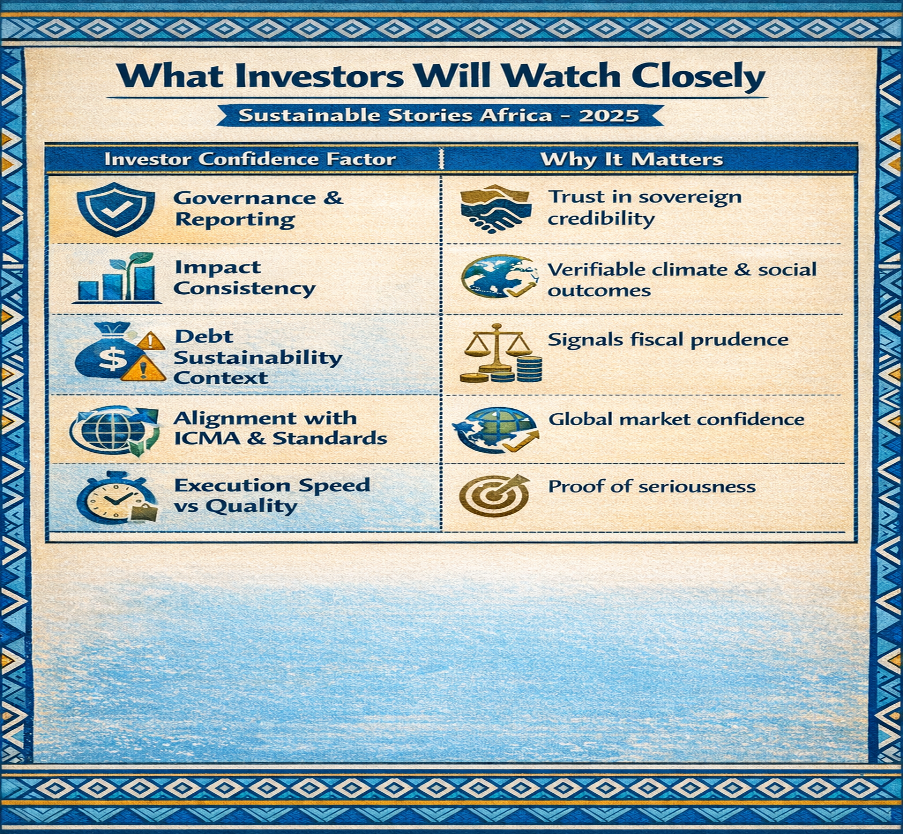
What Investors Will Watch Closely
| Investor Confidence Factor | Why It Matters |
|---|---|
| Governance & Reporting | Trust in sovereign credibility |
| Impact Consistency | Verifiable climate & social outcomes |
| Debt Sustainability Context | Signals fiscal prudence |
| Alignment with ICMA & Standards | Global market confidence |
| Execution Speed vs Quality | Proof of seriousness |
PATH FORWARD – Borrow Better. Build Resilience. Deliver Public Value.
Nigeria's Sustainable Bond Framework is a financing commitment to climate responsibility, inclusive growth, and disciplined sovereign credibility. It institutionalises governance, data accountability, and measurable outcomes while prioritising renewable energy, blue economy protection, resilient infrastructure, social inclusion, and economic empowerment.
The agenda ahead is execution: strong project pipelines, credible reporting, investor transparency, and policy consistency.
If managed rigorously, this framework positions Nigeria not only as an African sustainability leader but as a proof point that sovereign climate finance can reshape real economies.