As an enabler, the Bank of Industry (BOI) acts where markets fall short, bringing concessionary financing to industries that need it the most.
Nigeria's Inclusive-Growth Engine
Nigeria stands at a crucial juncture. With sluggish growth, rising unemployment and structural constraints, the need for inclusive development has never been greater.
Against that backdrop, the Bank of Industry (BOI) is positioning itself as a catalytic force in unlocking access to finance, fostering industrial transformation and bridging Africa's largest economy's long-standing gap in inclusive risk capital.
Between 2023 and 2025 BOI expanded its lending to enterprises across 14 economic sectors, underscoring the breadth of its interventions.
With Nigeria's MSME landscape being characterised by a sizeable financing gap, research indicates that many small and micro-enterprises struggle to obtain credit, limiting their potential to scale or move toward higher value-added industries.
Considering this, BOI's role as a development-finance institution becomes not only critical as a lender, but as an enabler of structural change and inclusive growth.
Financial Flows, Sector Reach & Social Outcomes
Financial Flows & Coverage
BOI reports that its interventions now stretch across 14 sectors of Nigeria's economy.
This is a significant signal of diversification beyond traditional lending corridors, as BOI has been active in sectors such as agro-processing, manufacturing, MSMEs, and downstream value chains.
Social & Economic Outcomes
By stepping in "where markets fall short", BOI's model attempts to address both supply-side gaps (lack of risk capital, high interest rates) and demand-side constraints (capacity of firms, limited collateral).
The social implication of such financing is material, enabling businesses to scale, thereby leading to increased employment, stronger value chains and more balanced regional development.
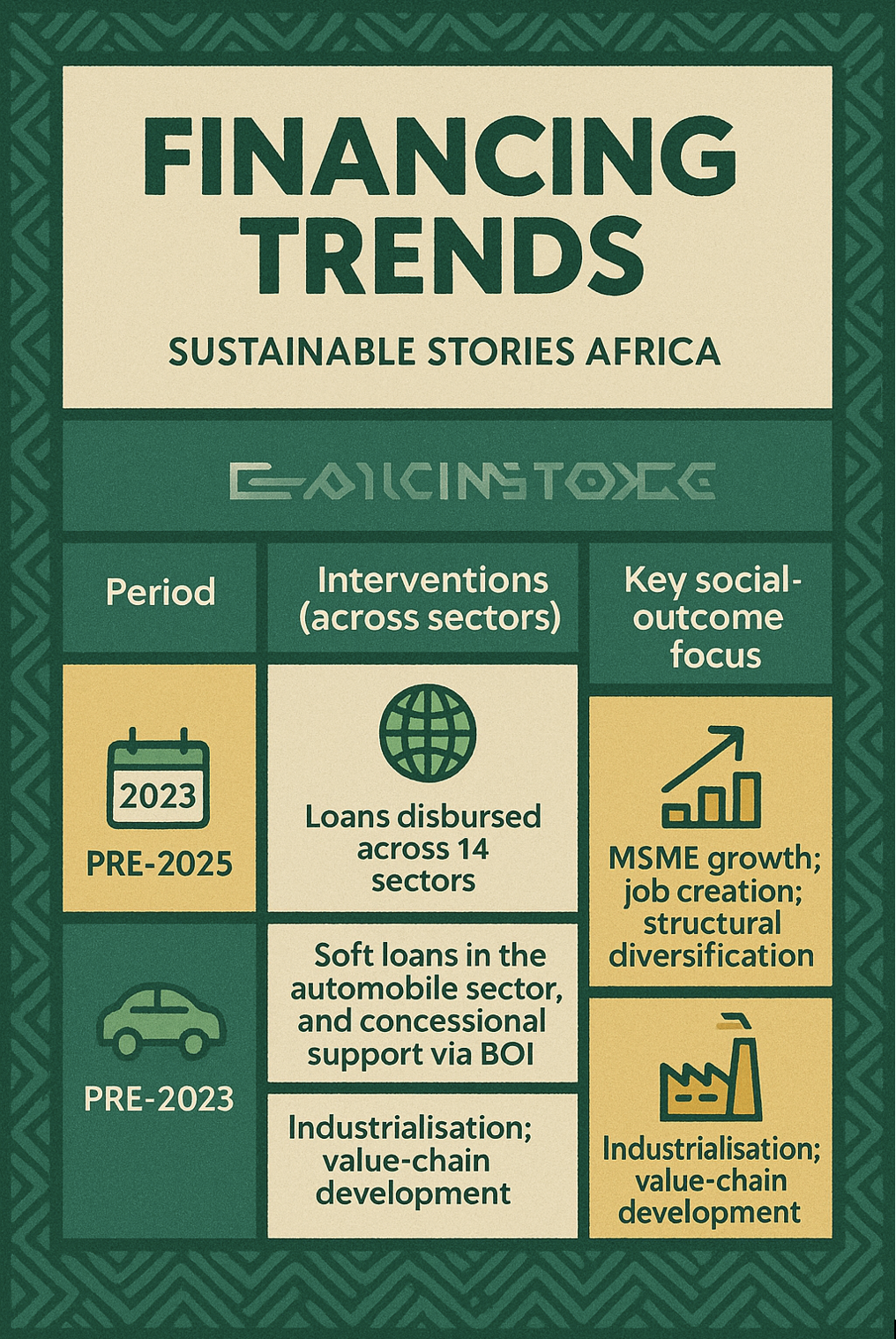
Financing Trends
| Period | Interventions (across sectors) | Key social-outcome focus |
|---|---|---|
| 2023-2025 | Loans disbursed across 14 sectors | MSME growth; job creation; structural diversification |
| Pre-2023 | Soft loans in the automobile sector, and concessional support via BOI | Industrialisation; value-chain development |
Alignment with ESG / SDG Objectives
Their funding model also aligns with Sustainable Development Goal 9 (Industry, Innovation and Infrastructure) and SDG 8 (Decent Work and Economic Growth).
This should result in Nigeria's broader financial-inclusion and industrialisation agenda providing the macro-framework in which BOI operates.
What's Enabling BOI's Expansion?
Institutional Mandate & Strategic Positioning
BOI, as Nigeria's oldest development-finance institution, brings the institutional capability to deploy concessionary financing, work with value-chain players and structure specialised instruments.
Funding Architecture & Partnerships
With BOI acting in the spaces "where markets fall short", it thus implies that the use of concessional, risk-absorbing or developmental instruments rather than purely commercial loans could strengthen more MSMEs to scale their businesses.
Access to such capital allows BOI to operate in sectors or actors that remain underserved by commercial banks.
Policy & Market Context
Nigeria's economy has been under pressure: inflation, FX volatility and structural shifts all weigh on firm performance and lending risk. In this environment, development-finance institutions like BOI assume an outsized role.
Furthermore, the diversification of BOI's sector reach suggests a response to the economy's need for value-chain upgrading, rather than volume lending.
Capacity Building & Ecosystem Engagement
Beyond financing, the implication is that BOI supports linkages, technology uptake, and scale-up potential.
This is crucial in ensuring that funds translate into real impact (jobs, productivity) and not just mere indebtedness.
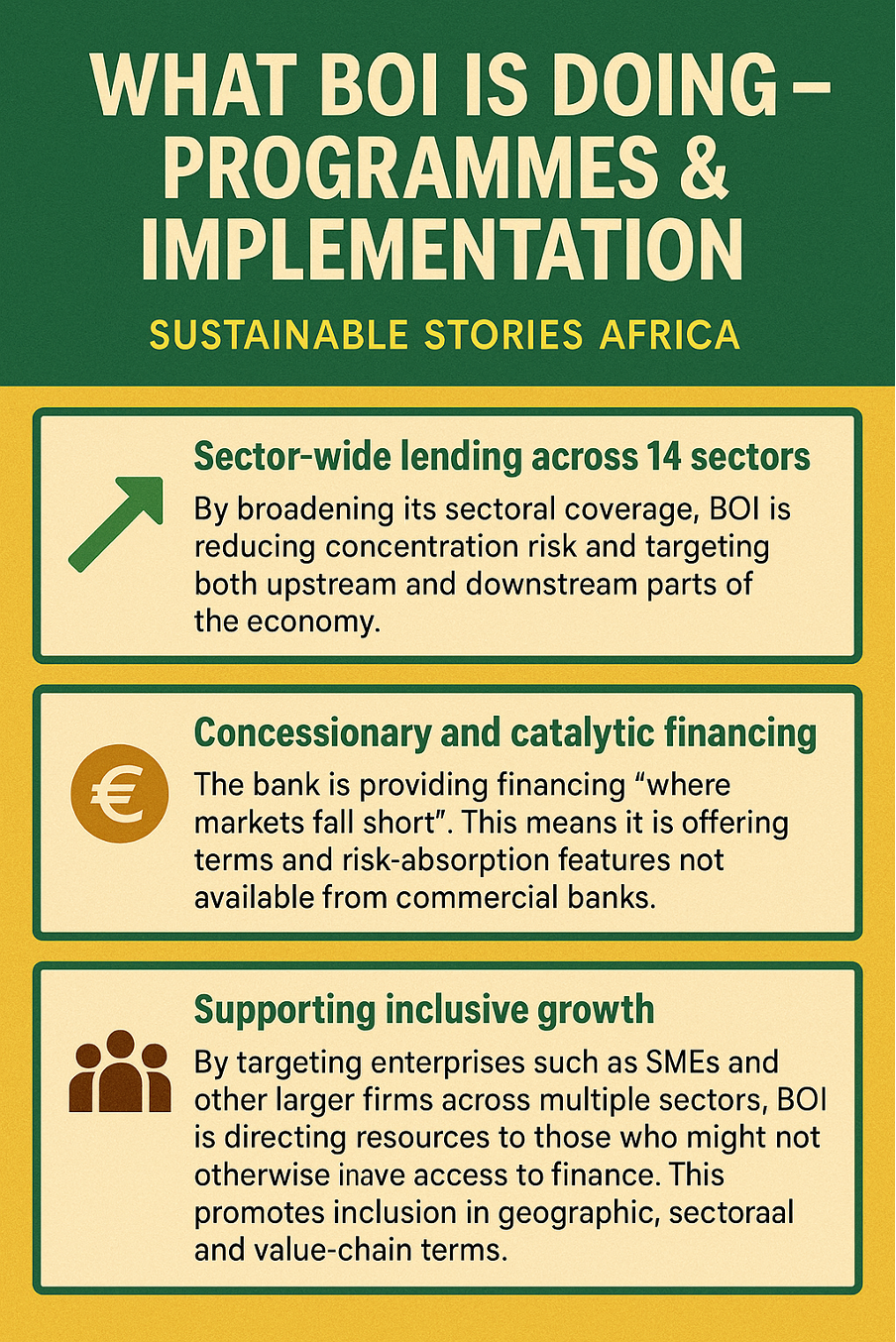
What BOI Is Doing – Programmes & Implementation
BOI's action strategy can be described in three key buckets:
- Sector-wide lending across 14 sectors: By broadening its sectoral coverage, BOI is reducing concentration risk and targeting both upstream and downstream parts of the economy.
- Concessionary and catalytic financing: The bank is providing financing "where markets fall short". This means it is offering terms and risk-absorption features not available from commercial banks.
- Supporting inclusive growth: By targeting enterprises such as SMEs and other larger firms across multiple sectors, BOI is directing resources to those who might not otherwise have access to finance. This promotes inclusion in geographic, sectoral and value-chain terms.
Implementation Challenges and Steps Ahead
- Ensuring that financing is accompanied by support (technical assistance, linkages, capacity building), thereby enhancing the likelihood of productive deployment.
- Robust monitoring and evaluation. These are critical to measuring job creation, value-added growth and resilience of financed firms.
- Macro-economic risks (currency, inflation, interest rates) remain high in Nigeria and may affect firm viability and loan performance.
- Scaling across many sectors increases complexity, such as tracking performance and tailoring interventions, which will be resource intensive.
Path Forward – Broadening Nigeria's Financing Horizon
BOI's evolving mandate reflects a structural realignment within Nigeria's financing ecosystem, signalling a move from segmented, sector-specific lending toward integrated, inclusive industrial financing.
This progression underscores a policy shift: addressing Nigeria's historic financing gaps through systemic instruments that strengthen industrial depth, widen credit access, and reinforce the foundation for sustainable economic transformation.
Can Nigeria balance growth with inclusion through institutions like BOI? As the bank expands lending across 14 sectors and channels catalytic finance to lagging markets, it seeks to drive structural transformation.
Yet, success hinges on policy execution, private-sector participation, and transparency in navigating macroeconomic headwinds that will define Nigeria's long-term industrial resilience, as longer as they can answer these questions.
- Sustainability: Can BOI maintain concessional or risk-absorbing terms without becoming financially unsustainable itself?
- Scale-up and private-sector leverage: Will BOI manage to mobilise private sector capital (e.g., through co-financing, guarantees) to amplify impact?
- Impact measurement and transparency: Will BOI publish clear metrics (jobs created, value-added generated, regional spread) that align with modern ESG/investor norms?
- For investors: An institution like BOI can offer signals about sectors where risk is partially mitigated — useful for private capital looking for development-adjacent opportunities.
- For policymakers: The model underscores the importance of regulatory, capacity and ecosystem support to turn financing into real economy outcomes.
- For firms and SMEs: Access to development-finance pathways opens potential for scale, innovation and linkages — provided implementation hurdles are managed.
Culled From: https://guardian.ng/issue/financing-nigerias-future-how-boi-is-powering-inclusive-growth/