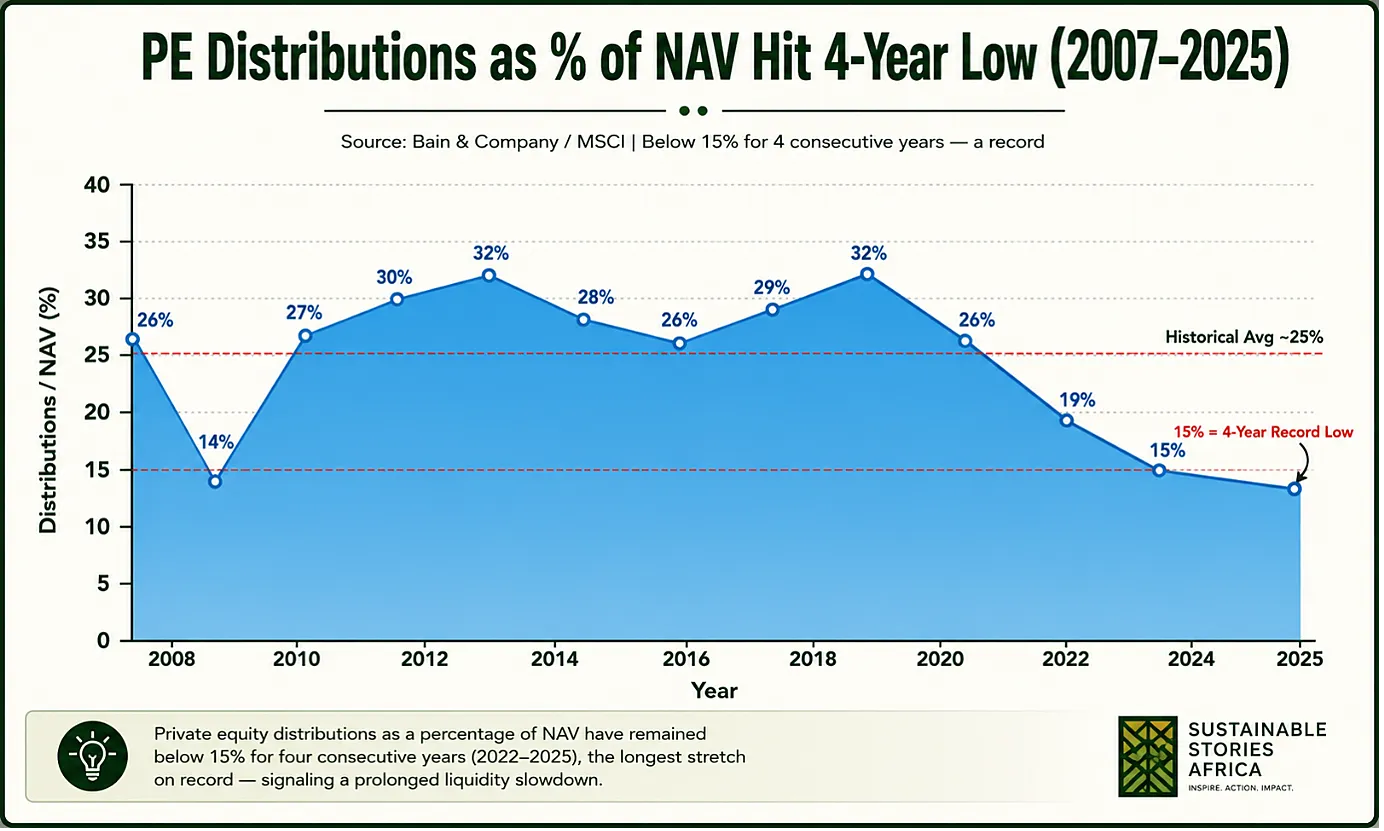
Here is 2025's private equity paradox: exit value surged 47% to $717 billion, the second-best year ever; however, distributions to limited partners remained flat at just 14% of net asset value, below the 15% threshold for a record fourth consecutive year.
The Bain & Company Global Private Equity Report 2026 explains why: 32,000 PE-backed companies holding $3.8 trillion in unrealised value sit unsold, with holding periods drifting toward seven years.
For African LPs and development finance institutions, these are live variables shaping private capital's liquidity right now.
$3.8 Trillion. Seven Years. Still Waiting.
Let us start with the mathematics of distribution. Distributions as a percentage of NAV were 14% in 2025, essentially unchanged from 2024, and the fourth consecutive year below the 15% threshold.
The last time PE was distributed at this rate was 2008 - 2009, during the global financial crisis.
However, today's problem is arguably more structural than that crisis, because in 2008 - 2009, the distribution drought lasted two years. Today it has lasted four years, with no full resolution in sight.
The root cause is visible in the data. The massive cohort of investments made in 2021 and 2022, at peak valuations and aggressive leverage, required exceptional EBITDA growth to generate target returns. Instead, those companies faced a succession of "black swan" events: COVID-19 disruptions, the interest rate shock of 2022 - 2023, and the tariff turbulence of 2025.
With returns below plan, GPs have been reluctant to exit at prices that would crystallise losses or subpar performance. So they hold. And hold. And hold.
The Liquidity Data That Should Alarm Every LP
The Bain 2026 exit analysis draws a direct line from extended holding periods to return deterioration:
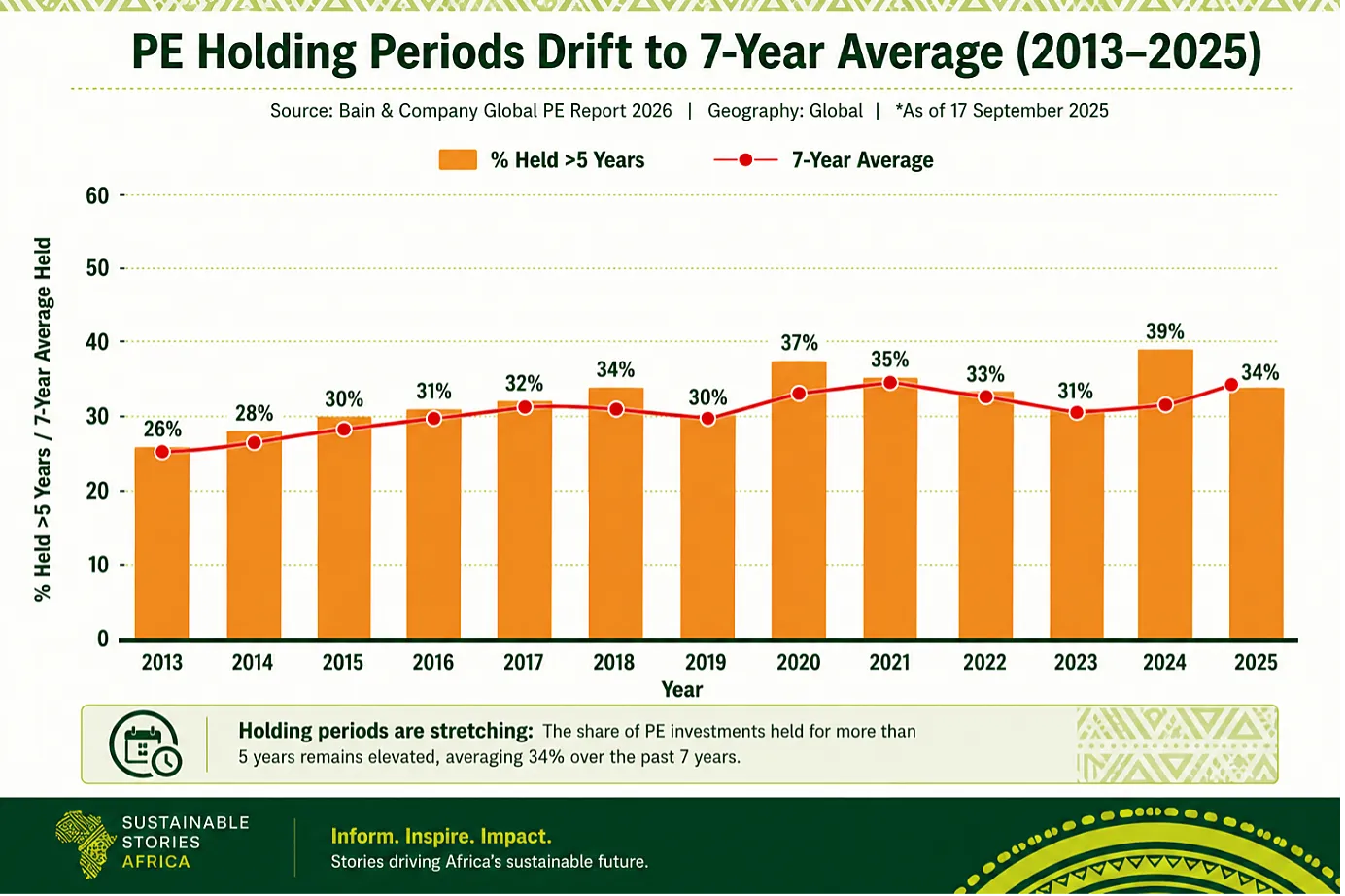
- Average holding period at exit: now approximately 7 years, up from 5 - 6 years in 2010 – 2021.
- 39% of all PE-held companies are now held for more than five years, up from 29% in 2019.
- TVPI (Total Value to Paid-In Capital) begins to flatten after year 8 of a typical fund vintage, meaning extended holds are not generating proportionate value.
- IRR declines even earlier because IRR reflects the time value of money; each additional year of holding without exit erodes it regardless of portfolio company performance.
- 53% of LPs are now constrained from making new PE commitments because prior capital has not yet been returned, up 15 percentage points from year-end 2024.
- Continuation vehicles (CVs) grew 62% year-over-year but still account for less than 10% of total PE exit value, a partial liquidity solution, not a structural fix.
- Distribution-to-paid-in capital (DPI) benchmark underperformance: every vintage from 2017 to 2021 is running behind historical DPI benchmarks.
Exit Channels – What Worked, What Didn't, and What Comes Next
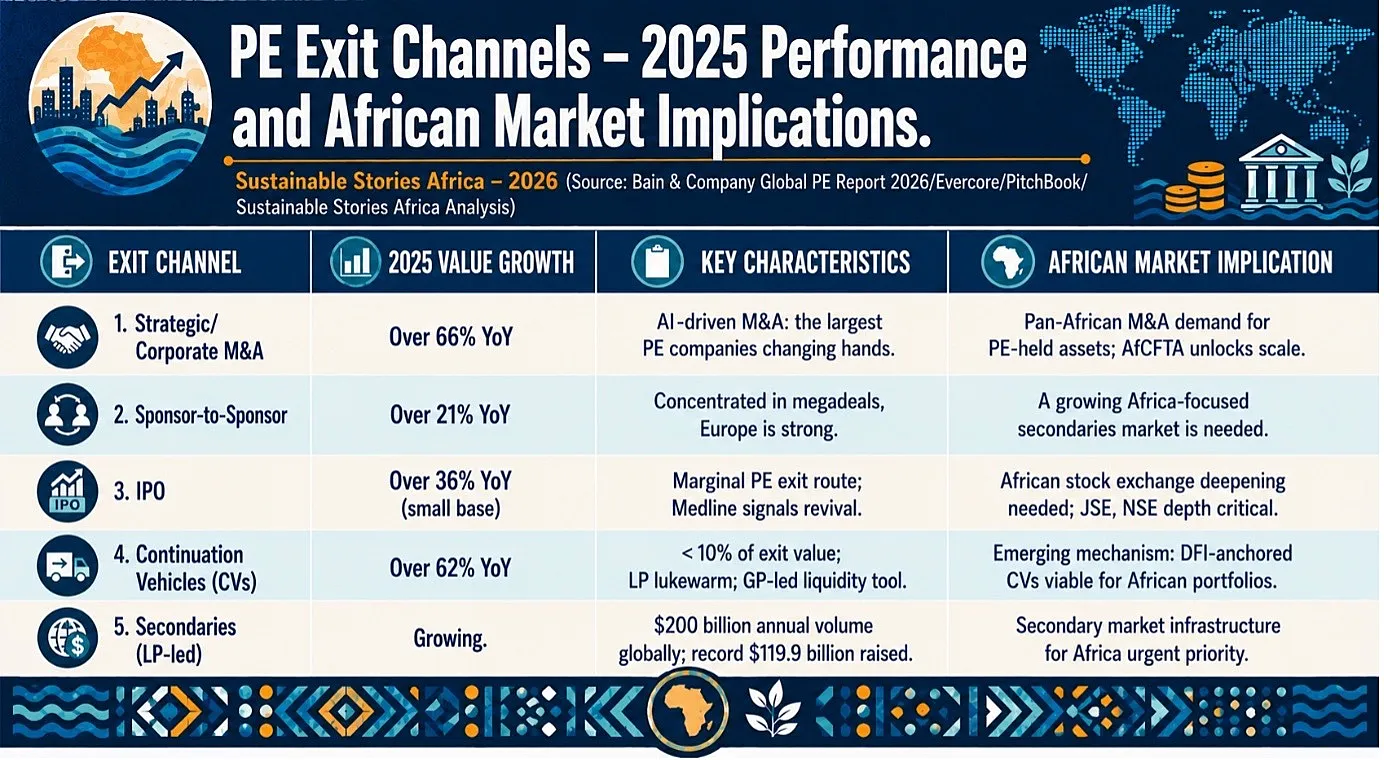
The Bain 2026 report analyses four exit channels in detail, revealing very different dynamics:
Strategic (Corporate M&A) – The Dominant Channel:
- Strategic exits grew 66% year-over-year, the largest and most productive exit channel of 2025. ECP's $29.4 billion sale of Calpine to Constellation Energy and GTCR's $17.6 billion sale of Worldpay to Global Payments dominated activity.
- The boom in corporate M&A, fuelled by AI transformation imperatives and balance-sheet strength among large corporations, is the primary driver of the exit recovery.
Sponsor-to-Sponsor – Concentrated:
- The sponsor-to-sponsor channel grew 21% globally, but much of this was the Aligned Data Centres transaction alone.
- Ex-Aligned, North American sponsor-to-sponsor volume would have declined 19%. European sponsor-to-sponsor activity was strong (over 56% year-on-year), suggesting more breadth in that market.
IPOs – Marginal, But Signalling a Recovery:
- IPOs grew 36% off a small base and remained a minor exit route.
- Only two PE-backed IPOs stood out: Hellman & Friedman's $4.2 billion Verisure offering and the $7.2 billion Medline IPO led by Blackstone, Carlyle, and Hellman & Friedman at year's end.
- The Medline IPO, the largest PE-backed IPO ever, the largest IPO in four years, is seen as a potential signal of a more robust public offering market in 2026.
Continuation Vehicles – Growing, But Not a Panacea:
- GP-led continuation vehicles grew 62% year-over-year and 37% annually since 2022. A quarter of GP survey respondents had launched a CV in the past two years, and 40% planned to explore one in the next 12 - 24 months.
- However, LPs are generally lukewarm on CVs as a liquidity solution, tolerating at most one per year from any GP.
- They remain a palliative, not a cure, for the distribution crisis.
 |  |
Africa's Liquidity Infrastructure Imperative
The Bain 2026 data on exit channels crystallises a defining challenge for African private equity: the continent lacks the liquidity infrastructure that allows PE investments to exit efficiently, predictably, and at value-maximising prices.
The strategic M&A channel, dominant globally, is constrained in Africa by the limited pool of domestic corporate buyers with balance-sheet capacity for large PE-backed acquisitions.
The sponsor-to-sponsor channel is constrained by the minimal pool of Africa-focused GPs capable of absorbing large secondary transactions.
IPOs are available in Johannesburg, Lagos, Nairobi, and Cairo; however, the depth is limited for larger transactions.
Continuation vehicles and secondaries are nascent instruments in African markets.
Building Africa's exit infrastructure is therefore not a luxury; it is the precondition for Africa's PE ecosystem to deliver the DPI performance that global LPs now require.
The three most actionable priorities: deepening African stock markets through regulatory reform and improved listing conditions; developing an active secondaries market for African PE interests, including DFI-facilitated LP-led transactions; and building pan-African M&A advisory and deal-structuring capacity that enables corporate acquirers across the continent to participate in PE exit processes.
From Liquidity Crisis to Liquidity Strategy
Five concrete actions for African PE stakeholders responding to the Bain 2026 exit data:
Build exit strategies into deals from Day 1
- Every African PE investment must have a defined exit pathway:
- M&A, secondary, or IPO route, with specific milestones and timeline, built into the investment thesis from entry.
Develop pan-African M&A platforms
- African development banks, investment banks, and business associations must build the deal-advisory infrastructure that creates a functioning M&A market for PE-backed companies across the continent.
Establish African secondaries liquidity mechanisms
- DFIs, including IFC, AfDB, and CDC/BII, should create African-focused secondary transaction facilities that provide LP-liquidity for Africa-focused funds.
Support the deepening of the African stock market
- Regulatory reform to lower listing costs, improve trading liquidity, and attract more domestic institutional investors to African equity markets will expand the IPO exit route for PE-backed companies.
Educate African LPs on continuation vehicles
- As CVs become a global market standard, African institutional investors, pension funds, and sovereign wealth funds need the governance frameworks and investment literacy to evaluate and participate in these structures.
Path Forward – Liquidity Is the Lifeblood of Private Capital
Africa Must Build the Plumbing
The Bain Global Private Equity Report 2026 documents a global PE liquidity crisis: $3.8 trillion in held value, seven-year average hold periods, and distributions at 15-year lows, driven by over-optimistic 2021 - 2022 valuations and insufficient exit infrastructure.
For Africa, the lesson is preventive: build exit infrastructure, secondary market capacity, and M&A advisory ecosystems now, before its own PE boom hits similar liquidity constraints.
Liquidity isn't a technicality; it's the mechanism that makes private capital work, and Africa must build the plumbing before the pipes are needed.