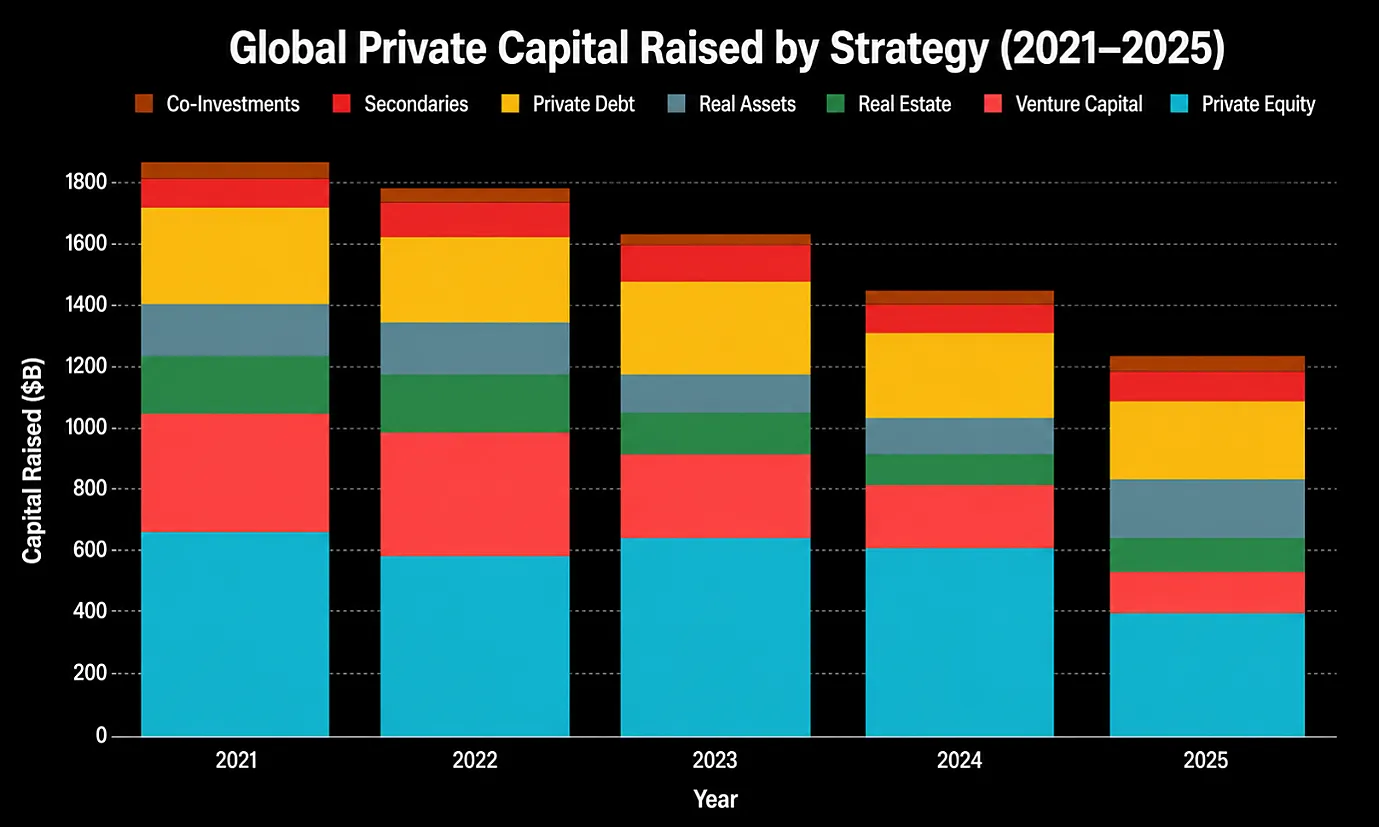
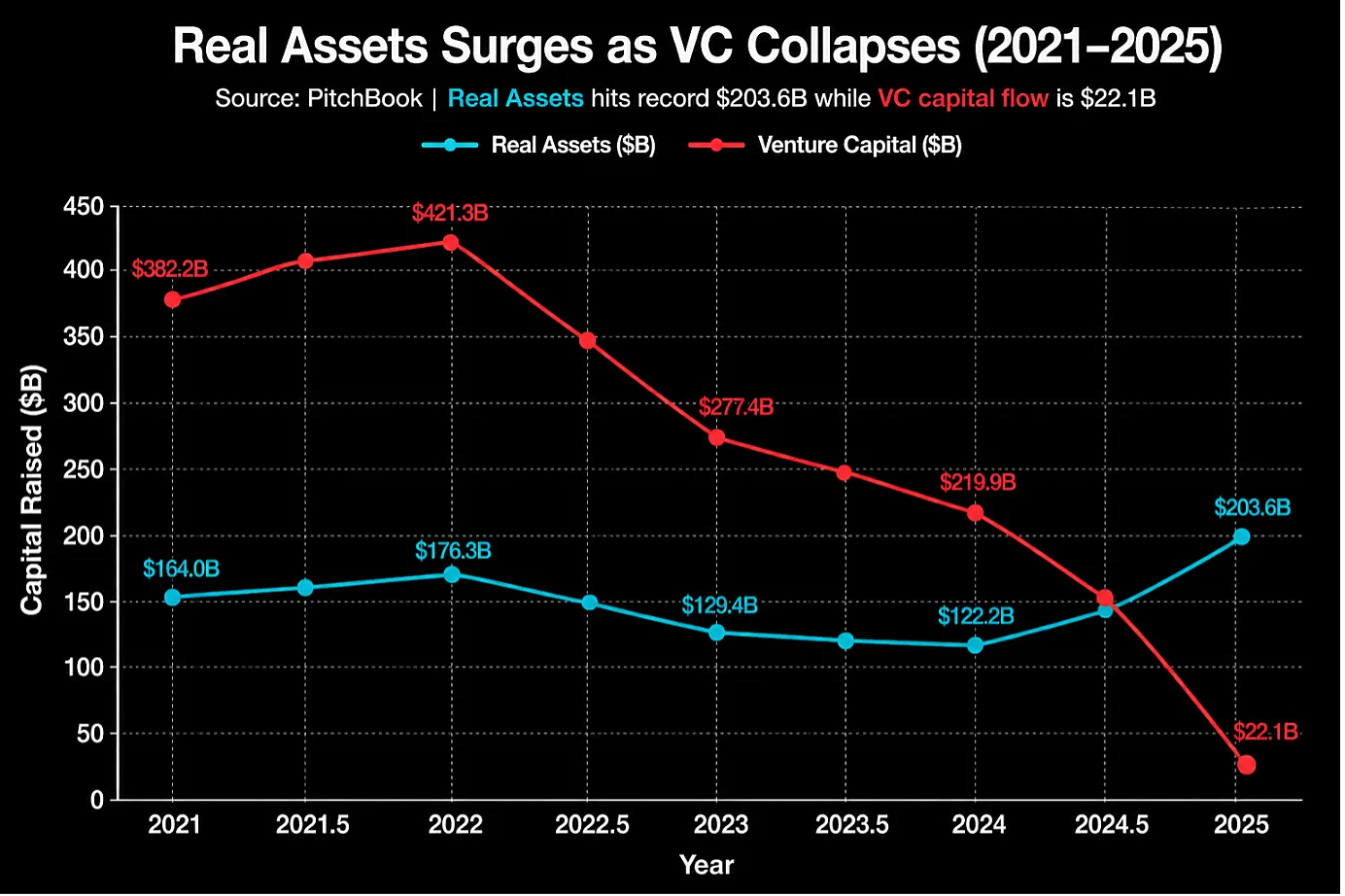
Global private capital fundraising told a story of stark divergence in 2025. While private equity continued its multi-year slide and venture capital hit its lowest total since 2015, infrastructure funds shattered records, secondaries posted back-to-back historic highs, and co-investments quietly crossed into record territory.
The message from the world's capital allocators is clear: when uncertainty dominates, stable income and tangible assets win.
For Africa, a continent hungry for long-term infrastructure investment, seeking deeper private capital markets, and navigating a volatile global fundraising environment, the signals from the PitchBook 2025 Annual Global Private Market Fundraising Report carry direct strategic implications.
The capital is moving. The question is whether Africa is positioned to capture it.
Records Set. Standards Shift. Africa Must Respond.
When PitchBook's Institutional Research Group published its 2025 Annual Global Private Market Fundraising Report on 3 March 2026, the data told a story that no headline alone could contain.
Across eight distinct private market strategies, “private equity, venture capital, real estate, real assets, private debt, funds of funds, secondaries, and co-investments”, the patterns of 2025 reveal not a single crisis, but a fundamental structural reordering of where and how global capital allocators choose to deploy their dollars.
The year's defining headline:
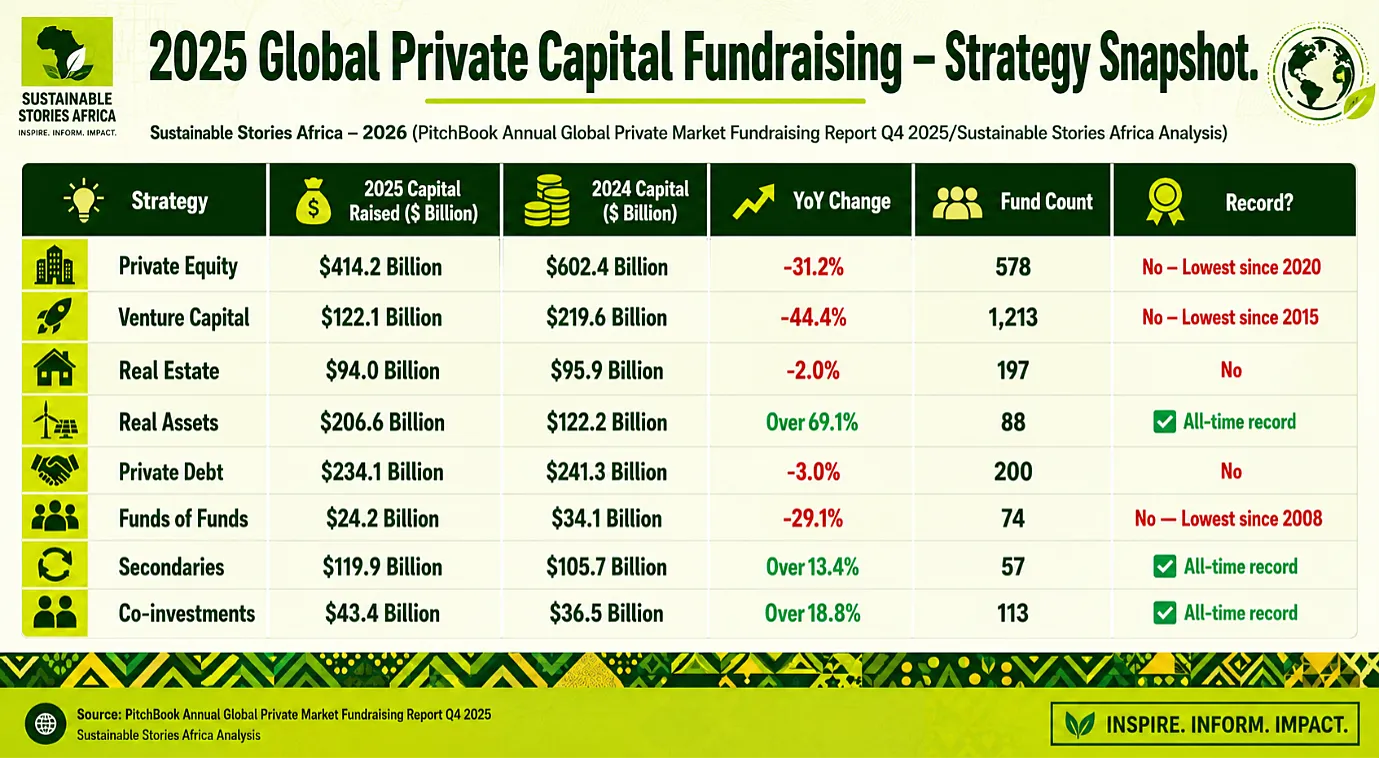
- real assets raised a record $206.6 billion, more than $30 billion above its previous all-time high, driven almost entirely by infrastructure megafunds chasing energy transition and AI data centre opportunities.
Simultaneously,
- private equity raised just $414.2 billion across 578 funds – the weakest fundraising environment since 2020, with fund counts collapsing from a peak of 1,767 in 2022. And venture capital, once the darling of global capital, continued its dramatic retreat, raising just $122.1 billion, 9.7% of total private capital raised, down from a 23.4% share at its 2022 peak.
The Year Infrastructure Became King
The most important data point in the 2025 private markets landscape is not PE's decline or VC's fall — it is the ascendancy of infrastructure as a primary asset class of global capital allocation. Of the 17 funds that closed on $10 billion or more in 2025, only five were primary PE funds. In 2024, 11 of the 20 largest fund closes were PE-focused. Infrastructure, secondaries, and private debt have become the new anchors of the private markets universe
The three largest funds to close in all of 2025 were infrastructure vehicles: the $25.2 billion Global Infrastructure Partners V, the $23.1 billion EQT Infrastructure VI Fund, and Brookfield's $20 billion Global Transition Fund II — focused entirely on energy transition infrastructure. Together, these three funds alone raised $68.3 billion — more than the entire global VC market raised in the first half of 2025.
Reading the 2025 Private Markets Data
The PitchBook report covers all major private market strategies. The divergence in 2025 is best understood strategy by strategy:
Private Equity:
- 578 funds raised $414.2 billion, the lowest fund count since 2015. Megafund capital (funds >$5 billion) fell 43% year-on-year.
- However, 88% of total capital still flowed to experienced GPs, and the average time to close a fund fell to 17 months, the first decline after four consecutive years of increases.
- Mid-market funds ($1– $5 billion) grew their share of total capital raised by 7.2%, a shift particularly visible in Europe.
Venture Capital:
- 1,213 funds raised $122.1 billion, the lowest since before the 2020 boom era.
- North America attracted 55.3% of all VC commitments, the highest proportion since 2008.
- Asia's VC share plummeted to 30.6% of commitments, the lowest since 2012, with China closing just 205 new funds in 2025, down from 1,522 in 2021.
- The top 10 VC funds raised only $26.7 billion, the lowest total since 2019.
Real Assets:
- The undisputed champion of 2025. Infrastructure funds accounted for 93.8% of the year's $206.6 billion total. European funds raised a record $86.4 billion.
- Core-plus and value-added infrastructure dominated as brownfield approaches, rebuilding and upgrading existing assets, captured LP appetite for income-generating, lower-risk infrastructure exposure.
Secondaries:
- Posted a second consecutive annual record at $119.9 billion, both the capital figure and the 9.5% share of total private capital raised were all-time highs. Transaction volume exceeded $200 billion for the first time.
- The $30 billion Ardian Secondary Fund IX was the largest secondary fund ever closed.
What This Shift Means for Africa's Capital Ambitions
The reordering of global private capital flows is not simply about where Western allocators are parking money.
It is about the themes attracting record inflows, infrastructure, energy transition, digital connectivity, and credit, and those themes map almost perfectly onto Africa's most urgent development priorities.
- Africa needs an estimated $130 – $170 billion annually to close its infrastructure gap.
- Global investors are now deploying record capital into precisely those sectors.
The energy transition anchoring Brookfield's $20 billion fund, the AI data centre infrastructure driving EQT and GIP's megafunds, and the digital connectivity projects attracting core-plus capital, these are the needs the continent has in abundance.
The secondaries market's record $200 billion in transactions creates an additional opportunity.
Africa-focused fund managers who have historically struggled to attract LP capital due to perceived exit limitations can increasingly point to secondary market mechanisms as viable liquidity pathways, reframing the African investment proposition at a moment when global capital is actively seeking deployment.
Africa Must Lean Into the Structural Shift
Five strategic implications for African stakeholders emerge directly from the 2025 private markets data:
- Lead with infrastructure: Global capital is flowing toward infrastructure. African DFIs, fund managers, and governments must package bankable opportunities that meet global LP criteria.
- Develop energy transition propositions: The $20 billion Brookfield Global Transition Fund II, closed in Q4 2025, sends an unambiguous signal: Energy transition infrastructure is the most fundable asset class on earth. Africa's renewable energy pipeline must be made investable at scale.
- Build secondaries capacity: With the secondaries market exceeding $200 billion in annual transactions, African funds and DFIs must develop mechanisms to participate in or attract secondary capital, directly addressing the liquidity problem that has historically deterred LP commitment.
- Target private debt for SME finance: Private debt's $618 billion dry powder stockpile represents a deep, available credit source for African SMEs, if the right intermediation structures are built.
- Position as a mid-market PE destination: As global LP appetite tilts toward mid-market funds in the $1 – $5 billion range, Africa's fund management community must professionalise at the scale required to absorb this tier of capital.
Path Forward – The Window Is Open — But Won't Stay Open Forever
The PitchBook 2025 data documents a pivotal structural realignment in global private capital. The assets, themes and strategies attracting record investment all have clear African analogues.
The infrastructure gap, the energy transition imperative, the digital economy build-out, and the credit market deepening are not aspirational futures for the continent.
They are present realities, and the capital to fund them is being raised at record scale, right now.
Africa's task is to build the pipelines, frameworks and the fund management capacity to intercept that capital before it flows entirely to other markets.