
Residential services platforms have spent years buying businesses, centralising functions and installing field-service software.
West Monroe argues that those tools are now table stakes, rather than a durable advantage.
The next source of value is “Execution IQ”: consistent data, repeatable decisions and operational intelligence embedded into daily work across every branch.
Scale Alone No Longer Creates Advantage
Private equity helped transform residential services from a collection of local operators into larger platforms spanning heating, cooling, plumbing, pest control and other home services.
The early formula was compelling: acquire fragmented businesses, centralise back-office functions, professionalise management and add technology while preserving local market knowledge.
That formula still matters; however, West Monroe’s 2026 technology guide argues that it no longer separates leaders from the pack.
Many platforms now pursue similar acquisition targets, recruit from the same labour pools and run widely adopted field-service systems such as ServiceTitan, BuildOps, ServiceTrade or Jobber.
Owning software and scale has become an expectation.
The differentiator is whether the platform can turn information into better action at every branch and job.
West Monroe calls this “Execution IQ”: the ability to measure performance consistently, guide decisions with data, make accountability visible and continuously improve without depending on a single exceptional manager or technician.
Aggregation’s Easy Gains Are Now Maturing
Scale can amplify inconsistency as quickly as it amplifies revenue. Acquired companies often arrive with different brands, pricing rules, customer records, dispatch habits and definitions of performance.
High employee turnover can remove undocumented knowledge, while semi-autonomous branches may repeat mistakes or hide successful practices from the rest of the network.
The result is a platform that looks integrated on an organisation chart but behaves like a loose federation in the field.
Earnings become harder to predict, job-level margins vary by technician or location, and management cannot easily explain why one branch converts leads better than another.
Technology records the variation, but dashboards alone do not correct it.
Buyers are responding by underwriting execution, not just growth. West Monroe highlights job-level gross margin, recurring revenue percentage, work-in-progress and cycle time as key measures.
Investors want to know whether revenue is durable, whether acquisitions improve after closing, and whether managers can trace performance back to the operational drivers that created it.
Execution IQ Makes Performance Repeatable Everywhere
Strong Execution IQ begins before an acquisition closes.
- A target should be assessed not only for its standalone earnings but for how it improves route density, adds services, strengthens capabilities or expands margins across the wider platform.
- After closing, shared processes, management practices and performance definitions create a common operating language.
Data then has to move.
- Customer, job, technician, asset, location and financial records often sit in separate applications.
- An operational intelligence platform establishes a shared data model and creates a near-real-time view of performance down to the job level.
That foundation allows the business to detect variance, diagnose causes and route decisions to the people who can act.
The guide’s operating sequence is practical: detect performance variance; diagnose whether the cause is lead quality, pricing, utilisation or behaviour; route the insight to the appropriate technician, general manager or regional leader; embed a next-best action into the workflow; and learn from the outcome.
Each completed cycle strengthens the next decision.
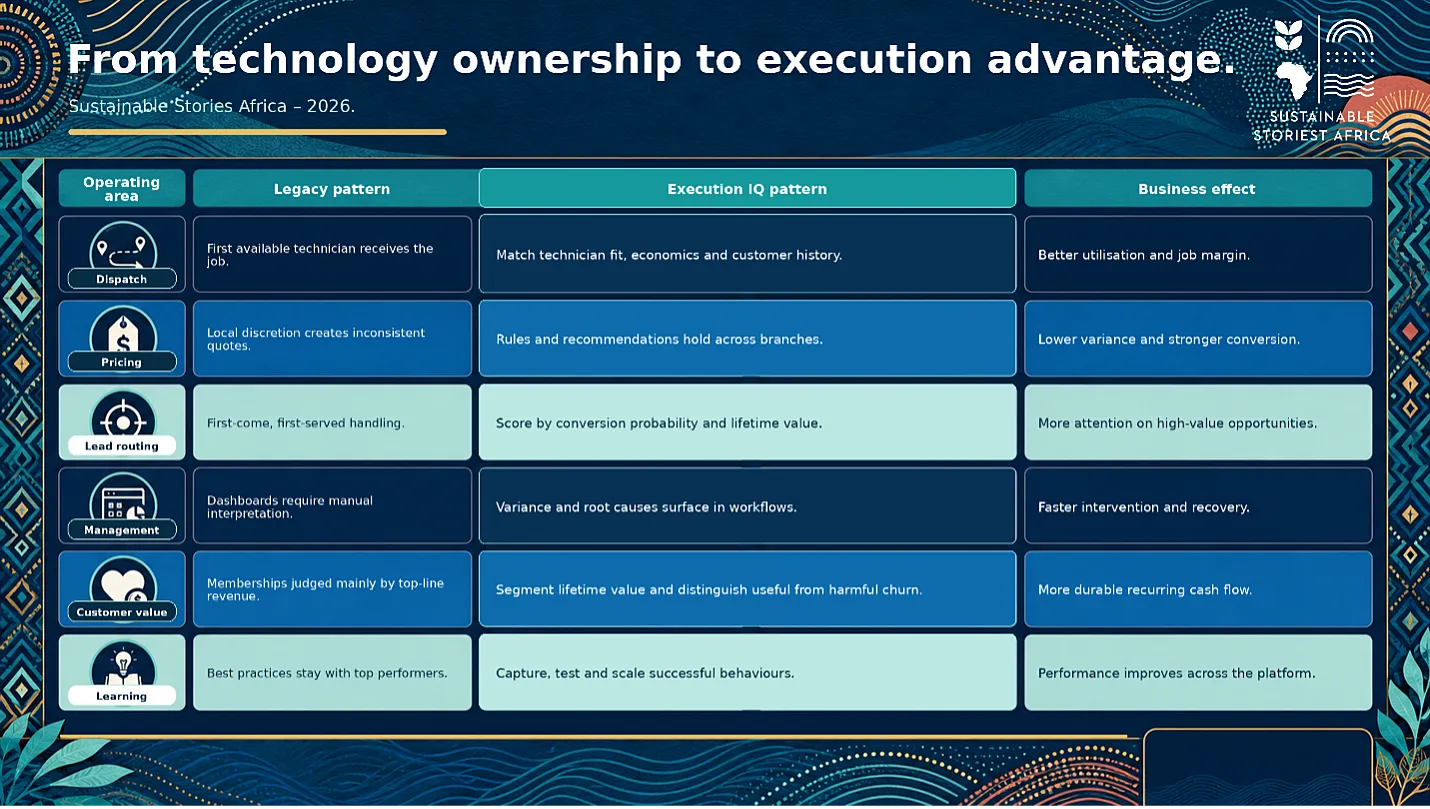
Embedded Intelligence Can Stabilise Platform Economics
West Monroe's client examples show what repeatability can unlock
A private equity-backed pest-control provider integrated seven acquisitions into PestPac in six weeks, versus four over the previous eight months, migrating over one million customer records and reporting fivefold sustained integration velocity.
In another case, AI-enabled diligence on a national HVAC and plumbing platform identified $8.5 million in digital growth potential, supporting a projected $6 million revenue uplift and a four-percentage-point expansion of EBITDA margin in the buyer's bid model. These consultancy-reported results illustrate how data can influence value before and after transactions.
The deeper opportunity is lower volatility: as pricing, scheduling, staffing, and lead allocation improve through repeated feedback, performance depends less on local heroics, cash flows become more predictable, and investors can distinguish sustainable improvement from temporary growth.
For African residential and small-business services, the lesson requires adaptation, given informality, mobile payments, non-standardised addresses, and unreliable connectivity, favouring lightweight systems over unchanged imported platforms.
Build Data Foundations Before Scaling Artificial Intelligence
Operators should begin with process and data discipline, not an AI pilot.
Common definitions of a customer, job, branch, technician, margin, and completed service are essential, since duplicate records, inconsistent codes, and missing cost data weaken any trained model.
Data ownership, quality thresholds, and access controls should be made explicit.
The next step is workflow selection.
- Management should identify decisions that are frequent, measurable, and economically important, such as dispatching, quoting, lead routing, maintenance reminders, inventory allocation, or technician coaching, defining who acts, what evidence appears, and what outcome determines success.
Human accountability remains central.
- Recommended actions must reach branch managers or field workers in understandable, challengeable form, with fairness checks ensuring pricing and prioritisation models don't exclude lower-income neighbourhoods, penalise newer technicians, or hide discriminatory assumptions.
Investors should test execution during diligence;
- Examining data lineage, integration time after acquisitions, job-level margins, branch variance, recurring revenue quality, and the percentage of recommendations leading to completed action, a dashboard should not receive the same valuation credit as a working system.
Ultimately, leaders should build a compounding loop: identifying leakage, embedding interventions, and scaling proven results.
Path Forward – Execution Must Become Organisational Infrastructure Now
Residential services platforms have largely standardised scale and software.
Their next advantage will come from how consistently they turn data into decisions, action and learning across every job and branch.
The immediate priorities are shared definitions, integrated data, measurable workflows, human oversight and repeatable post-acquisition playbooks.
Technology creates value only when execution improves with it.