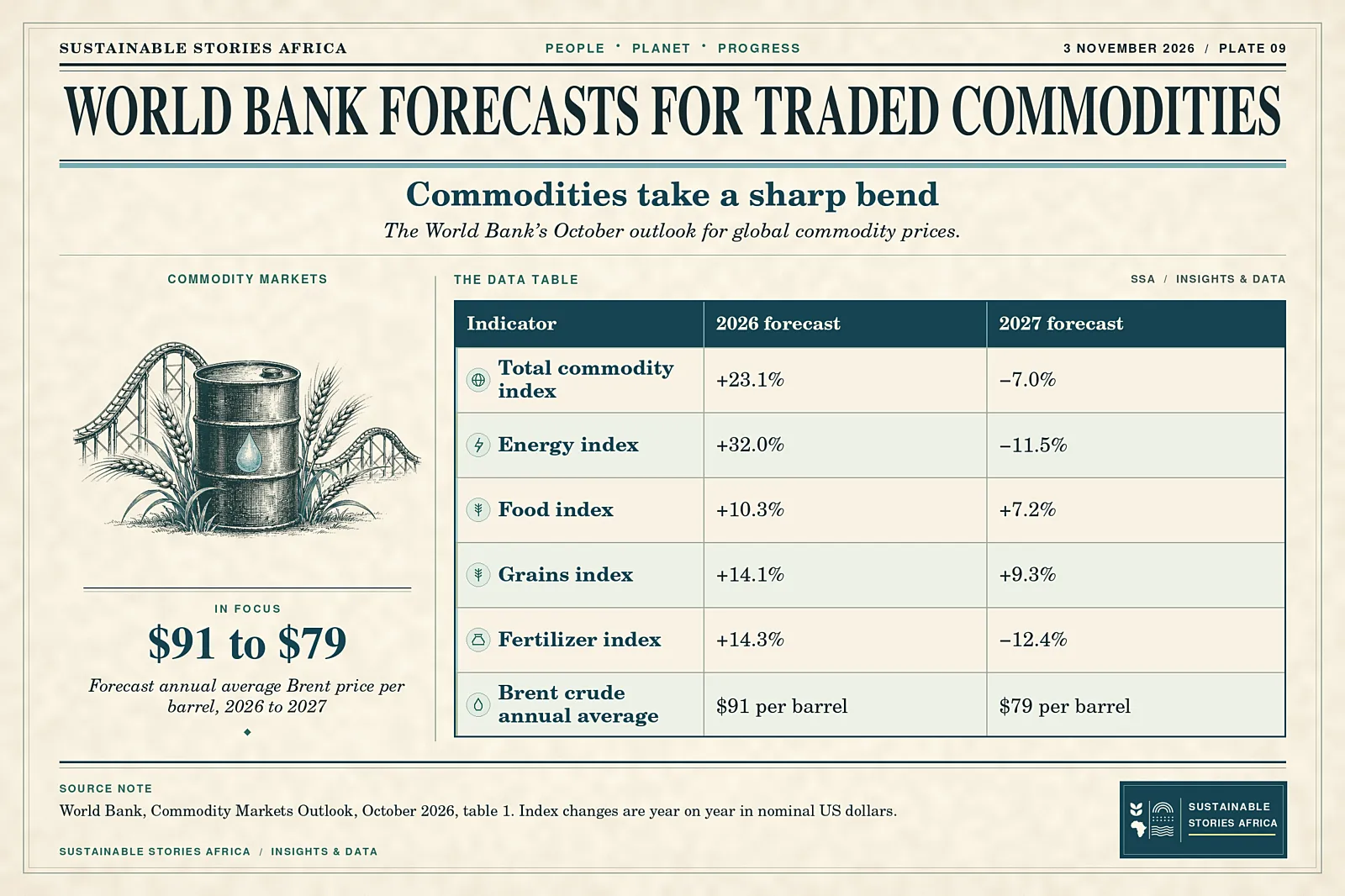
The World Bank expects global commodity prices to rise 23.1% in 2026.
Energy leads the surge, while food prices are projected to keep rising even as oil eases in 2027.
The outlook puts pressure on African importers and leaves exporters weighing volatile revenue against higher domestic costs.
Fuel and Food Prices Diverge Again
The World Bank’s October Commodity Markets Outlook projects a 23.1% rise in its global commodity price index in 2026, with energy up 32%.
- Brent crude is forecast to average $91 a barrel this year, compared with $69 in 2025.
- Supply disruption due to the Middle East conflict has hit oil markets, while war-related constraints around the Black Sea and a strong El Niño threaten parts of the food supply.
In the Bank’s baseline, Brent falls to $79 in 2027, but the global food commodity index rises another 7.2% after an expected 10.3% increase this year.
- That divergence complicates budgeting for African countries that import fuel, grain or both.
- A softer crude market can ease one source of pressure while the cost of securing staples keeps climbing.
Those projections are for internationally traded commodities in nominal US dollars.
- What households pay in local markets also depends on exchange rates, inland freight, taxes, stock levels and retail margins.
A government planning its budget needs to model those factors separately.
Why the Energy Shock Matters Now
The Bank expects global oil production to fall by more than 5% in 2026.
- It also projects a 2.5% drop in oil demand.
- Higher prices and weaker demand can coexist when supply contracts more sharply, and buyers draw on inventories to cover the difference.
The strain can be particularly acute for refined products when damaged facilities or disrupted routes constrain supplies of diesel and other fuels even as crude finds alternative routes.
For importers, procurement therefore is about the price and availability of the product they actually need.
- A diesel buyer can face tight freight schedules and expensive cargoes even if benchmark crude price reduces.
For governments with regulated tariffs or retail prices, the gap can appear in a utility’s accounts or as pressure for budget support.
Exporters may gain foreign exchange or public revenue if export prices rise and production holds up.
- Countries that also import refined fuel, fertiliser or grain must weigh those receipts against the cost of buying essential goods.
- Government revenue can also respond more slowly than the immediate demands on the import bill.
The headline index can also obscure a split within agriculture.
- The Bank expects the broader agriculture index to rise just 1.4% in 2026 even as its food index increases 10.3%, because beverage prices are projected to fall sharply.
- A country can therefore face a higher grain bill while some export receipts weaken.
- Analysts need to look at the actual goods an economy sells and buys rather than infer its trade position from the broad agriculture figure.
The impact depends as much on the volume sold or imported as on the projected price.
What the October Forecast Shows Clearly
The Bank forecasts a 14.1% rise in grain prices in 2026 and a further 9.3% rise in 2027
- Its fertiliser index moves in the opposite direction next year, with a projected 12.4% fall after a 14.3% rise in 2026.
- Even when fertiliser eases internationally, local availability depends on order timing, access to credit and whether supplies arrive before planting.
The Bank’s October forecast for 2027 Brent is $9 a barrel higher than its April forecast.
- The revision matters for budgeting because it illustrates how a lower price than this year can still be materially higher than officials expected when preparing plans.
- The April projection for the 2027 food index was also lower.
An adverse scenario puts 2027 Brent at $105 a barrel and food prices above their 2022 level.
- It illustrates what sustained disruption could do to energy and food markets.
- Budget teams can use that scenario to test assumptions while retaining the Bank’s central forecast as a distinct planning case.
Farmers respond to costs differently from fuel distributors.
- A distributor can adjust an order within weeks if another supplier has capacity.
- A farmer who applies less fertiliser may face the yield consequences months later.
- When input finance is available only after planting, cheaper supplies in a later quarter can arrive too late to influence that harvest.
Tracking the calendar alongside the price helps officials see whether intervention can still protect output or needs to focus on household incomes.
Where Faster Preparation Can Lower Costs
- A flour mill can reduce exposure to delivery delays by knowing which alternative suppliers meet its specifications and how long it takes to change routes.
- An agricultural cooperative can pool fertiliser purchases and agree delivery windows that fit its planting calendar.
These steps cost money and must be judged against the disruption they prevent.
For governments, preparing a targeted response gives them options if prices rise unexpectedly.
- A temporary transfer or school-feeding adjustment can support families with the most exposed budgets.
- Releasing strategic stocks can help where storage and distribution are ready, with clear replenishment rules so the response does not create a shortfall later.
Monitoring must extend beyond a global index.
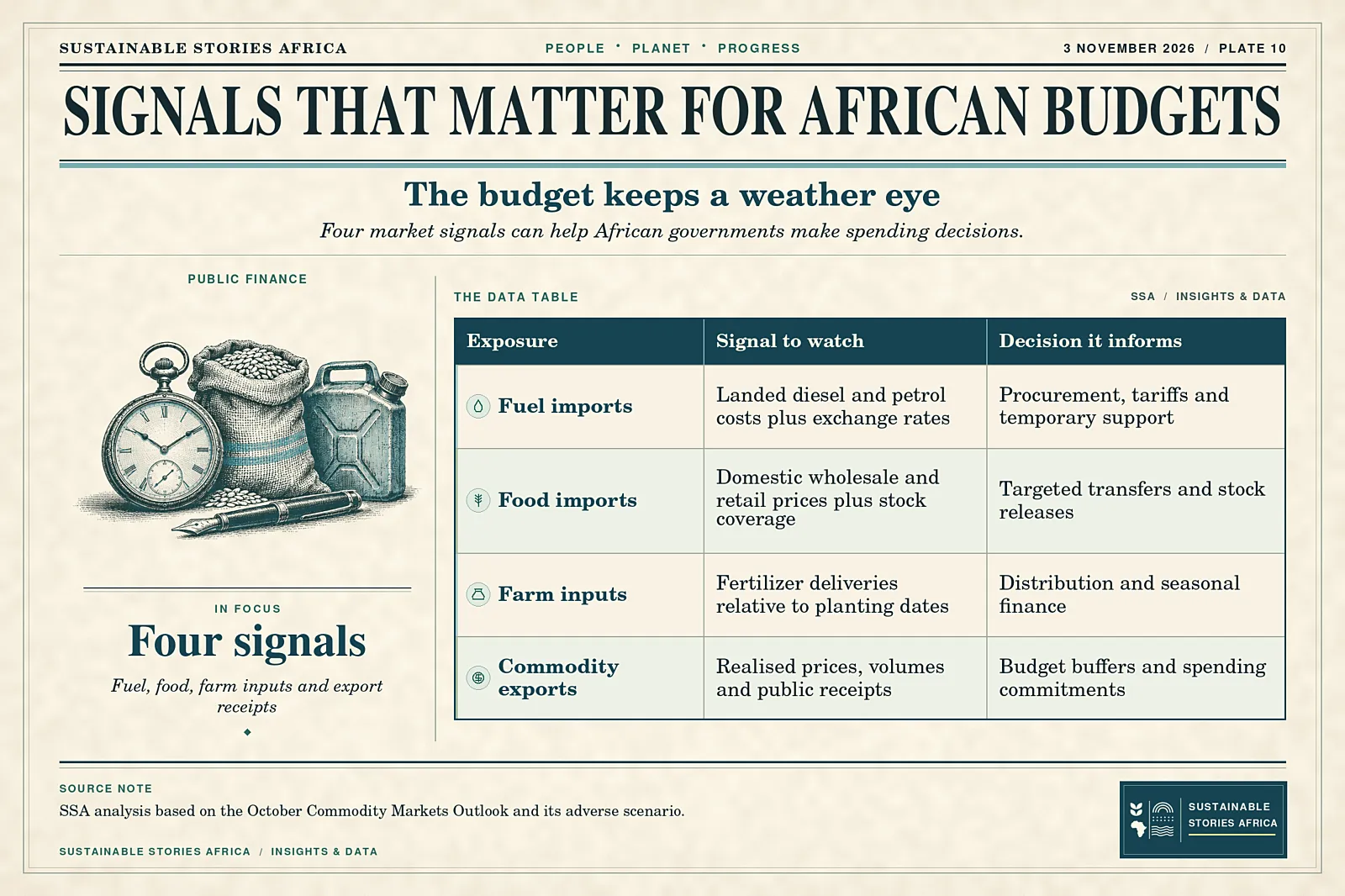
- Domestic wholesale prices can show whether imports are arriving and reaching buyers.
- Retail prices in vulnerable districts indicate pressure on consumers, while freight costs and foreign exchange conditions can help explain why a local price has diverged from a world benchmark.
Utilities and transport operators can test the same scenarios against their own contracts.
- A bus operator may face higher costs before it can revise fares.
- A power utility using imported fuel may have to absorb a currency loss even when the world oil price is stable.
The central forecast provides a common starting point for those calculations, while the adverse scenario shows whether an operator could continue providing service without a change in tariffs, additional credit or temporary public support.
Making those assumptions explicit gives budget officials time to act before arrears build.
What Importers and Exporters Can Track
Finance ministries can stress-test their budget assumptions against baseline and adverse oil and food.
- Importers should track fuel by grade, key staples by origin, and the ability to pay for cargoes.
Governments should make the fiscal costs of any support visible, specify how long it will run and review whether it reaches the intended buyers.
- Exporters can plan how to use temporary windfalls while protecting budgets against a reversal.
- Reporting actual export volumes alongside realised prices helps show whether higher benchmarks have lifted revenue.
- Linking new commitments to a cautious revenue assumption gives governments room to respond if markets turn.
Agriculture ministries can track fertiliser and seed availability before local planting seasons.
- Port authorities can monitor unloading and clearance times.
- A coordinated view helps separate a global price problem from a domestic bottleneck that can be addressed directly.
What to Watch as Prices Shift
Oil and food should have separate assumptions in 2027 budgets.
Updating them alongside exchange rates and freight costs will show which pressures are reaching households and firms.
Governments can prepare targeted responses with clear triggers, then revise them as actual prices, supply conditions and budget receipts come in.