A World Bank study spanning North Africa and neighbouring economies finds that 42% of the region’s population cannot afford a nutritious diet.
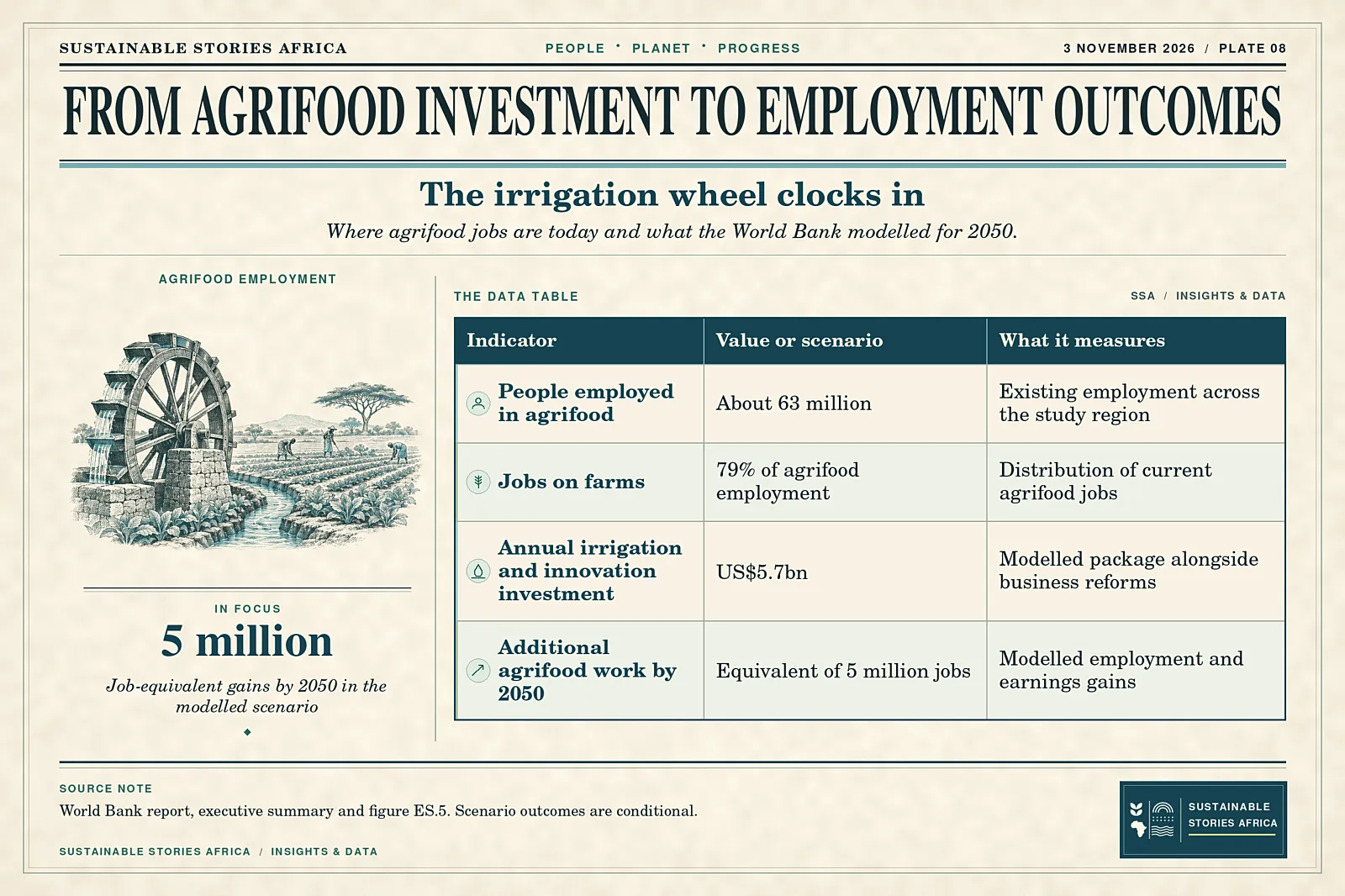
Agri-food systems already employ about 63 million people.
Cutting food losses, managing scarce water and investing in logistics could help feed more people while creating work on farms and along the supply chain.
The Cost of a Nutritious Diet
Food can be available in a market and still be out of the reach of the people who shop there.
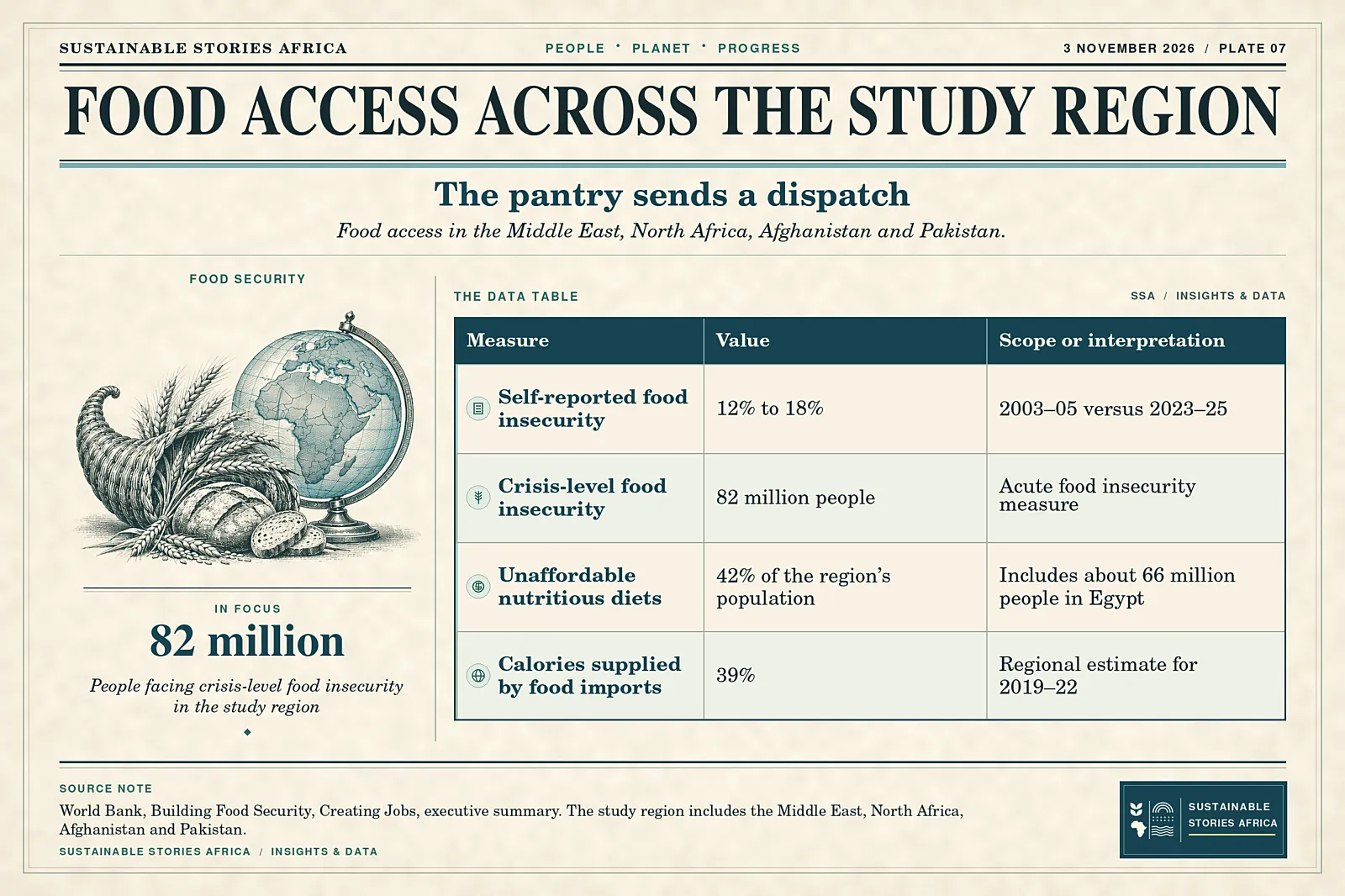
A World Bank study covering the Middle East, North Africa, Afghanistan and Pakistan finds that about 42% of the region’s population cannot afford a nutritious diet.
- Egypt alone accounts for an estimated 66 million people in that group, one of the report’s largest concentrations.
The Bank’s analysis links food security to a second concern.
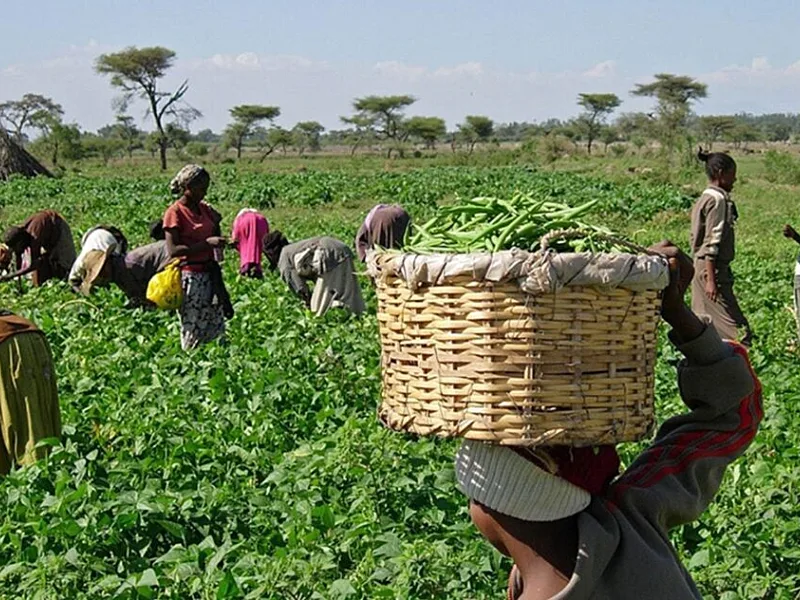
- The region’s agrifood systems employ approximately 63 million people, nearly three in every ten jobs, with most employment still on farms.
- The work beyond the farm gate has been growing quickly.
- Processing, storage and distribution can help more of a harvest reach consumers while giving farmers a broader market for their produce.
For North Africa, the link between jobs and diet affordability raises a practical question.
- How can countries expand the supply of nutritious food and support workers’ incomes while managing water scarcity and exposure to imported prices?
Food Insecurity Takes More Than One Form
The report puts the share experiencing self-reported food insecurity at 18% in 2023 – 2025, up from 12% in 2003 – 2005.
- It also estimates that 82 million residents were at crisis levels of food insecurity.
- These measures capture different experiences.
Self-reported insecurity describes people’s access to food, while a crisis classification identifies acute conditions that require urgent attention.
Fragility, conflict and violence are central to the acute picture.
- Economies facing these conditions accounted for over four in five people experiencing crisis-level food insecurity in the study region.
- At the same time, a nutritious diet is unaffordable for many people in middle-income countries.
- Targeted income support, dependable transport and lower spoilage can matter to those families even where markets remain open.
The World Bank estimates that regional food demand could rise by 67% by 2050.
- How that additional demand is met will affect import costs, land and water use, and the kinds of work available in rural and urban areas.
Morocco illustrates the stakes of relying on irrigation.
- The World Bank says irrigated land accounts for about one-fifth of cultivated area there but contributes more than half of the sector’s value added.
- That share can reach 75% during drought.
- The report also cites evidence that severe droughts in Tunisia reduced agricultural employment by 8% to 10%.
The two examples show how water stress can change both production and incomes.
- When investment supports more intensive production, a river basin or aquifer must account for withdrawals and each farm’s efficiency.
Where Food Systems Lose Their Value
The report estimates that about a third of food is lost or wasted between farms and consumers.
- Some losses occur before products arrive at a shop, because sorting, storage, handling or transport are inadequate.
- Others arise later.
A cold room can help with the first problem if farmers can reach it, power stays on, and buyers pay for the quality it preserves.
Imports are another part of the calculation.
- They supplied 39% of calories across the study region and can conserve domestic water where growing locally the same goods would require extensive irrigation.
- They can also leave households exposed to disruption when suppliers or routes are concentrated, and governments or importers face foreign exchange shortages.
The choice therefore varies by product and location.
- Grain stocks, diversified suppliers and effective ports can make imported staples more dependable.
- Fresh produce may gain more from reliable local transport, cold storage and better market information.
- Water accounting helps governments compare the costs before deciding which crops and locations to support.
Financing a cold chain takes more than a building lease.
- It requires enough produce throughout the season to cover fixed costs, storage tariffs farmers can pay and a route to consumers willing to buy the product.
- Shared facilities can help smaller farms reach that threshold.
- A contract that rewards the operator for keeping products at the required temperature can help preserve quality.
If the operator’s revenue depends only on volume, it has less reason to invest in maintenance that protects each shipment’s value.
Where Better Jobs Could Come From
The Bank reports that off-farm agrifood employment grew at twice the global rate over 2010 – 2023.
- Demand for technicians who service cooling equipment, food safety staff, drivers and warehouse workers can grow as businesses handle more volume and reach more customers.
- Some jobs become more productive when firms can process goods locally or sell a larger share of a harvest at higher quality.
In the Bank’s high-investment scenario, annual spending on irrigation and innovation of about $5.7 billion, alongside business climate reforms, could more than double fruit and vegetable production and increase cereal yields by 72% by 2050.
- The model also projects a smaller irrigation water bill under that package.
- Realising such gains depends on how water is allocated and whether it is accompanied by efficiency and credible limits on withdrawals.
The report estimates that ambitious investment and reform could generate the equivalent of five million additional agrifood jobs by 2050.
- That measure includes gains in earnings and employment.
- It is a modelled comparison with a reference case, so the number of new posts will depend on how investment is made and where the gains arise.
Protecting consumers during a price shock involves a different set of decisions.
- Governments can review how grain reserves are rotated, which households receive income support and whether suppliers can still compete.
- An import contract secured before a crisis may ease supply pressure, while a cash transfer can protect purchasing power when the food is available but unaffordable.
Tracking both stock and affordability helps avoid spending scarce public funds on responding to other problems.
How Governments Can Back Better Investment
Authorities can start by measuring where food disappears from supply chains.
- In a market where spoilage occurs mostly in transit, road reliability or shared cooling may deliver more value than another production subsidy.
- Where consumers cannot afford fresh food even when supply is available, targeted transfers may help more directly.
- Procurement can give smaller operators access to transparent contracts while preserving food safety requirements.
Water agencies and agricultural ministries should evaluate projects together.
- Yield gains matter alongside the volume of water withdrawn, the cost to farmers and any effect on downstream users.
- Support for producers can combine access to finance with practical training, contracts and organisations that let small farms consolidate shipments or bargain collectively.
Investors can assess who will use a warehouse or packing facility before building it.
- Demand commitments, reliable energy and measurable spoilage savings are stronger grounds for finance than capacity targets.
- Programmes should also track who gets better work and whether job gains reach women and younger workers.
Path Forward – How to Track Food System Gains
Governments can publish food losses, diet affordability and water use alongside agrifood programmes' employment results.
This combination shows where investments help consumers and where they raise earnings.
Projects that preserve more food, sustain water supplies and give smaller producers a reliable route to buyers deserve close attention as demand grows.