From Johannesburg's townships to the subantarctic high seas, South Africa is stress‑testing what a just environmental transition looks like on the ground.
A new Environment Quarterly edition throws more light on pilots in e‑waste, plastics, oceans and biotrade, converting policy language into real jobs, experiments and enforcement.
The stories also expose hard questions about scale, finance and political will. Can circular pilots, youth training and development, and cross‑border rescues keep pace with accelerating climate risk, biodiversity loss and rising waste volumes by 2030?
Ground Truths Of A Just Transition
South Africa's latest Environment Quarterly tracks a dense quarter of activity: an e‑waste pilot in Gauteng, a landmark G20 environment meeting in Cape Town, new plastics and recycling investments, high‑stakes marine science, and rights‑based biotrade deals.
These initiatives collectively test whether the country can translate its progressive environmental laws and global diplomacy into everyday resilience, livelihoods and enforcement.
The edition publication l ands as South Africa leads global forums on climate and biodiversity while grappling with high unemployment, energy insecurity and mounting ecological stress.
The tension is clear: circular economy and oceans projects are creating proofs-of-concept, yet their reach, financing and integration into the broader economy will decide if they shift the needle nationally.
E‑Waste, Jobs And Circular Hubs Rising
Township E‑Waste Becomes Circular Testbed.
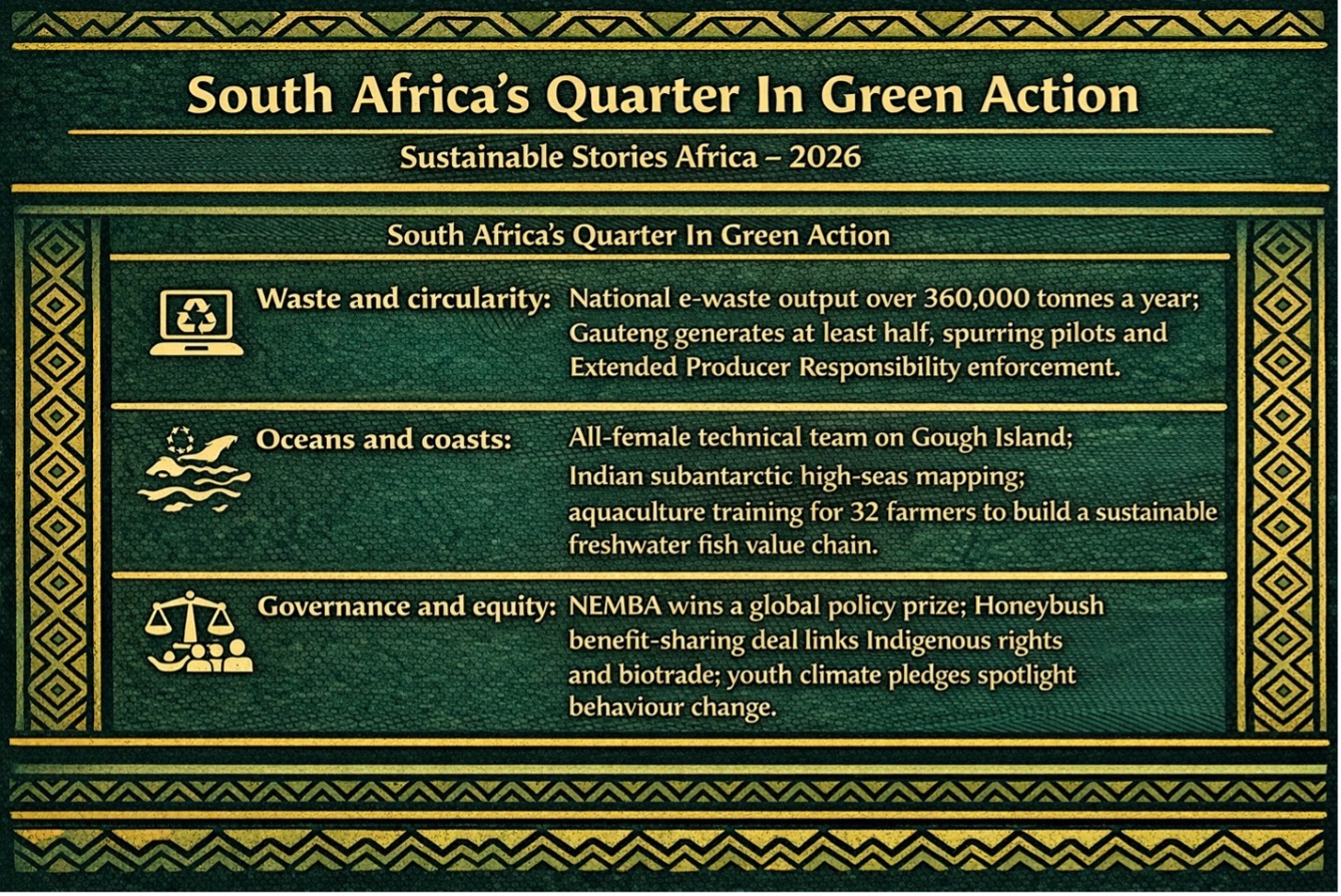
A new e‑waste recycling pilot in Johannesburg and Ekurhuleni is tackling more than 360,000 tonnes of electronic waste generated annually in South Africa, half of it in Gauteng alone.
Spearheaded by the Department of Forestry, Fisheries and the Environment (DFFE) with city and provincial partners, the project links community collection, producer responsibility organisations and local processing to keep toxic lead, mercury and chemicals out of land and water.
Deputy Minister Bernice Swarts frames the programme as both environmental defence and economic catalyst, with transfer sites and buy‑back centres envisioned across wards to monetise discarded phones, fridges and appliances.
Anchored in the National Waste Management Strategy and Extended Producer Responsibility regulations, the pilot aims to show that producers can co‑fund a system where e‑waste is feedstock, not fallout.
Oceans, Plastics and Science Power At Work
High Seas Science Shapes Future Rules.
From Gough Island to Cape Town's labs, South Africa is using science diplomacy to anchor its oceans agenda.
The 71st Gough Island expedition now fields the base's first all‑female technical team, maintaining critical infrastructure for year‑round weather and seabird monitoring on a UNESCO World Heritage outpost that hosts major populations of threatened species like the Tristan albatross and northern rockhopper penguin.
In Cape Town, the PHOCIS workshop convened experts from South Africa, Europe, India, Australia and the United States to map ecological zones in the Indian subantarctic high seas, feeding Marine Protected Area proposals under the CCAMLR regime.
Parallel sessions on continuous plankton recorder standards and a plastics monitoring network are standardising how plankton shifts and microplastics are tracked, turning long‑term data into an "ocean pulse" for climate and pollution policy.[1]
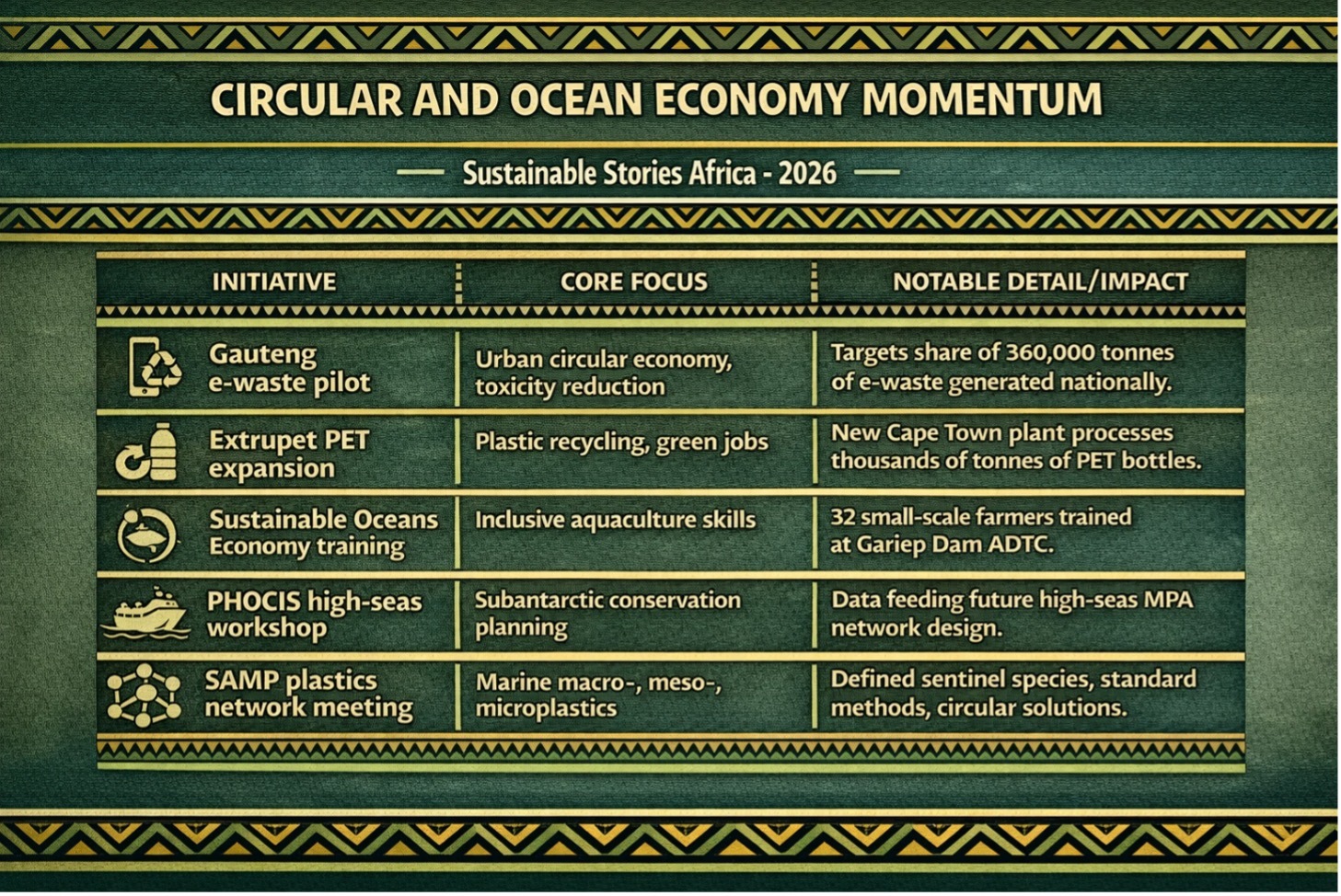
Circular and Ocean Economy Momentum
| Initiative | Core focus | Notable detail/impact |
|---|---|---|
| Gauteng e‑waste pilot | Urban circular economy, toxicity reduction | Targets share of 360,000 tonnes of e‑waste generated nationally. |
| Extrupet PET expansion | Plastic recycling, green jobs | New Cape Town plant processes thousands of tonnes of PET bottles. |
| Sustainable Oceans Economy training | Inclusive aquaculture skills | 32 small‑scale farmers trained at Gariep Dam ADTC. |
| PHOCIS high‑seas workshop | Subantarctic conservation planning | Data feeding future high‑seas MPA network design. |
| SAMP plastics network meeting | Marine macro-, meso-, microplastics | Defined sentinel species, standard methods, circular solutions. |
Law, Biotrade and Youth Climate Agency
Future‑Proof Laws Back Shared Benefits.
Legal architecture and rights‑based deals are emerging as South Africa's quiet leverage points.
The National Environmental Management: Biodiversity Act (NEMBA) has been recognised among the world's top eight biodiversity policies by the World Future Policy Awards, praised for science‑based governance, invasive‑species controls and benefit‑sharing provisions.
That framework underpins the newly signed Honeybush Access and Benefit‑Sharing Agreement, which ties industry growth to Indigenous Khoi and San knowledge holders and local producers.
At the same time, learners from multiple Gauteng high schools used the International Day for Climate Action to publicly pledge waste reduction, energy conservation and climate justice advocacy.
This youth‑led framing of responsibility, reinforced by practical guidance on greener festive seasons and local clean‑ups, links national policy narratives with household‑level behaviour shifts.
South Africa's Quarter In Green Action
Scaling Pilots, Hardwiring Accountability
Scaling Pilots Into Systemic Green Change.
The quarter's stories converge on a few priorities: embed producer responsibility across waste streams, deepen circular manufacturing like PET recycling, and institutionalise inclusive training so that youth, women and small enterprises sit at the centre of the green economy.
Governments and partners are urged to extend ward‑level e‑waste hubs, expand aquaculture demonstration centres, and hard‑wire SAMP plastics metrics and CPR plankton data into regulatory thresholds and investment decisions.
Internationally, South Africa's G20 leadership, CCAMLR science role and policy awards give it leverage to argue for fairer green finance, technology partnerships and trade terms that reward biodiversity stewardship.
The path forward demands transparent reporting on these pilots, ring‑fenced funding to scale what works, and continuous community engagement so that township recyclers, coastal fishers, Indigenous communities and learners all see themselves as co‑authors of the country's environmental transition story.
Path Forward – Scaling Circular And Ocean Leadership
Scaling Community‑Rooted Green Transitions
Over the next cycle, South Africa is being urged to scale flagship pilots in e-waste, PET recycling, aquaculture and marine science into fully funded, nationally coordinated programmes that embed circularity and ocean protection in the real economy.
This includes ward-level collection hubs, enforced producer responsibility, and stronger data-driven standards for industry and ports.
At the same time, policy advances such as NEMBA, the Honeybush agreement, and youth initiatives must be matched with predictable funding, cross-government coordination and climate-smart investment pipelines, aligning global green leadership with tangible gains in jobs, health and biodiversity nationwide.