Nigeria's ESG challenge is not a shortage of ideas, ambition, or regulation. It is a financing problem. O ne that sits quietly between policy intent and real-world impact.
Research shows that sustainability finance is not merely supportive of ESG outcomes; it is the catalytic mechanism that determines whether they scale.
From renewable energy to waste management and sustainable agriculture, the evidence is clear: without deliberate financial architecture, Nigeria's ESG transition remains fragmented, undercapitalised, and uneven.
Finance Is the ESG Transmission Belt
Nigeria has spent the past decade positioning itself as a leader in sustainability in West Africa.
Green bonds have been issued, renewable energy policies have been issued, and the rhetoric of ESG has been embedded across banking, energy, and corporate governance frameworks. However, progress on the ground remains slower than ambition suggests.
A 2025 peer-reviewed study on sustainability finance and ESG innovation in Nigeria offers a sobering diagnosis.
While ESG initiatives exist across energy, agriculture, waste, and infrastructure, their scale is constrained by high borrowing costs, weak institutional support, and limited access to long-term capital. The result is an ESG ecosystem rich in pilots, but poor in replication.
The report's core argument is structural: sustainability finance is not an accessory to ESG; it is the engine. Where finance is fragmented, ESG innovation stalls. Where finance is aligned, ESG outcomes multiply.
Nigeria's ESG Bottleneck Is Financial
The headline constraint is capital. Despite global green bond issuance exceeding $500 billion annually, Africa accounts for just 0.3% of outstanding green bonds, with Nigeria representing a fraction of that share.
Nigeria's first sovereign green bond, issued in 2017, was symbolically important, but financially modest, in comparison to national needs.
At the same time, Nigeria faces steep financing headwinds. Average lending rates exceed 25%, making long-term, capital-intensive ESG projects commercially unviable.
Renewable energy, waste-to-energy, and sustainable agriculture projects require substantial upfront capital; however, they are unfolding in markets weighed down by currency volatility (with relative stability throughout 2025), policy uncertainty, and heightened perceptions of risk.
The result is a paradox: ESG demand is rising, but financing channels remain misaligned with sustainability time horizons.
ESG Innovation Exists – Scaling Does Not
The report documents substantial ESG innovation across Nigeria's economy. Off-grid solar firms such as Lumos and GVE Systems have electrified hundreds of thousands of households.
The Nigerian Electrification Project has connected over 300,000 people through solar mini grids. Lagos alone processes over 2,000 tonnes of waste daily into energy through waste-to-energy partnerships.
Sustainable agriculture has also advanced. Climate-smart farming initiatives have trained over 50,000 farmers, increasing yields while reducing water use.
Digital platforms such as Hello Tractor have mechanised over 1.5 million hectares for smallholder farmers.
However, these successes remain isolated. The study finds weak coordination, limited replication, and insufficient financial integration across sectors. ESG innovation, in effect, is surviving despite the challenges in the financial ecosystem, not because of it.
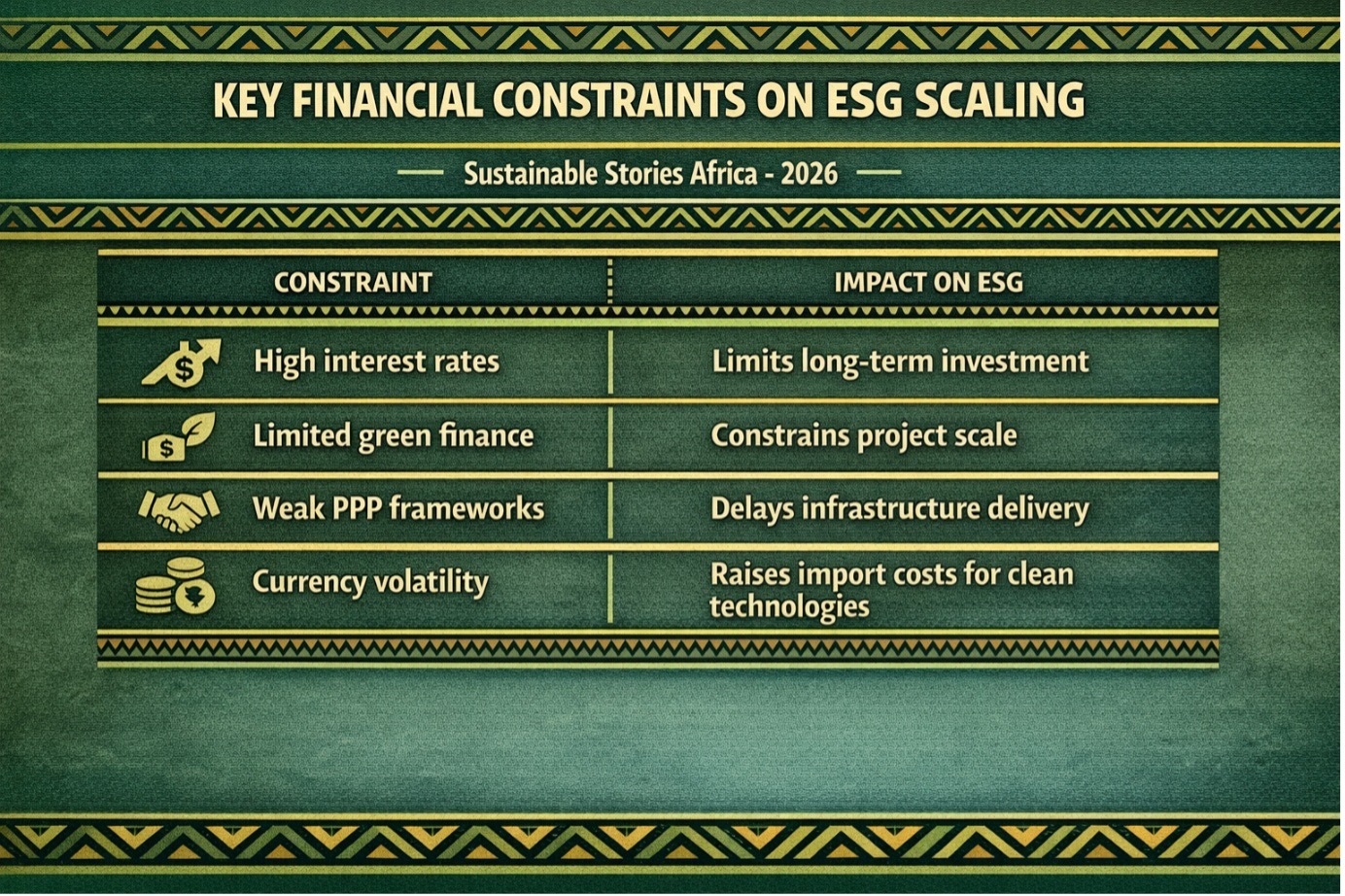
Key Financial Constraints on ESG Scaling
| Constraint | Impact on ESG |
|---|---|
| High interest rates | Limits long-term investment |
| Limited green finance | Constrains project scale |
| Weak PPP frameworks | Delays infrastructure delivery |
| Currency volatility | Raises import costs for clean technologies |
Why Sustainability Finance Changes Everything
Sustainability finance addresses ESG's core mismatch: long-term impact versus short-term capital. Instruments such as green bonds, sustainability-linked loans, blended finance, and impact investing align financial incentives with environmental and social outcomes.
The evidence is compelling. Globally, renewable-energy investment reached $3.3 trillion by June 2025, largely through tailored financial instruments. In Nigeria, blended finance models supported by development partners have demonstrated how public capital can de-risk private investment, lowering project costs and accelerating deployment.
Beyond funding, sustainability finance enforces accountability. ESG-linked financing requires measurable outcomes, strengthening transparency and governance. In this sense, finance does not merely fund ESG; it disciplines it.
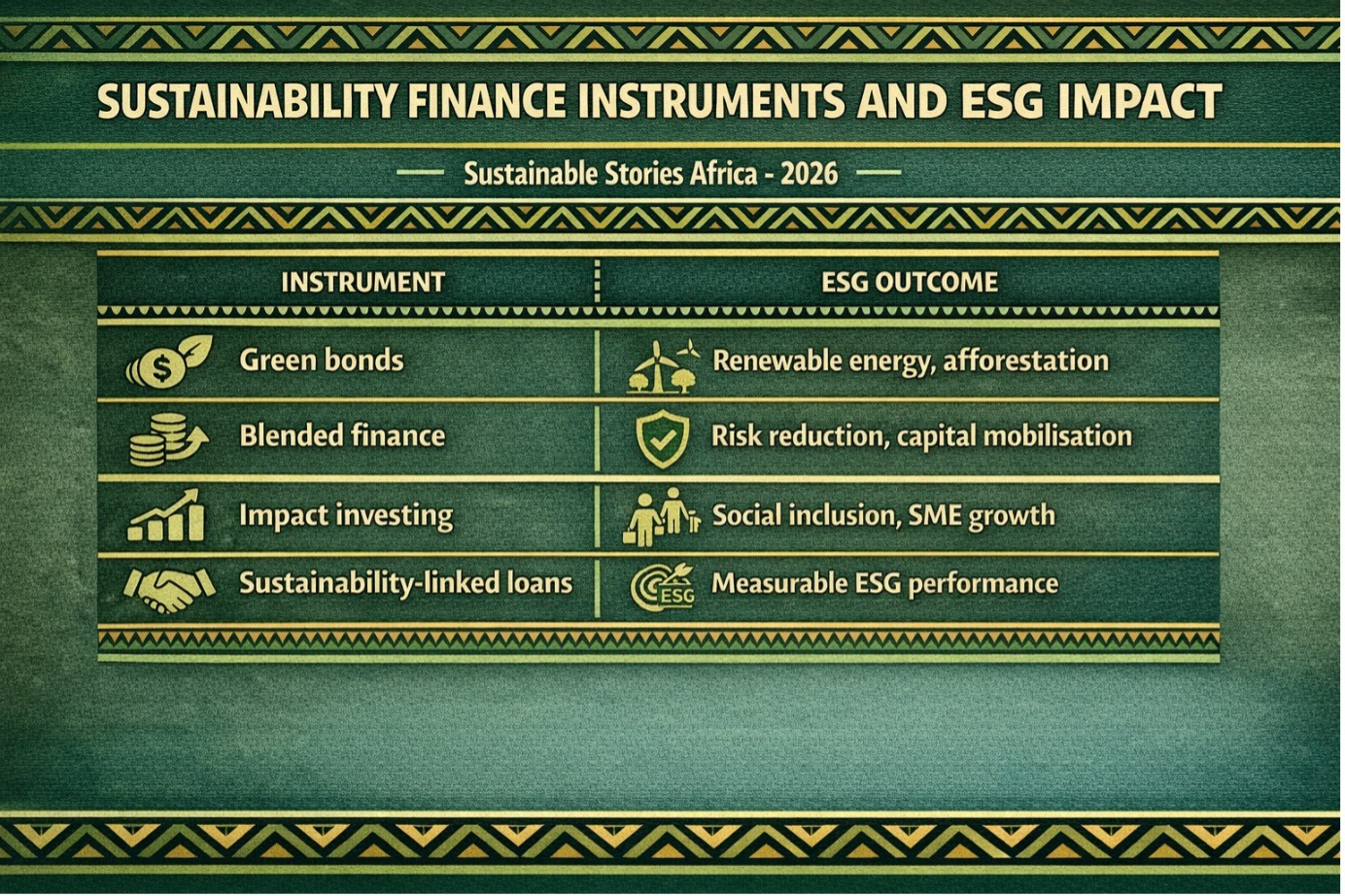
Sustainability Finance Instruments and ESG Impact
| Instrument | ESG Outcome |
|---|---|
| Green bonds | Renewable energy, afforestation |
| Blended finance | Risk reduction, capital mobilisation |
| Impact investing | Social inclusion, SME growth |
| Sustainability-linked loans | Measurable ESG performance |
Align Capital With National Priorities
The study outlines a clear reform agenda. First, Nigeria needs a coherent green-finance framework, covering incentives, reporting standards, and risk-sharing mechanisms.
Countries with mandatory sustainability (this is expected to take full effect by 2028 in Nigeria) are reporting up to 20% higher green investment inflows, according to global benchmarks cited in the research.
Second, financial institutions require capacity building. Many financial institutions lack the necessary tools to assess ESG risks more effectively and efficiently, leading to conservative lending decisions.
Dedicated green-finance desks, supported by regulatory guidance, could materially expand credit availability.
Third, private capital must be crowded in. Tax incentives, partial credit guarantees, and stronger public-private partnership frameworks would reduce perceived risk and unlock domestic investment.
PATH FORWARD – Finance First, ESG Follows
Nigeria's ESG future will not be determined by policy statements alone. It will be shaped by how capital flows align with sustainability ambition.
Sustainability finance is the missing transmission belt, connecting innovation to scale, policy to practice, and ESG intent to measurable impact.