For years, the link between a declining ecosystem and a declining balance sheet was intuited but rarely proven in granular, company-specific terms.
A landmark 2025 database from the University of Oxford and TNFD, containing over 600 evidence entries from 360 sources, now provides the most detailed map.
However, nature-related risks flow through forests, rivers, and farmland to operational shutdowns, erosion of firm value and stranded assets.
For African businesses and investors sitting at the intersection of resource dependence and regulatory change, this framework is not academic theory. It is an operational risk manual, one that most institutions have not yet opened.
Mapping the Route from Nature to Finance
The conversation around biodiversity risk has long been trapped at the level of sentiment: companies say they care, regulators say they should disclose, and investors say they will eventually price it in.
What has been missing is a systematic framework explaining how, mechanically, causally, and measurably, the degradation of a wetland, the invasion of an alien species or the drying of a river aquifer ultimately erodes a company's earnings and access to capital.
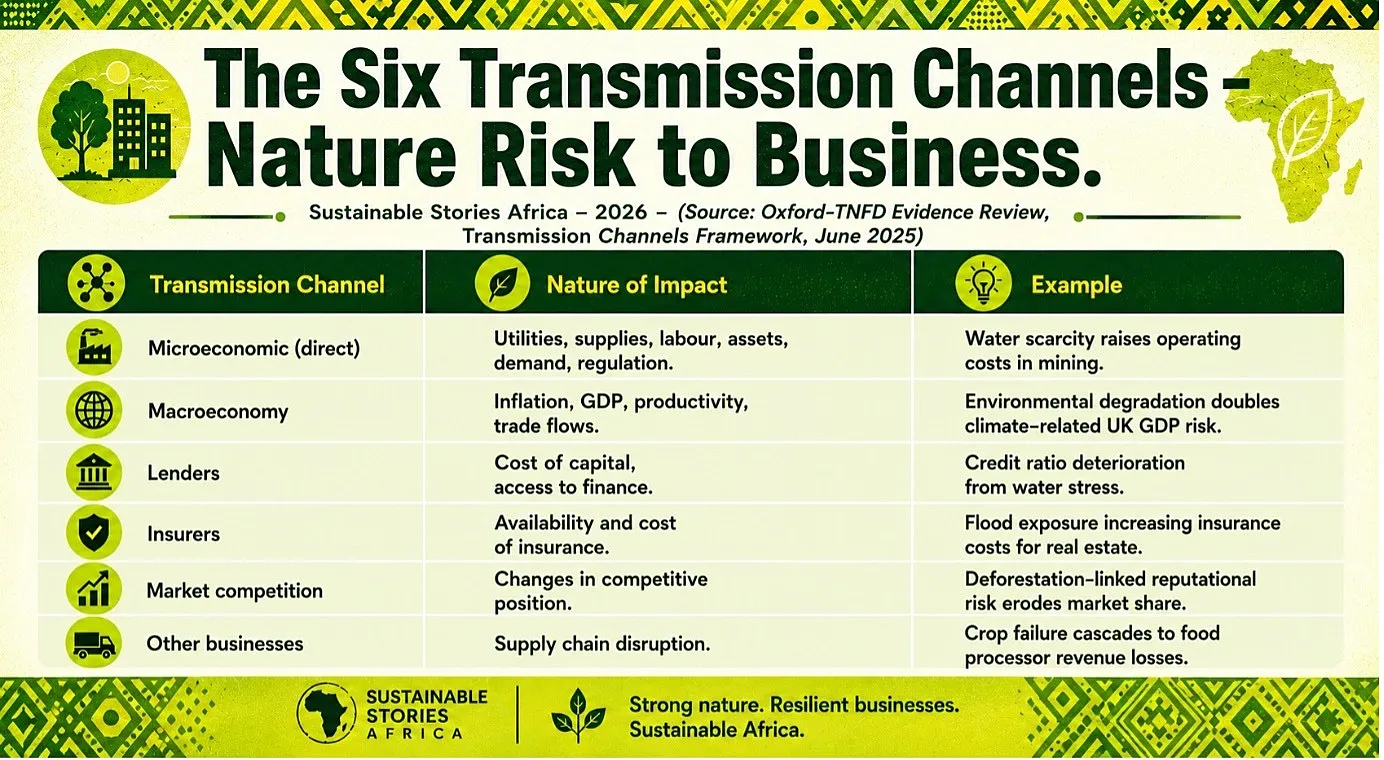
That framework now exists. The Transmission Channels Framework for Nature-Related Risks to Businesses, developed as part of the Oxford-TNFD evidence review published in June 2025, provides a comprehensive, evidence-grounded map of the pathways through which nature-related hazards materialise as financial effects at company, sector and macroeconomic levels.
For Africa, home to some of the world's most biodiverse and most exploited ecosystems, as well as to some of the world's most nature-dependent industries, this framework offers both a warning and a roadmap.
Five Drivers, Three Risk Types, Six Financial Channels
The framework starts at the source: five drivers of nature change identified by the Intergovernmental Science-Policy Platform on Biodiversity and Ecosystem Services (IPBES):
Land/freshwater/ocean use change, climate change, resource use, pollution, and invasive alien species.
These drivers do not stay contained in nature. They cascade through a risk taxonomy of three types, physical, transition and systemic, and then travel through up to six transmission channels into businesses.
600 Data Points – What the Evidence Actually Shows
The nature-related financial risks database, which underpins the review, includes over 600 entries covering 17 physical, 5 transition and 6 systemic risks.
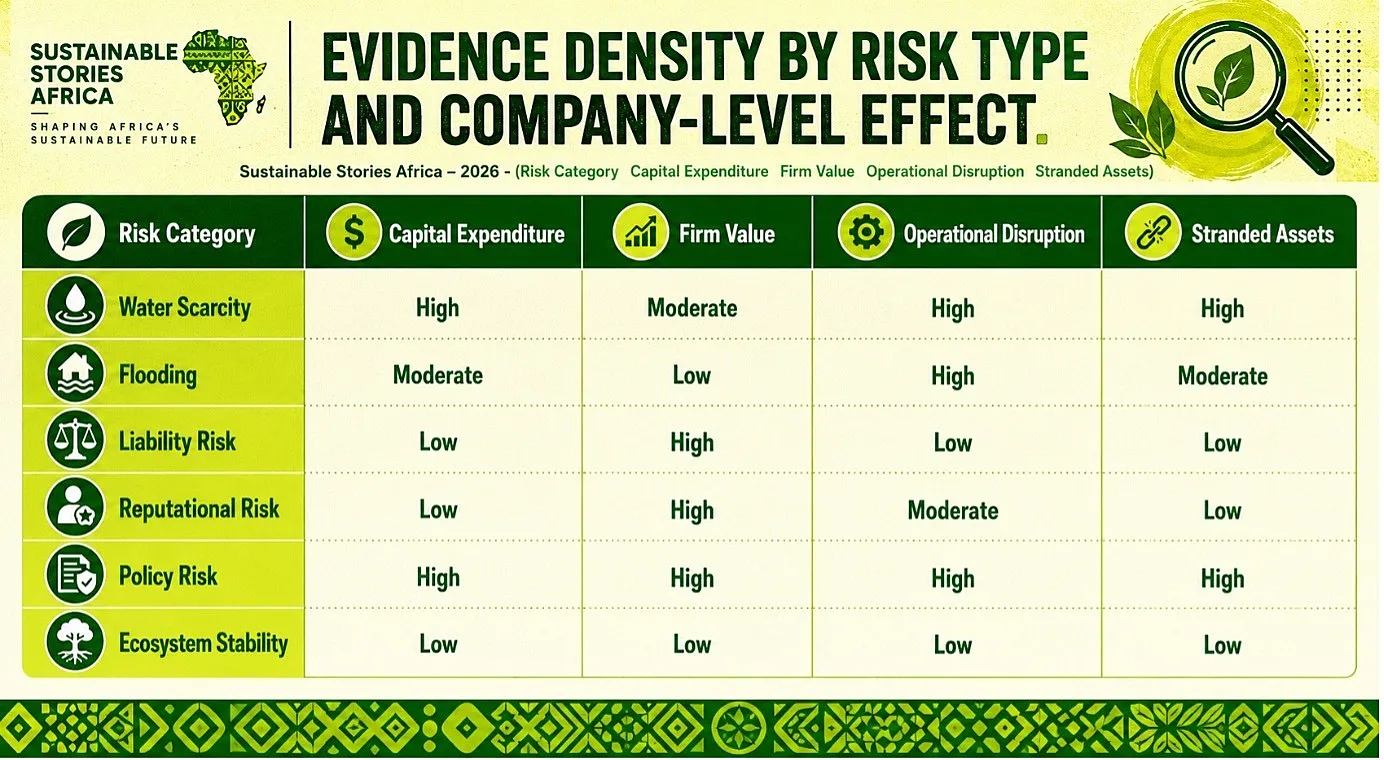
The evidence is strongest in several concentrated areas.
Physical risks:
- Water scarcity carries the heaviest evidence load, showing direct links to capital expenditure increases, operational disruption, stranded assets and firm value decline. Flooding and harmful algal blooms follow.
For Africa, the significance of water risk is immediate: the continent's thermal power sector, agricultural systems and mining operations are already exposed to severe water stress, mirroring evidence documented in India, Chile and Brazil.
Transition risks:
- Liability risk leads the evidence base, with court settlements in the billions tied to PFAS pollution, marine degradation and environmental contamination. Reputational risk affecting deforestation-linked sectors, including agrifood, metals and mining, is fully documented.
Policy risk shows strong evidence for stranded assets, particularly in fossil fuel sectors and water-dependent industries undergoing regulatory tightening.
Systemic risks:
- Amazon dieback, multi-breadbasket failure, crop extinction and ecosystem services collapse are classified as systemic hazards in the database. Evidence at the company level is limited, but the macro-level stakes are extraordinary.
A macroeconomic scenario analysis estimated that environmental degradation could reduce UK GDP by 6% versus the baseline by 2030, larger than the impact of the 2008 financial crisis.
An antimicrobial resistance scenario could cut GDP by 12%. Critically, at least half of the financial risk to the UK originates from overseas, showing how nature risks travel across borders through trade and capital flows.
What an Evidence-Led Risk System Could Build
A financial sector that genuinely integrates nature risk would do more than protect itself from losses.
It would redirect capital away from nature-destructive activities and towards nature-positive investments, a shift that research increasingly shows is both financially rational and structurally necessary.
When investors and lenders begin to internalise nature risk the way they have begun to internalise carbon risk, the distortions of the current system, in which $7 trillion per year flows into nature-negative activities, begin to correct.
Companies that have already invested in biodiversity-aligned operations, sustainable water management and resilient supply chains are already demonstrating better credit outcomes and longer-term access to capital.
The evidence base confirms this. The financial case is there. What remains is the will and the regulatory framework to act on it.
Translating Evidence Into Practice for African Markets
For African policymakers, financial regulators and corporate boards, the evidence review offers four clear entry points for action:
- Adopt the TNFD LEAP methodology (Locate, Evaluate, Assess, Prepare) as a structured starting point for nature-related risk identification across sectors highly exposed to nature dependencies, agriculture, mining, energy, real estate and financial services
- Commission Africa-specific causal chain studies that link local drivers of nature loss (deforestation, overfishing, wetland conversion) to company-level financial effects, filling the significant regional gap in the global evidence base
- Require CDP environmental disclosures from listed companies, which currently reveal that 69% of disclosing companies are exposed to water-related risks worth up to $225 billion
- Integrate nature risk into credit frameworks of development finance institutions and commercial banks, particularly for infrastructure, agribusiness and extractive sector lending
Path Forward – Africa's Evidence Gap Must Be Filled
Building the African Nature Risk Evidence Base
The Oxford-TNFD database is a powerful starting point; however, Africa is significantly underrepresented in its evidence base.
Of the 360 sources spanning the database, African company-level case studies remain marginal.
This is both a data gap and a governance risk: African businesses are exposed to some of the highest concentrations of nature-related physical risks globally.
However, the evidence to support investor decision-making and regulatory action remains thin. Building that evidence base, through continental research partnerships, mandatory disclosure pilots and TNFD-aligned national frameworks is the defining sustainability finance task of this decade.