
The global financial system has crossed a critical threshold: ESG is no longer optional. It is infrastructure that powers risk management, drives investment credibility, and redefines capital strategy.
Where Capital Meets Climate Intelligence
The story of ESG is no longer moral. It is mathematical. Financial institutions now recognise that the future of capital allocation sits at the intersection of data, credibility, regulation, and investment discipline. The ESG Data Insights Report 2025 reveals a financial ecosystem rapidly mainstreaming ESG into its investment engines, not as branding, but as economics.
From portfolio design to risk models and stewardship, ESG data now shapes performance confidence. 99% of surveyed institutions consider ESG essential to investment decision-making. 74% say client demand drives ESG integration, while 65% cite regulatory risk as the new financial governance reality.
This is the new investment frontier: ESG not as compliance rhetoric, but as a measurable determinant of resilience, returns, and reputation.
ESG Has Become Finance's New Operating System
The report's most striking revelation is unanimity. No respondent dismisses ESG data, a historic moment in global finance. ESG has shifted from an optional narrative to a required currency. 99% of financial institutions rank ESG as important or critical to investment strategy, with 60% integrating ESG partially and 40% fully embedding it into their financial models.
This movement is not driven only by conscience. It is driven by performance, regulation, and reputation:
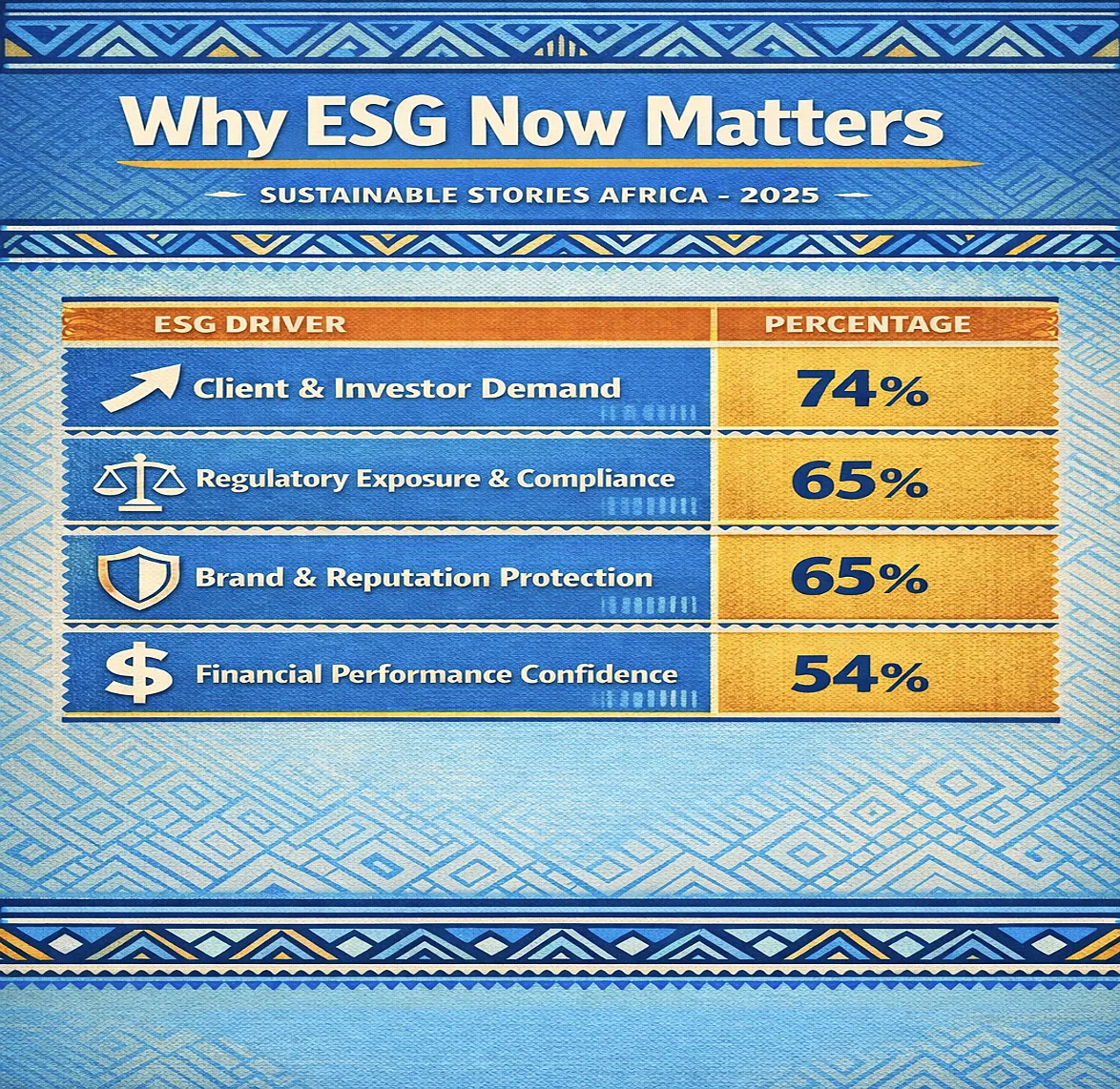
- 74% say client pressure leads to ESG adoption
- 65% cite regulation as a decisive force
- 54% believe ESG improves financial performance
- 72% use ESG to identify long-term risks
In short, Capital now believes ESG is a profitability protection.
Why ESG Now Matters
| ESG Driver | Percentage |
|---|---|
| Client & Investor Demand | 74% |
| Regulatory Exposure & Compliance | 65% |
| Brand & Reputation Protection | 65% |
| Financial Performance Confidence | 54% |
Data Is the New Capital Advantage and Weakness
The report reveals a market deeply dependent on ESG intelligence and deeply frustrated by it.
Key Insights:
- 99% rely on ESG data
- 80% depend on external ESG rating agencies
- 64% use MSCI, 62% Bloomberg, 58% Sustainalytics
- 68% still conduct their own in-house ESG research
But here is the problem:
- 65% face data standardisation problems
- 57% struggle to compare ESG ratings
- 56% lack long-term historical ESG data
- 27% say ESG data is too expensive
- 49% say sector-specific ESG data is still weak
This creates a paradox: ESG is indispensable, yet often unreliable.
INFOGRAPHIC BLOCK (Narrative form)
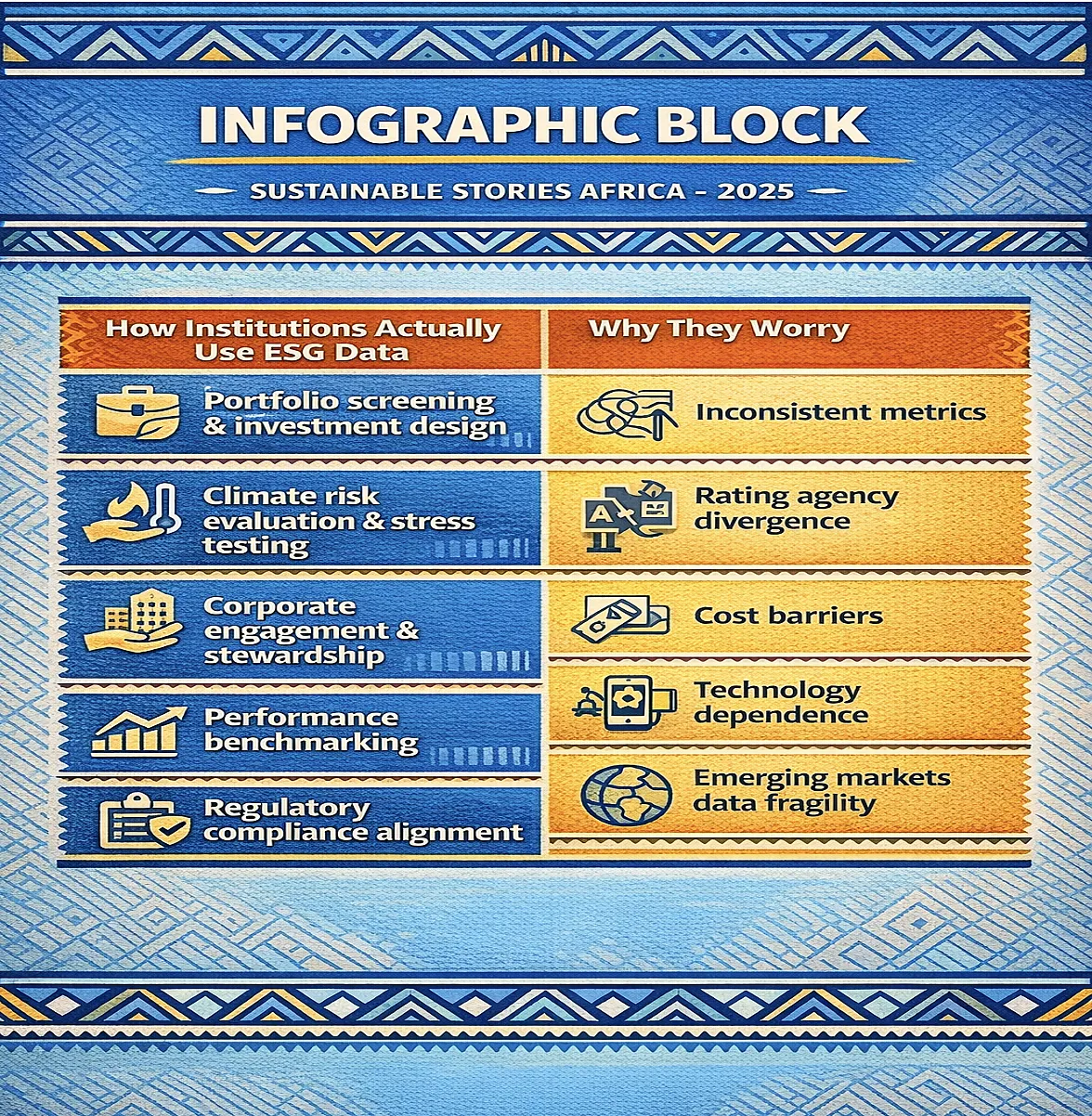
This is no longer a debate about whether ESG matters. It is now about whether ESG is credible enough to be trusted.
When ESG Works, Financial Systems Become Smarter
The upside is powerful. Institutions that align ESG with investment performance report measurable benefits:
- 50% see a strong positive link between ESG and returns
- 43% see moderate positive correlation
- Only 6% see no correlation. Only 1% see a negative impact
This proves something fundamental: ESG is not "charity finance." It is performance finance.
Institutions are also institutionalising accountability:
- 76% track ESG against targets
- 60% conduct impact assessments
- 43% publicly report ESG outcomes
- 33% use external audits to ensure credibility
And leadership is shifting structurally:
- 74% have formal ESG teams
- 56% train investment staff in ESG
- 43% enforce ESG policy frameworks
- Many are building AI ESG engines and internal scoring systems
ESG is maturing into a discipline.
Fix the Weak Links or Lose Trust
The report is clear: the future winners in finance will be those who solve ESG's credibility gaps.
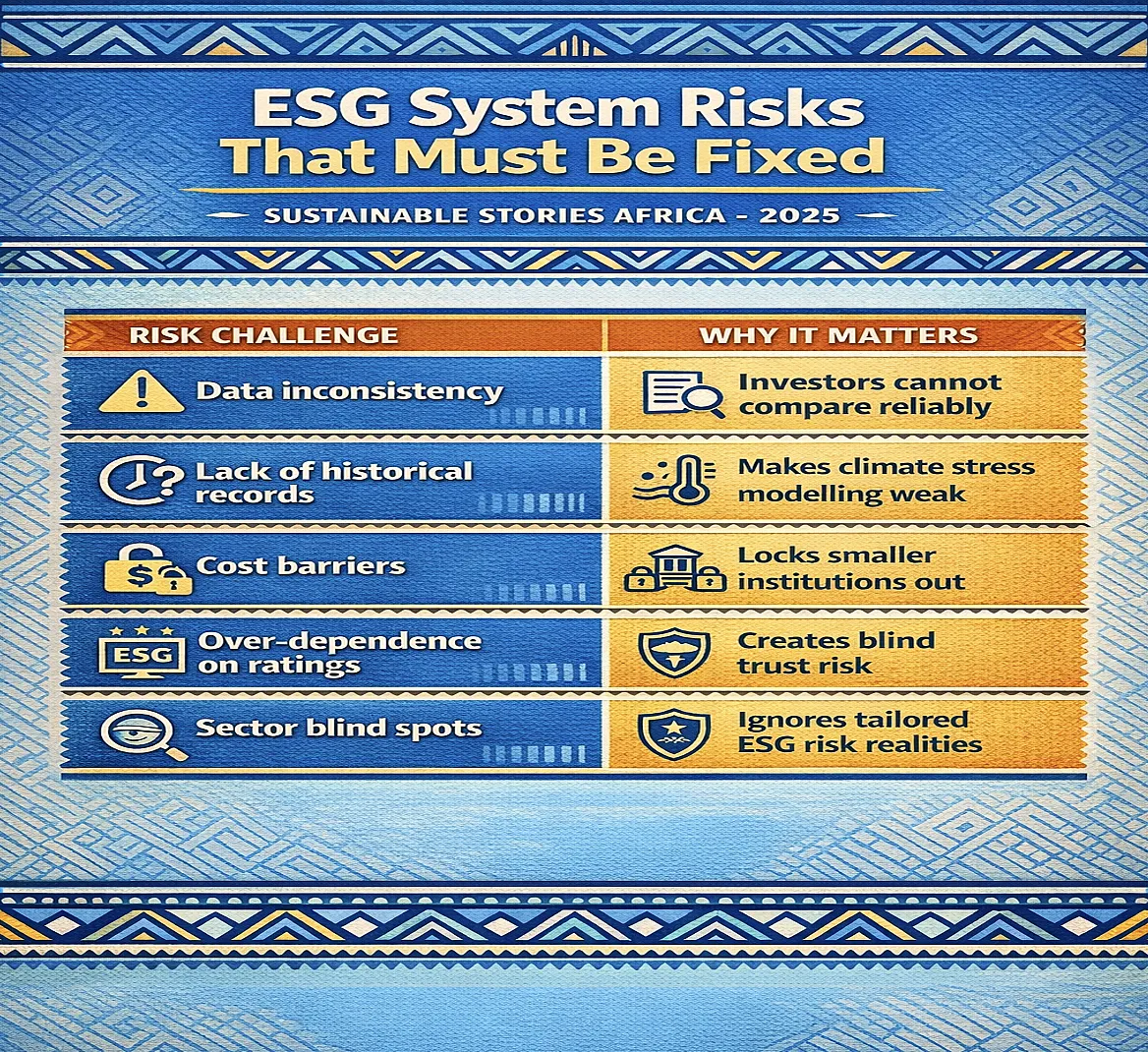
ESG System Risks That Must Be Fixed
| Risk Challenge | Why It Matters |
|---|---|
| Data inconsistency | Investors cannot compare reliably |
| Lack of historical records | Makes climate stress modelling weak |
| Cost barriers | Locks smaller institutions out |
| Over-dependence on ratings | Creates blind trust risk |
| Sector blind spots | Ignores tailored ESG risk realities |
ESG System Risks That Must Be Fixed
Meanwhile, spending is growing:
- 61% invest $50,000–$99,000 annually
- 31% invest $100,000–$500,000 annually in ESG analytics, AI systems, and intelligence
Regulation will tighten:
- 68% adapting to climate disclosure rules
- 66% complying with mandatory ESG reporting
- 78% now use ESG data management platforms
The market is maturing fast. The stakes are higher. The credibility requirement is non-negotiable.
PATH FORWARD – Standardise, Strengthen, Digitise and Deliver.
The ESG investment ecosystem is entering a decisive phase: from enthusiasm to execution discipline. Financial institutions must strengthen ESG data credibility, deepen technology integration, expand standardisation, lower access barriers, and enhance regional equity, especially for emerging markets.
The future belongs to financial systems that integrate ESG not as cosmetic policy, but as structural intelligence powering resilient, profitable, and responsible capital allocation. ESG now defines financial leadership.