Twenty-five African entrepreneurs show that capital readiness, funding fit and persistence must work together.
Africa’s women entrepreneurs are not short of ambition; they are short of finance structured around how their businesses actually grow.
A new AFAWA–Lionesses of Africa playbook draws practical lessons from 25 founders, shifting the conversation from a single funding product to readiness, fit, credibility and long-term financial relationships.
Financing Gap Demands Practical Founder Evidence
African women entrepreneurs face an estimated $42 billion financing gap, a figure repeatedly cited by the African Development Bank’s Affirmative Finance Action for Women in Africa initiative.
The number describes a structural market failure, but it can obscure the decisions behind it: whether to fund growth through revenue, borrow against cash flow, bring in equity partners, use guarantees or delay expansion.
Financing Business Growth, published by Lionesses of Africa with the African Development Bank’s AFAWA initiative, brings those decisions into view.
The playbook features 25 leading African women entrepreneurs who share practical strategies, experiences and advice.
Its value lies in showing that financing is not one event. It changes with business stage, asset needs, revenue visibility, risk and the founder’s willingness to share control.
That framing is important for policymakers and lenders.
- A business may be viable but not ready for a particular instrument.
- A founder may need working capital rather than equity, equipment leasing rather than a general loan, or patient capital rather than short-tenor debt.
Better finance begins with a better diagnosis.
Funding Fit Matters More Than Fashion
Entrepreneurs are often encouraged to pursue venture capital as proof of success. Yet equity is appropriate only when growth potential, investor returns and governance expectations align.
For many trading, manufacturing, agriculture and service businesses, retained earnings, supplier credit, purchase-order finance, leasing or bank debt may preserve more ownership and fit the cash cycle better.
The right question is not,
- “What money is available?”
It is,
- “What obligation does this money create, and can the business carry it?”
This is because;
- Debt requires predictable repayment.
- Equity requires dilution, governance and an exit logic.
- Grants may fund experimentation but can distort priorities if the business becomes dependent on donor cycles.
- Revenue is slow, but it provides strong evidence of customer demand.
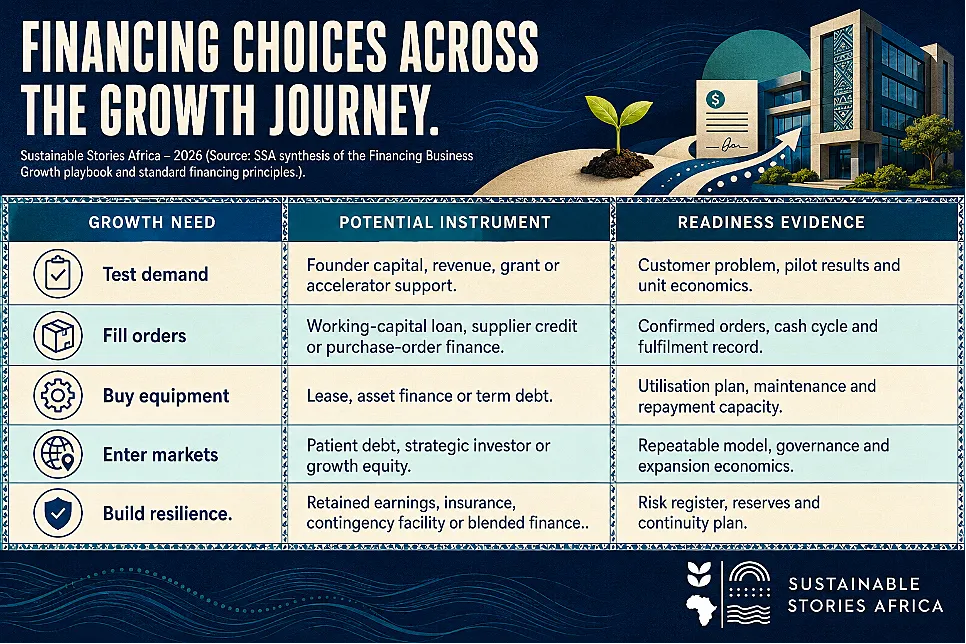
Founders need a financing architecture that can evolve. Early-stage capital may validate a product; working capital may support orders; asset finance may expand capacity; and later equity may open markets.
Each layer should solve a defined constraint rather than increase the cash balance.
Readiness Converts Businesses Into Credible Propositions
Capital providers assess evidence.
- Founders therefore need reliable accounts, tax and registration records, clear ownership, customer contracts, cash-flow forecasts and an explanation of how funds will generate returns or repayment.
These are not ceremonial documents prepared after an investor appears; they are operating tools.
Governance also influences access.
- Separating personal and business money, documenting decisions, establishing approval limits and creating credible boards or advisers can reduce perceived risk.
For women founders who already face bias, strong records cannot eliminate discrimination.
However, they can make it harder for institutions to hide poor lending practice behind vague claims of unreadiness.
The ecosystem has obligations too.
- Banks should examine business models and cash cycles rather than rely excessively on fixed collateral.
- Guarantee schemes should measure additional lending and business outcomes, not only facilities approved.
- Investors should publish decision timelines and feedback.
- Business-support organisations should help founders produce finance-ready evidence without turning compliance into a permanent consultancy expense.
Digital transaction records can strengthen a financing case, but access to data must be fair.
Founders should understand how platforms and lenders use sales, payment and inventory information
Consent, portability and correction processes matter if alternative data is to expand credit rather than reproduce hidden bias.
Founder Stories Reveal Systems Behind Capital
Case studies change what the market can see.
They show how founders combined instruments, recovered from rejection, built lending relationships and strengthened financial management.
They also reveal where informal networks, procurement access and sector knowledge can matter as much as a pitch deck.
However, stories should not be used to romanticise persistence.
A founder who survives repeated barriers is not evidence that the system works.
The playbook’s lessons become most useful when institutions convert them into product design: repayment aligned with seasonality, smaller ticket sizes with graduated limits, movable-asset security, digital cash-flow data and transparent credit assessment.
This is where development impact and commercial logic meet.
- Financing women-led firms can expand jobs, supplier networks, household income and local services.
- The strongest programmes track those outcomes alongside portfolio quality, enabling evidence to replace assumptions about women-owned enterprises.
Case selection should also reflect diversity. High-growth technology firms can offer compelling narratives, but finance systems must serve manufacturers, traders, farmers, care businesses and creative enterprises.
Publishing sector-specific repayment and growth evidence can help lenders distinguish business-model risk from gendered assumptions.
Capital Providers Must Redesign Their Processes
- Governments and development institutions should address legal identity, movable collateral, procurement access, credit information and digital payments.
- Banks need relationship managers trained to understand sectors and gendered barriers.
- Funders should offer combinations of finance, technical support and market access without making women complete overlapping application processes.
Founders, meanwhile, should build a data room before a capital raise, forecast downside scenarios, define the amount and purpose of funding, and identify the milestones it will buy.
They should negotiate not only pricing but security, covenants, control rights, reporting burden and the consequences of slower growth.
Measurement should follow the customer journey. Institutions need to know how many applicants progress, where women exit the process, how long decisions take and whether approved facilities are drawn.
Disaggregated data can reveal whether a product advertised for women actually reaches them on usable terms.
Path Forward – Match Capital With Capability
Women founders need financing that matches cash cycles, assets and growth stages, supported by reliable records and clear governance.
Capital providers must improve product design and decision transparency.
The playbook’s 25 voices should become more than inspiration.
Their experience can guide measurable reforms that narrow the $42 billion gap while building stronger, investable and resilient African enterprises.