


Global sustainable bond issuance reached $878 billion in the first nine months of 2026, according to Moody’s.
Green and social bonds supported growth, while other categories weakened.
For African issuers, the market’s expansion raises a practical question: how can borrowing translate into credible, affordable projects and measurable benefits?
A growing market with uneven momentum
Global sustainable bond issuance reached $878 billion through the third quarter of 2026, up 8% from a year earlier, according to a Moody’s report published on 17 November.
- Third-quarter issuance was $271 billion, an 11% annual increase.
The figures indicate continued financing activity under sustainability labels.
- They do not show how much money reached African projects or establish the environmental and social results of that borrowing.
- For governments and companies considering the market, both distinctions are essential.
A bond can provide capital for an eligible purpose.
The wider value depends on the financed project, the debt terms, and the quality of reporting after investors have supplied the money.
Green and social bonds drive the quarter
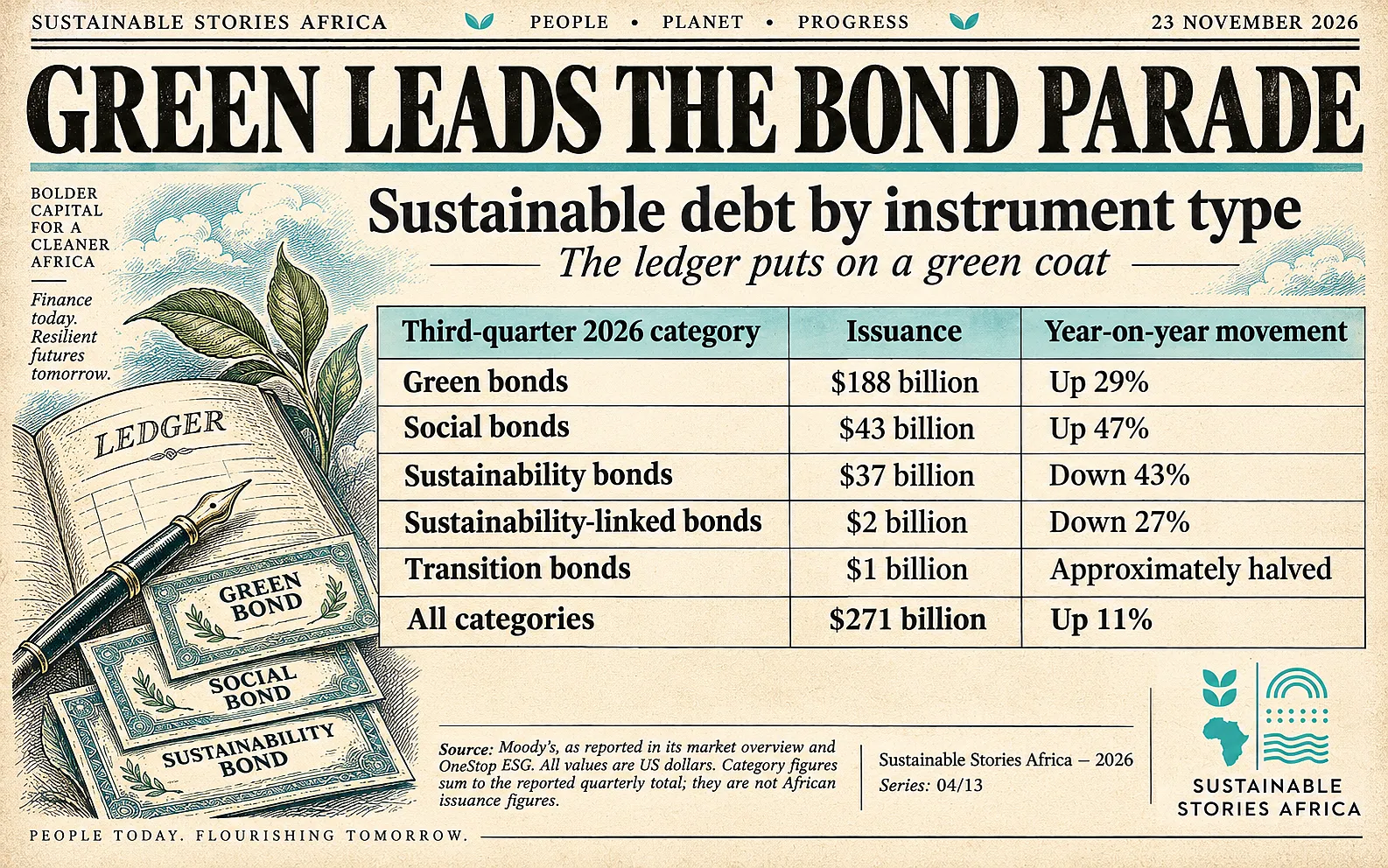
Moody’s reports third-quarter green bond issuance of $188 billion and social bond issuance of $43 billion, increases of 29% and 47%, respectively.
- Europe accounted for $142 billion across sustainable categories, more than half the quarterly global total.
Other categories moved in the opposite direction.
- OneStop ESG’s account of Moody’s findings puts sustainability bond issuance at $37 billion, down 43%; sustainability-linked bonds at $2 billion, down 27%; and transition bonds at $1 billion, around half their year-earlier level.
These categories have different structures.
- Use-of-proceeds bonds finance designated eligible activities.
- Sustainability-linked bonds can support general corporate purposes, with financing terms tied to sustainability targets.
The distinction changes what investors need to assess and what issuers must demonstrate.
Moving from a label to public value
For African borrowers, the most useful lesson concerns preparation.
- A financing label cannot substitute for a workable project, a credible repayment plan or the capacity to track expenditure.
- Issuers need to establish those foundations before deciding whether a labelled bond is the appropriate instrument.
Consider a proposed water project.
- Its environmental or social case would need more than a description of the infrastructure.
- Investors and communities could reasonably ask who will receive service, how reliability will be measured, what households will pay and whether the operator can maintain the asset.
The financing structure also deserves attention.
- Debt denominated in a foreign currency can expose a borrower earning local revenues to exchange-rate changes.
- A sustainability designation does not remove that mismatch.
- Assess project selection and financial resilience together.
The reported growth therefore presents an opportunity, not an automatic entitlement to cheap capital.
- A smaller issuer with clear project accounts and credible outcome reporting may have a stronger sustainability case than a larger borrowing programme with vague promises.
This is an assessment principle, not a prediction about market pricing.
Put reporting and repayment alongside issuance
Issuers should publish clear frameworks explaining eligible spending, selection procedures and how funds will be tracked.
Investors should examine reporting commitments alongside conventional credit analysis, including debt service and implementation risks.
Outcome indicators should be specific enough to test.
- Installed capacity differs from electricity delivered; infrastructure built differs from households served.
- Reporting both outputs and service outcomes would help readers understand what financed projects achieve.
Moody’s also reports that 89% of use-of-proceeds instruments in its second-party opinion portfolio received its two highest sustainability-quality scores, compared with 62% of sustainability-linked structures.
- These figures describe its assessed portfolio, not the entire market.
The central accountability task begins after issuance: showing where money went, whether promised activities occurred and what changed for the intended beneficiaries.
Path Forward – Turning sustainable borrowing into public value
The expanding bond market creates financing possibilities, but African issuers still need credible projects, appropriate debt structures and reporting capacity.
Investors and communities should assess delivery alongside issuance volumes.
A larger labelled market is useful only when financing supports demonstrated outcomes.