


Stephen Pitt-Walker argues that separating the chair and chief executive roles gives corporate accountability a firmer foundation.
His 22 November article recognises arguments for combined leadership while questioning its oversight risks.
For African boards, the discussion offers a practical test of who can challenge management and act on uncomfortable evidence.
Who leads the scrutiny of leadership
Stephen Pitt-Walker has called for companies to separate the roles of board chair and chief executive, arguing in a LinkedIn article published on 22 November that accountability should be built into governance arrangements.
- His argument focuses on the tension created when the person running a business also leads the board that reviews management.
The article is a governance argument, rather than an announcement of a new regulation.
- It brings a familiar boardroom question into practical focus: who controls the agenda and information when directors assess the chief executive’s performance?
This question matters to investors and to people affected by corporate decisions.
- A board’s ability to examine weak performance, unresolved complaints or unreliable information can influence whether problems are addressed before they become more costly.
Independence needs authority and information
Pitt-Walker acknowledges that combined leadership can offer continuity, organisational knowledge and speed.
- He also notes that evidence linking role separation to better financial performance is mixed.
- His case therefore centres on accountability rather than a guaranteed increase in returns.
Where roles remain combined, he advocates an empowered lead independent director, independent committees and meetings without management.
- He also warns that a chair’s dependence on a controlling shareholder can weaken substantive independence even when management and chair roles are separate.
The OECD’s Corporate Governance Factbook 2025 provides a wider reference point:
- 76% of surveyed jurisdictions require or encourage separation, compared with 44% in 2014.
This is a finding about governance frameworks, not the percentage of companies that actually separate the roles.
- It does not establish a universal legal requirement.
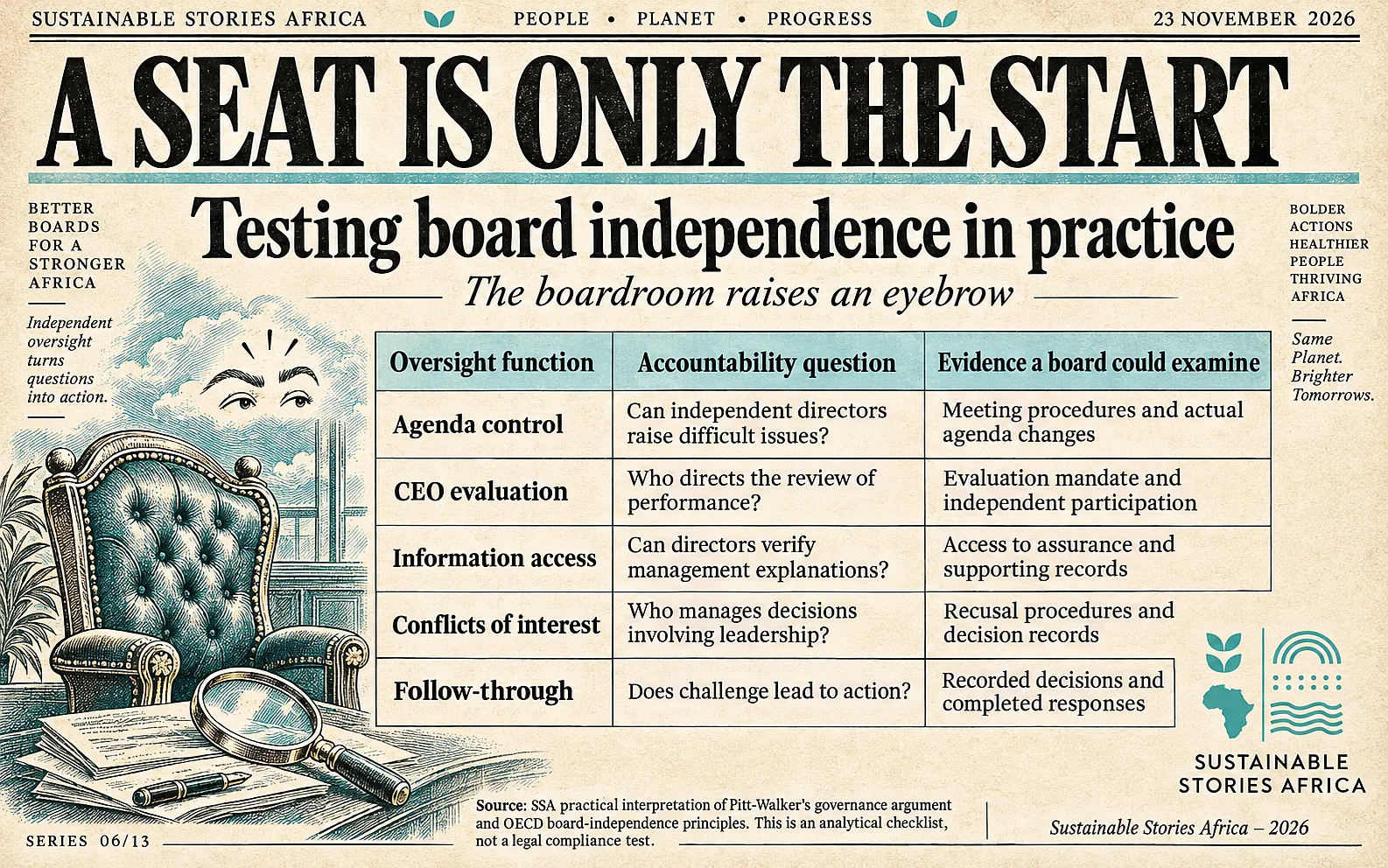
Making governance work beyond job titles
For African companies, the article’s strongest practical application is to review how oversight works in ordinary decisions.
- A structure chart cannot show whether directors receive information early enough or whether a difficult issue disappears between meetings.
Consider a board reviewing a sustainability commitment that is falling behind schedule.
- Effective scrutiny would require reliable progress information, a clear account of spending and the opportunity to question management’s assumptions.
- Changing the chair’s title would accomplish little if those conditions remained absent.
The same applies to a founder-led business preparing for outside investment.
- Clear decision rights can help preserve the founder’s contribution while giving other directors a defined role.
- The challenge is to establish boundaries that everyone can use when views diverge, rather than rely on goodwill alone.
Independent oversight can also support management.
- A chief executive who receives informed challenge before a major commitment can test assumptions and improve the proposal.
- This is a potential benefit of the arrangement, not proof that every disagreement improves a decision.
Review the decisions that reveal control
Boards can begin with a small set of consequential processes: executive evaluation, remuneration, succession, related-party transactions and responses to serious concerns.
- For each, they should identify who initiates the review, who supplies evidence and who can approve action.
They should then test those written arrangements against recent practice.
- Were conflicts recorded?
- Did directors obtain the information they requested?
- Were agreed actions completed?
A review based on actual decisions can reveal weaknesses that a policy inventory misses.
Shareholders can ask companies to explain why their chosen leadership structure suits the business and how independent challenge is protected.
- Where roles are combined, that explanation should identify the safeguards and the circumstances in which the arrangement will be reconsidered.
Path Forward – Making independent oversight effective in decisions
The debate should lead boards to examine the authority, information and working relationships behind formal independence.
Separation can support accountability, but it still needs capable directors and workable procedures.
Companies should explain their arrangements clearly and demonstrate how oversight affects decisions, especially when leadership interests are directly involved.