The African Development Bank has approved €93.9 million for Uganda’s rural electricity programme.
The funding supports UREAP Phases I and II, including compensation and new last-mile connections.
For households, schools, clinics and small businesses, the project could turn grid expansion into daily access.
Last-Mile Power Gets Fresh Backing
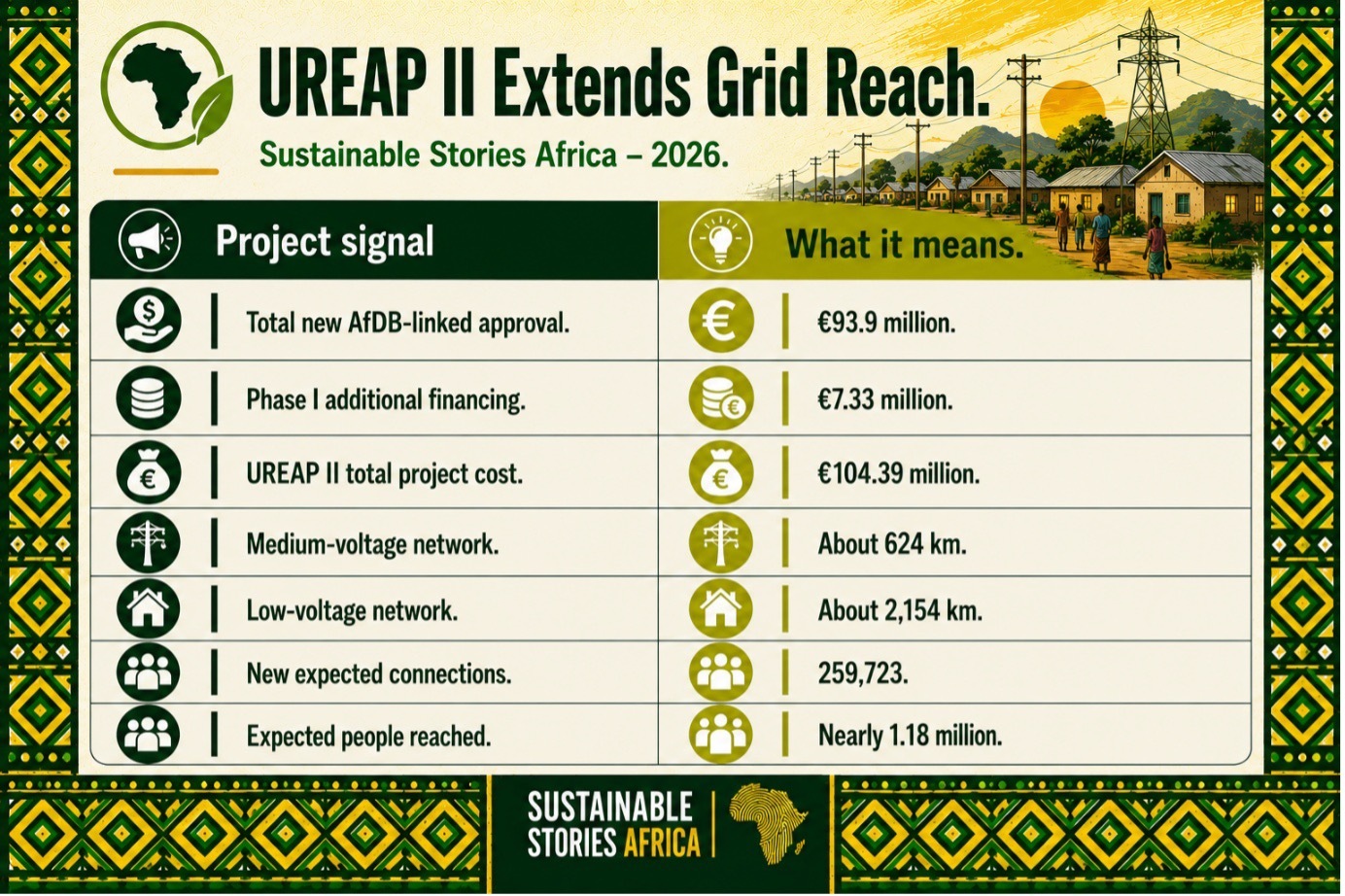
The African Development Bank Group has approved €93.9 million to expand last-mile electricity connections in Uganda under the Rural Electricity Access Project, UREAP, supporting the completion of Phase I and the rollout of Phase II across rural and peri-urban communities.
The package includes €7.33 million in additional financing to complete compensation payments for people affected by UREAP Phase I, which has already provided last-mile grid connections to 137,770 households, benefiting about 670,000 people.
AfDB also approved Phase II on April 7, 2026, with a total project cost of €104.39 million.
The story matters because access to electricity is not only an infrastructure statistic. It is the difference between
- A clinic storing vaccines
- A student studying after sunset
- A welder keeping machines running
- A rural trader moving beyond daylight-only business hours.
UREAP II Extends Grid Reach
UREAP II will construct about 624 kilometres of medium-voltage lines and 2,154 kilometres of low-voltage distribution networks, delivering an estimated 259,723 new grid and mini-grid connections over six years.
These include connections for more than 250,000 households, 3,000 businesses, and public institutions such as schools and health centres.
The financing structure includes an AfDB loan of €86.58 million, a €12.93 million Climate Investment Funds loan financing, a €1.72 million CIF grant, and €3.16 million in Government of Uganda counterpart funding.
Electricity Can Change Rural Economics
AfDB’s East Africa Regional Manager for Energy, Aleymahu Wubeshet-Zegeye, said the financing ensures that communities are not left behind, allowing the Bank and Uganda to complete earlier commitments and secure development impact.
For communities, that impact is practical.
- A hairdresser can run clippers without a generator.
- A maize mill can process harvested produce closer to farms.
- A health post can refrigerate medicine.
- A school can use digital tools. These gains may look small individually.
Together, they reshape rural productivity.
Delivery Must Protect Affordability
The project also contributes to Mission 300, the AfDB–World Bank initiative to connect 300 million people in Sub-Saharan Africa to electricity by 2030.
Uganda is among the countries expected to benefit from the initiative’s push to move energy access from planning documents into household and business connections.
Still, last-mile power access succeeds only when connections become usable electricity.
That means affordability, reliable supply, transparent connection processes, maintenance, and support for productive use of small businesses.
Without these, new lines can reach communities without transforming livelihoods.
The ESG test is whether public finance expands clean, inclusive and economically useful electricity access for communities that have waited the longest.
Path Forward – Connect Homes, Power Livelihoods
Uganda’s priority is to turn approved financing into working connections, reliable service, fair compensation and productive energy use.
If implemented well, UREAP Phases I and II can reduce energy poverty, support rural enterprise, improve public services and advance Africa’s wider sustainable electricity access agenda.
Press Release: African Development Bank approves €93.9 million to expand last-mile power connections under UREAP Phases I & II | Africa Energy Portal