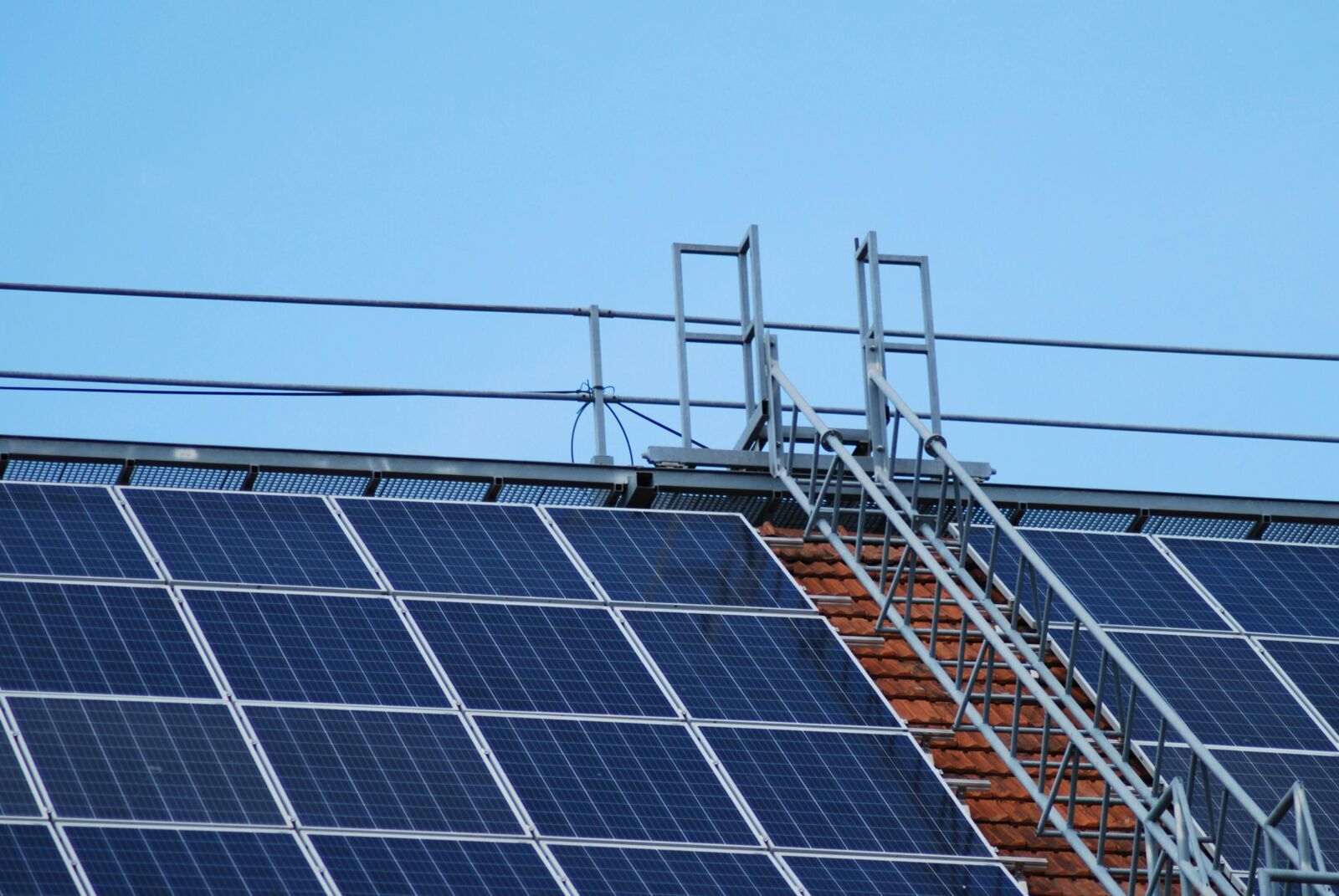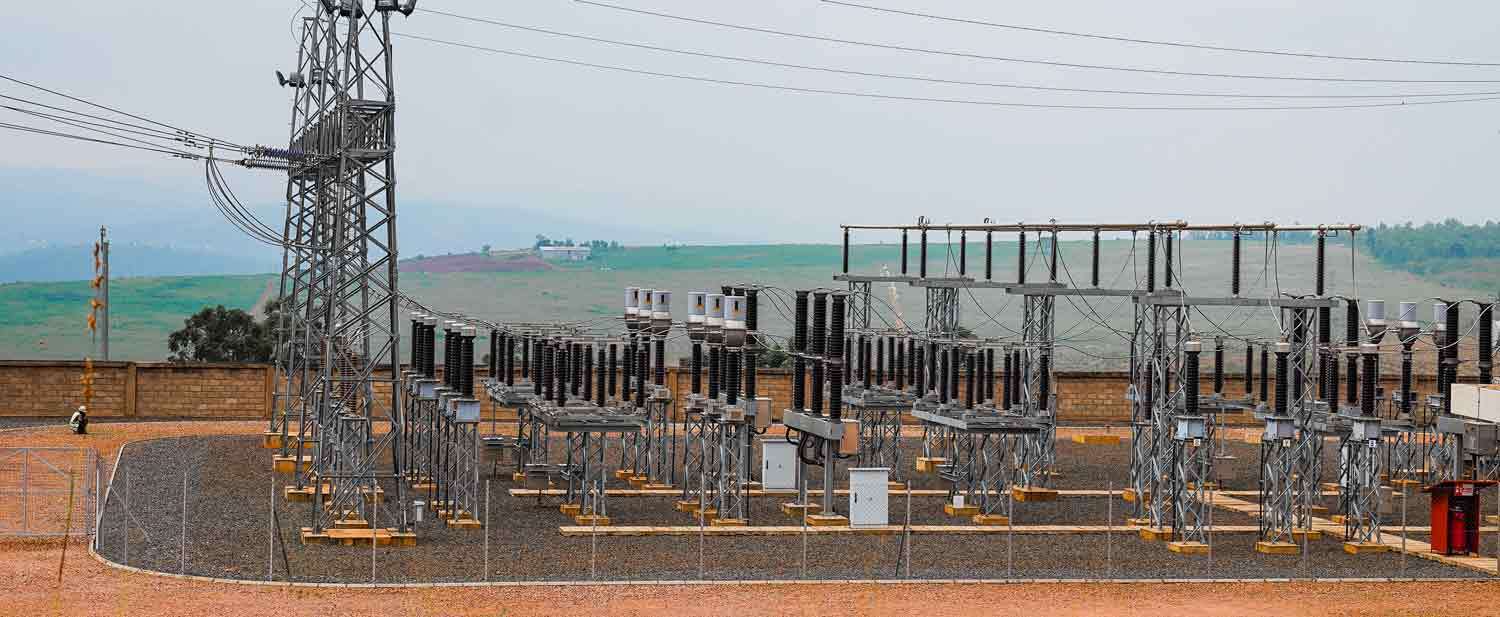
Corporate power purchase agreements are gaining momentum across Africa as companies seek cheaper, cleaner and more reliable electricity.
The shift matters now because grid pressure, diesel costs and ESG obligations are pushing businesses toward long-term private power contracts.
For investors, the prize is predictable revenue; for factories, mines and telecoms, it is survival-grade energy security.
Private Power Becomes Big Business
Across Africa, corporate power purchase agreements are moving from niche energy contracts to a serious investment strategy, as businesses turn to private renewable power to escape unreliable grids, volatile diesel costs and rising carbon scrutiny.
Its commercial reality is now the new driving force. Companies need power they can price, trust and report.
For investors, corporate PPAs offer long-term offtake agreements, bankable cash flows, and exposure to fast-growing demand for solar, storage and hybrid energy systems.
The opportunity is especially common in countries such as South Africa, Nigeria, Kenya, Egypt and other markets where industrial users, telecom operators, mines, data centres and manufacturers are under pressure to cut energy costs while meeting sustainability targets.
Africa still accounts for only about 2% of global clean energy investment despite having roughly 20% of the world’s population, according to the IEA, leaving a wide financing gap for private capital to fill. (IEA)
Why Companies Are Signing Faster
Corporate PPAs allow businesses to buy electricity directly from independent power producers, often under 10- to 25-year contracts. The model gives developers revenue visibility while giving companies a hedge against blackouts, tariff shocks and diesel dependency.
South Africa has become the continent’s clearest test case. Regulatory changes since 2021 eased licensing limits for private generation, while the Electricity Regulation Amendment Act, effective from January 2025, aims to open the market to more competition and electricity trading. (IEA)
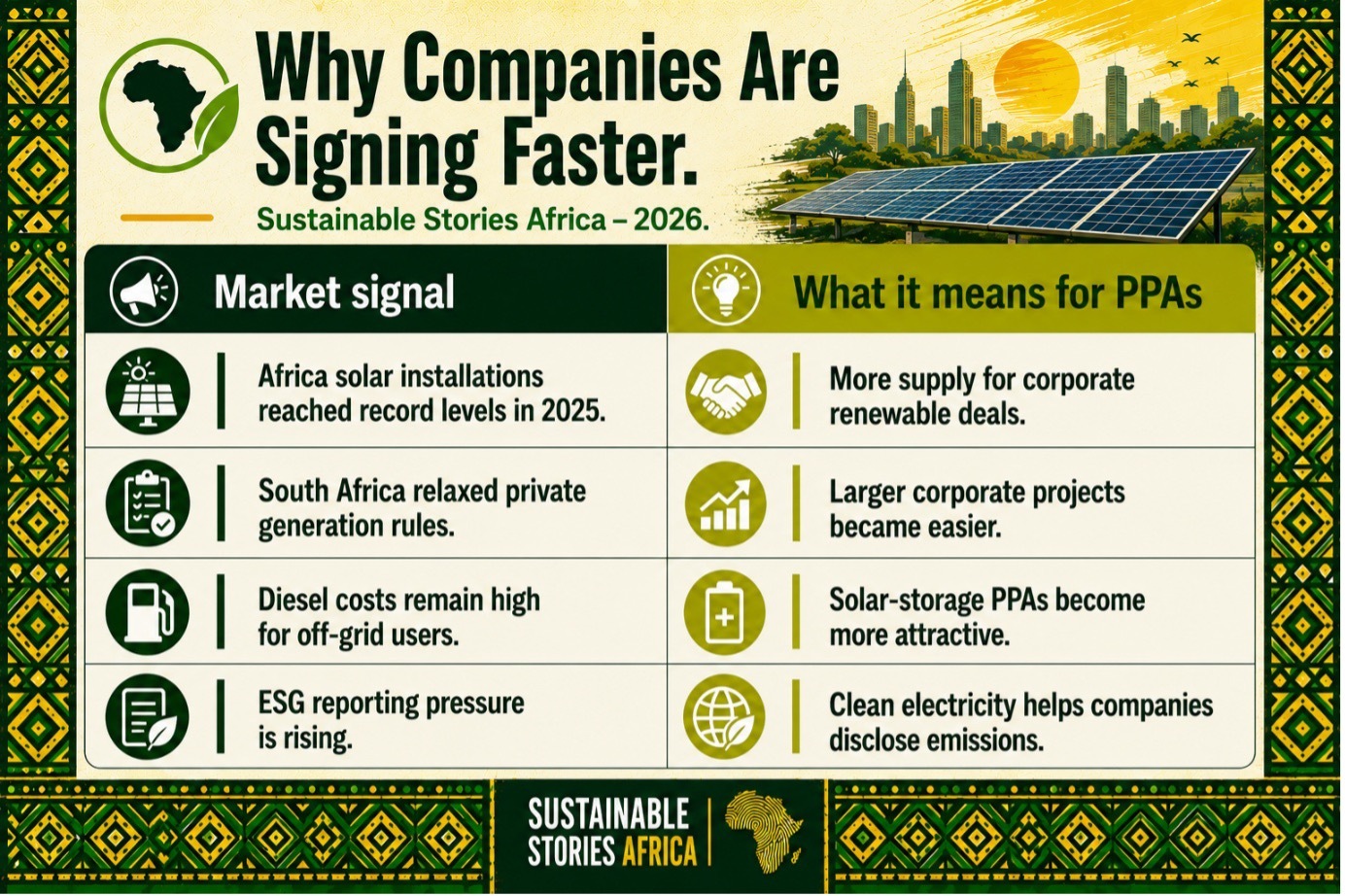
The commercial logic is spreading beyond South Africa. Reuters reported that Africa installed 4.5 GW of photovoltaic capacity in 2025, a 54% increase from 2024, with demand for battery storage rising as companies seek more reliable power.
Investors See Predictable Green Revenue
For investors, the appeal is not only climate impact. It is contract certainty. A well-structured PPA can turn a factory, mine or telecom tower into a reliable buyer of clean electricity, reducing the revenue risk that often weakens African infrastructure projects.
BloombergNEF found that corporate PPAs signed globally between 2015 and 2024 supported 301 GW of renewable energy projects, showing how corporate demand can unlock new clean power capacity when contracts are bankable.
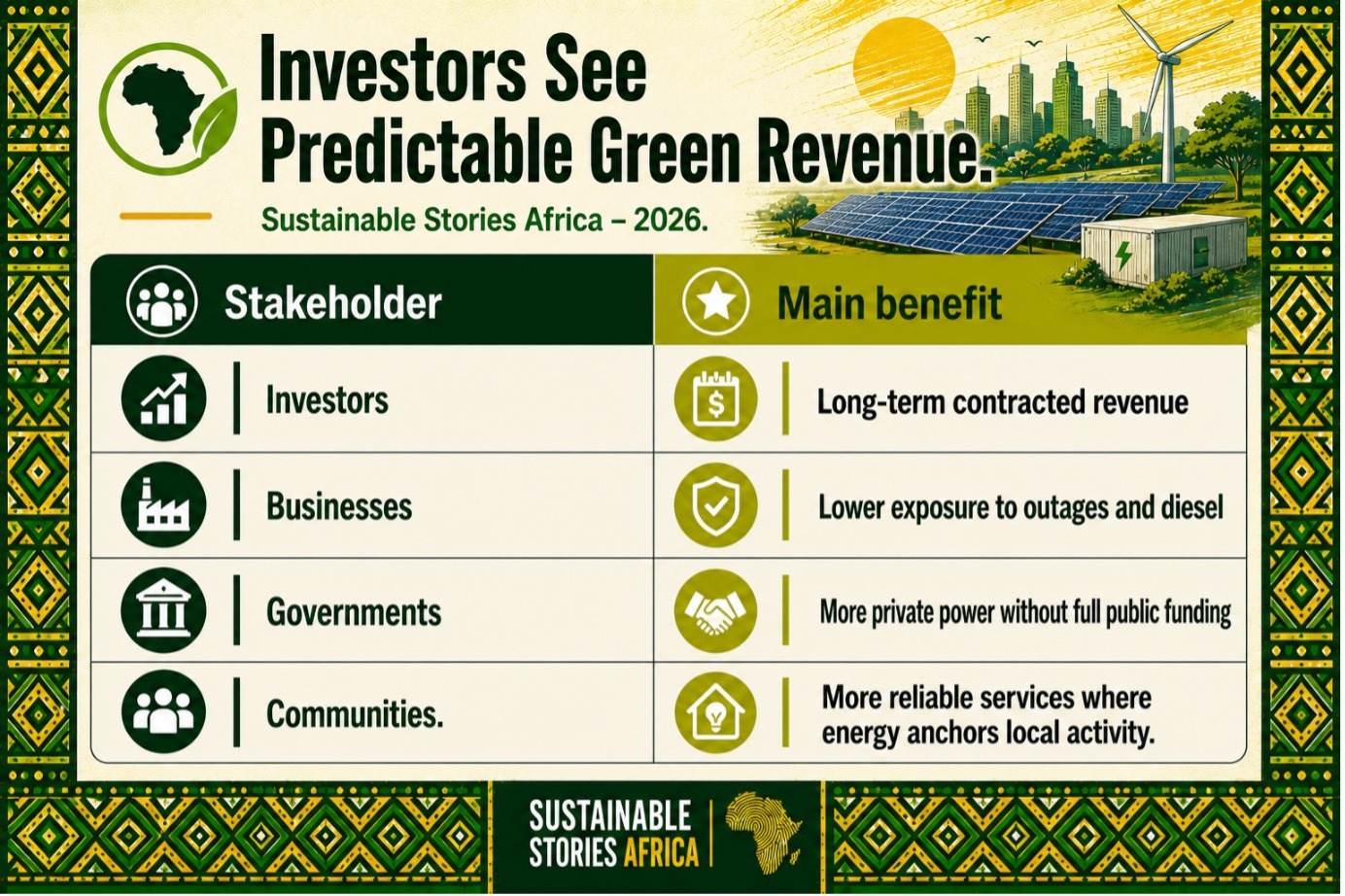
The human story is practical. A telecom tower that shifts from diesel to solar can reduce fuel logistics, improve uptime, keep the mobile money system up, and enable emergency calls and online learning in underserved areas.
Recent reporting shows African telecom operators are increasingly turning to solar and hybrid systems as diesel costs surge.
Policy Must Catch The Market
The next test is whether African regulators can turn corporate PPA momentum into a scalable energy market rather than a deal-by-deal workaround.
Governments need clearer wheeling rules, standardised contracts, transparent tariffs, faster permitting and local-currency financing options.
Without that, only large corporations with strong balance sheets will benefit, while smaller manufacturers and mid-sized businesses remain trapped between weak grids and expensive backup power.
The strongest opportunity lies in combining private capital with public reform.
If African markets can reduce regulatory uncertainty, investors will have more confidence to fund solar, storage, mini-grids and hybrid systems.
If they cannot, corporate PPAs may remain concentrated in a few countries and a few powerful buyers.
Path Forward – Build Rules Investors Can Trust
Africa’s corporate PPA boom can advance ESG, energy security and industrial competitiveness if governments make private power easier to contract, finance and wheel across grids.
The priority is clear: bankable rules, credible offtakers, transparent tariffs and inclusive access for smaller businesses. That would turn today’s investor appetite into broader clean-energy growth for African markets.
Culled From: Investors cash in as corporate PPAs surge in Africa