Comoros is trying to turn climate vulnerability into an investment plan, using a UNECA and UNCTAD-backed roadmap to strengthen governance, build bankable projects and widen access to external climate finance.
The question is whether new institutions, diaspora capital, green and blue bonds, sukuk and carbon credits can move from policy design to real protection for communities before climate risks deepen.
Comoros Turns Climate Risk Into Finance
Comoros has laid out a phased roadmap to mobilise external climate finance, placing governance reform, accredited national institutions, donor coordination and innovative financial instruments at the centre of its climate-resilience strategy.
The roadmap, prepared with support from the United Nations Economic Commission for Africa and UN Trade and Development, seeks to translate Comoros’ climate-finance strategy into concrete initiatives.
Its stated objective is to build an ecosystem that can attract climate finance from external sources, including aid, through investment, bonds, carbon markets and diaspora participation.
For African markets, the Comoros plan matters because it captures a wider challenge facing small and vulnerable economies: climate finance is available globally, but often difficult to access locally.
The barrier is not always ambition. It is governance, project preparation, data, accreditation, credibility and the ability to match national priorities with investor and donor requirements.
Climate Finance Starts With Governance First
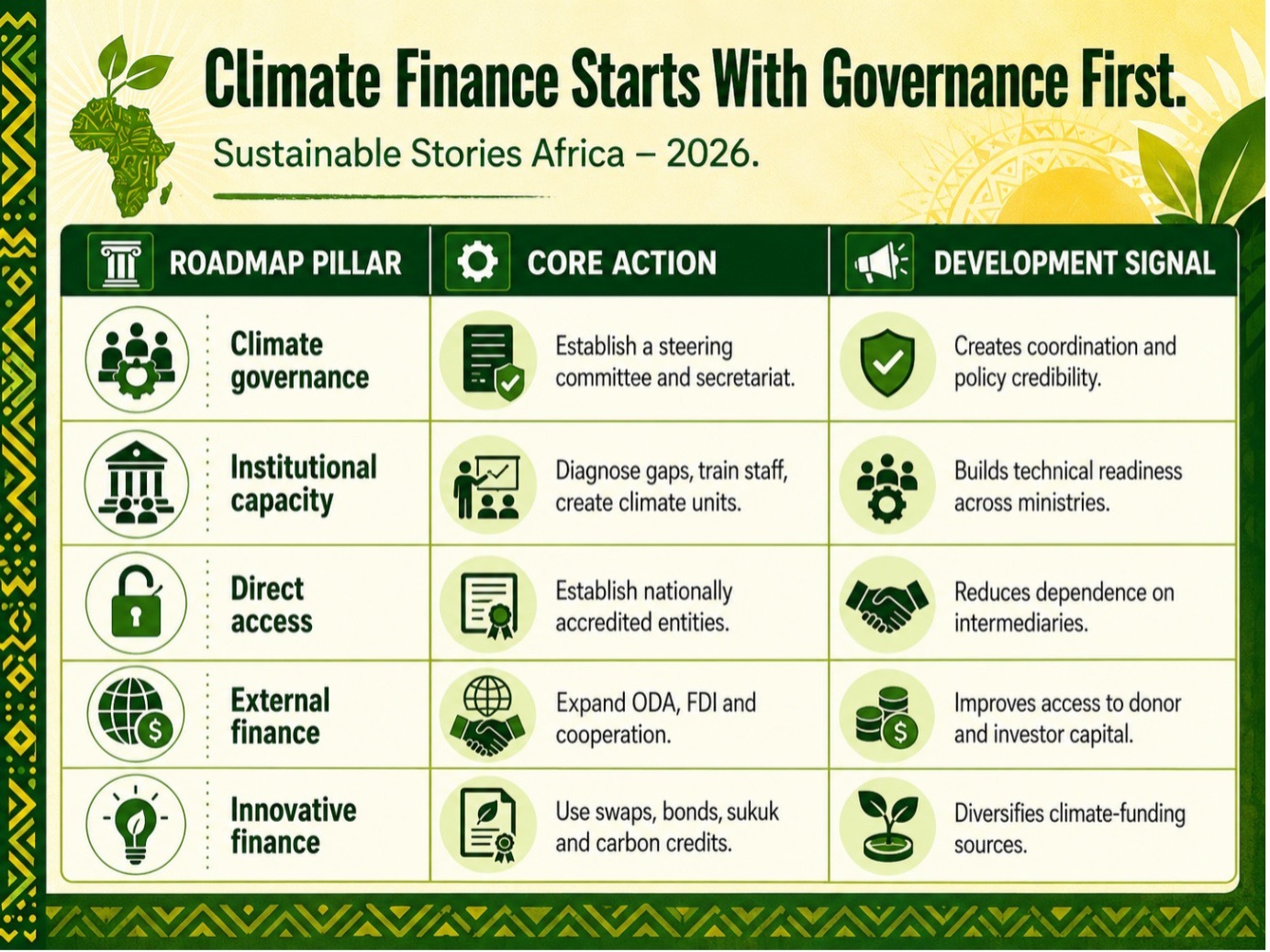
The most important signal in the roadmap is that Comoros is treating climate finance as a governance challenge rather than as a funding chase.
At the centre of the plan is a proposed national climate steering committee and permanent secretariat, designed to provide what the report calls a “stable, inclusive, and operational institutional framework” for coordinating national climate action.
The mechanism is expected to improve policy coherence and make it easier for Comoros to access international climate finance mechanisms.
That is a practical shift. Many African climate plans fail not because the priorities are unclear, but because ministries, donors, project developers and financiers operate in fragmented lanes.
Comoros is proposing a structure that can convene institutions, validate projects, track performance and turn climate priorities into fundable pipelines.
The roadmap’s first pillar includes four phases:
- Legal preparation through a presidential decree, appointment of committee members, operational launch with a national action plan and MRV system, and integration into the Emerging Comoros Plan.
The aim is not just to create another committee, but to anchor climate coordination in the state budget, annual reporting and national development planning.
Roadmap Links Donors, Investors, and Diaspora
Comoros is pursuing a two-track approach to climate finance: expanding official development assistance aligned with climate priorities and attracting foreign direct investment into sustainable sectors.
The roadmap proposes an updated inventory of existing climate finance, a classification of technical and financial partners, and a portfolio of bankable projects aligned with the country's nationally determined contributions.
This portfolio would be reviewed by accredited entities, categorised by mitigation and adaptation themes, and submitted to relevant financing mechanisms.
Diplomatic advocacy is central to the strategy. With limited international influence, Comoros intends to leverage regional alliances, including the Indian Ocean Commission, COMESA, and AfCFTA, to strengthen visibility and access.
A national database linked to the Development Assistance Database would enable real-time tracking of financial flows, disbursements, and project performance.
For investors, the plan outlines familiar enablers: business-climate reforms, infrastructure investment, investment forums, and public-private partnerships, with the National Investment Promotion Agency tasked with attracting foreign and diaspora capital into green and blue sectors.
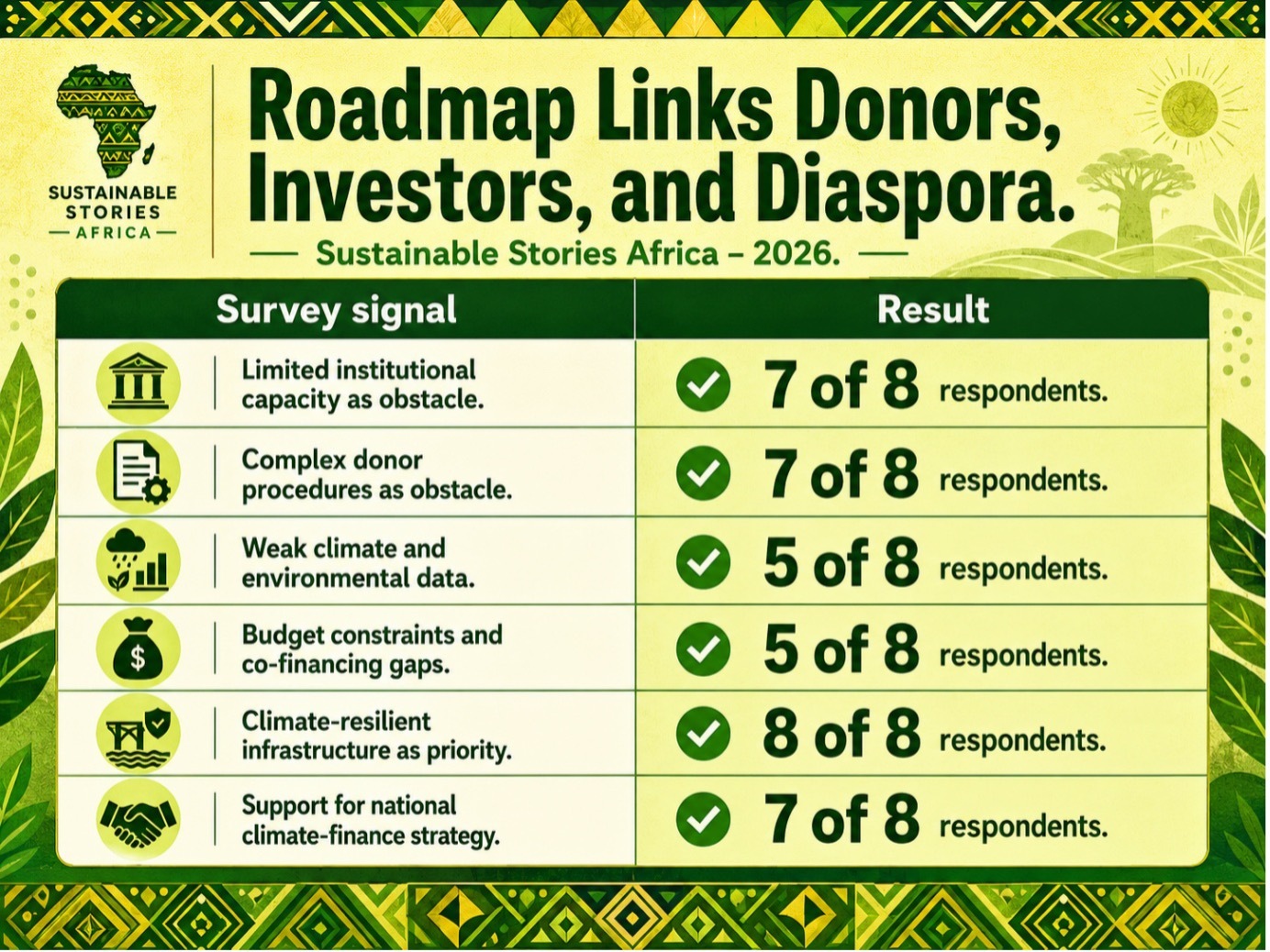
A survey underpinning the roadmap highlights why this reform agenda is urgent. Respondents identified limited institutional capacity, complex donor procedures, weak environmental data, and budget constraints as primary barriers.
Climate-resilient infrastructure was the unanimous sectoral priority, followed by biodiversity, renewable energy, marine ecosystems, and water management.
New Instruments Can Fund Local Resilience
The roadmap’s most ambitious section is its embrace of innovative finance. Comoros is considering debt-for-climate and debt-for-nature swaps, diaspora bonds, green and blue bonds, sukuk and carbon credits as part of a broader financial ecosystem for ecological transition and climate resilience.
However, the report also notes a major constraint: under the IMF Extended Credit Facility agreement for 2023 - 2027, the country may contract debt on concessional terms, meaning multilateral support will be essential.
Debt-for-climate or nature swaps are framed as suitable for least developed countries, restricted to concessional borrowing.
The roadmap proposes debt analysis, identification of bilateral creditors, selection of priority environmental investments, and negotiations with creditor countries, supported by institutions such as the World Bank, the African Development Bank, the IMF and the Green Climate Fund.
Diaspora bonds are another important channel. The plan seeks to mobilise savings from Comorians abroad through a credible bond structure, supported by regulation, project validation, digital subscription platforms, roadshows in France, the Gulf countries and the United States, independent audits and repayment safeguards.
Green and blue bonds would target projects with environmental benefits, while sukuk could open climate investment to Islamic finance investors.
Carbon markets would allow Comoros to monetise verified emissions reductions, including through voluntary markets and Article 6.2 transactions involving internationally transferred mitigation
Delivery Depends On Trust And Data
For Comoros, the hard part begins after the roadmap. The country must now turn design into delivery.
That means passing the legal instruments, staffing the permanent secretariat, building MRV capacity, training sectoral officials, accrediting national entities and producing credible project pipelines. It also means showing investors and donors that funds can be tracked, audited and tied to measurable climate outcomes.
The ESG implications are significant. A stronger MRV system improves transparency. Accredited entities strengthen national ownership. A climate-finance database improves accountability.
Green and blue investment screening can help direct capital into sectors with environmental and social value. Public-private partnerships can bring infrastructure finance closer to communities if governance is strong.
The risk is that ambitious instruments become policy language without transaction readiness. Bonds require ratings, guarantees, investor trust and repayment discipline. Carbon markets require credible baselines, validation, verification and safeguards against double counting.
Diaspora bonds require confidence that money will reach approved projects. Debt swaps require creditor willingness and strong negotiation capacity.
For African policymakers, Comoros offers a clear lesson: climate finance is not only about asking for more money. It is about building the institutions that make money trustworthy.
Path Forward – Finance Must Become Visible Climate Delivery
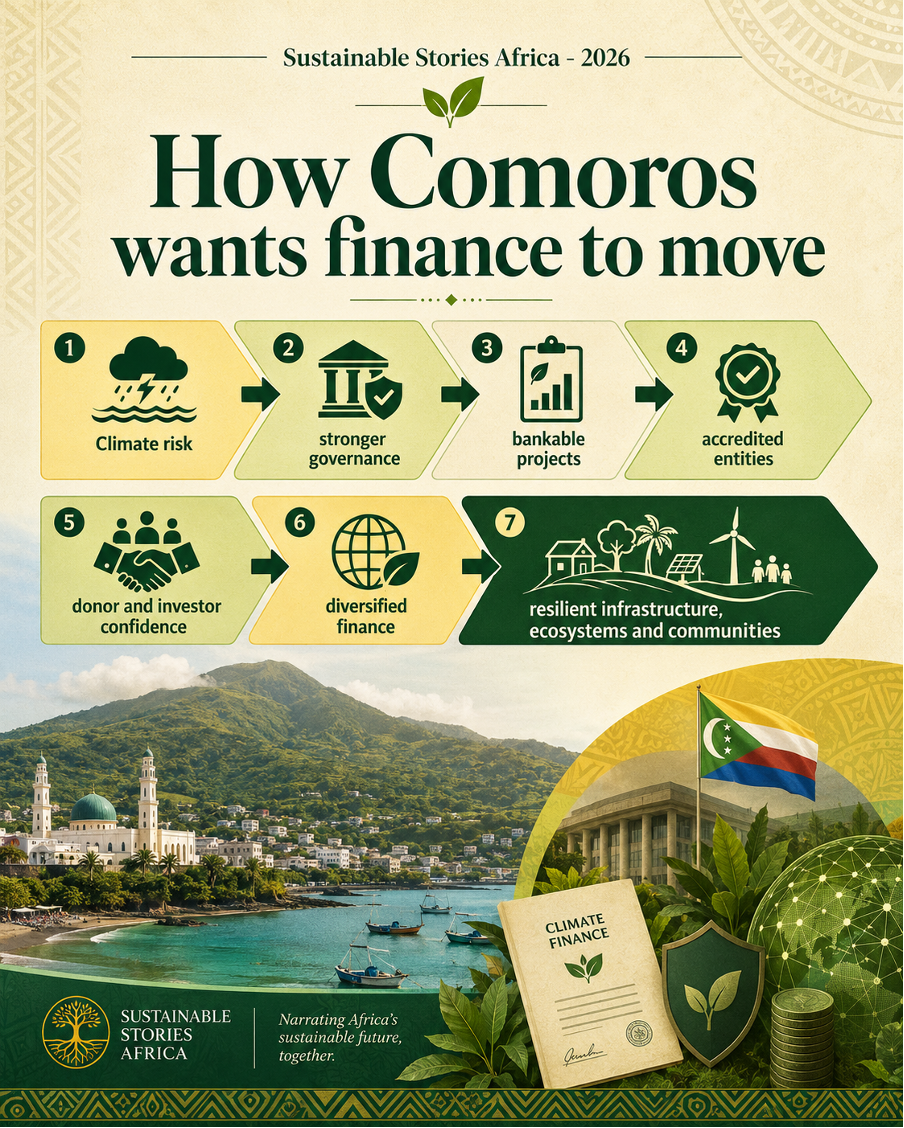
Comoros’ priority is to move from roadmap to execution: establish the climate steering committee, accredit national entities, build MRV systems, prepare bankable projects and use concessional, transparent instruments to attract external finance.
The wider promise is practical: climate finance must reach infrastructure, ecosystems, local firms and communities. That is how Comoros can turn vulnerability into resilience, and resilience into investable sustainable development.