Africa’s debt debate is shifting from how much countries owe to how borrowing is governed, disclosed and used.
UNECA’s Economic Governance Report III argues that weak institutions, opaque liabilities and global financing pressures are turning debt into a development risk — but stronger governance could make borrowing a tool for resilience.
Debt Governance Now Shapes Africa’s Future
Africa’s public debt challenge is no longer just a fiscal story. It is now a governance test, a development test and, increasingly, a social contract test. In its Economic Governance Report III: Assessment of Governance of Public Debt in Africa, UNECA argues that the continent’s debt vulnerabilities are shaped not only by debt levels, but by the institutions that authorise, negotiate, monitor and disclose borrowing.
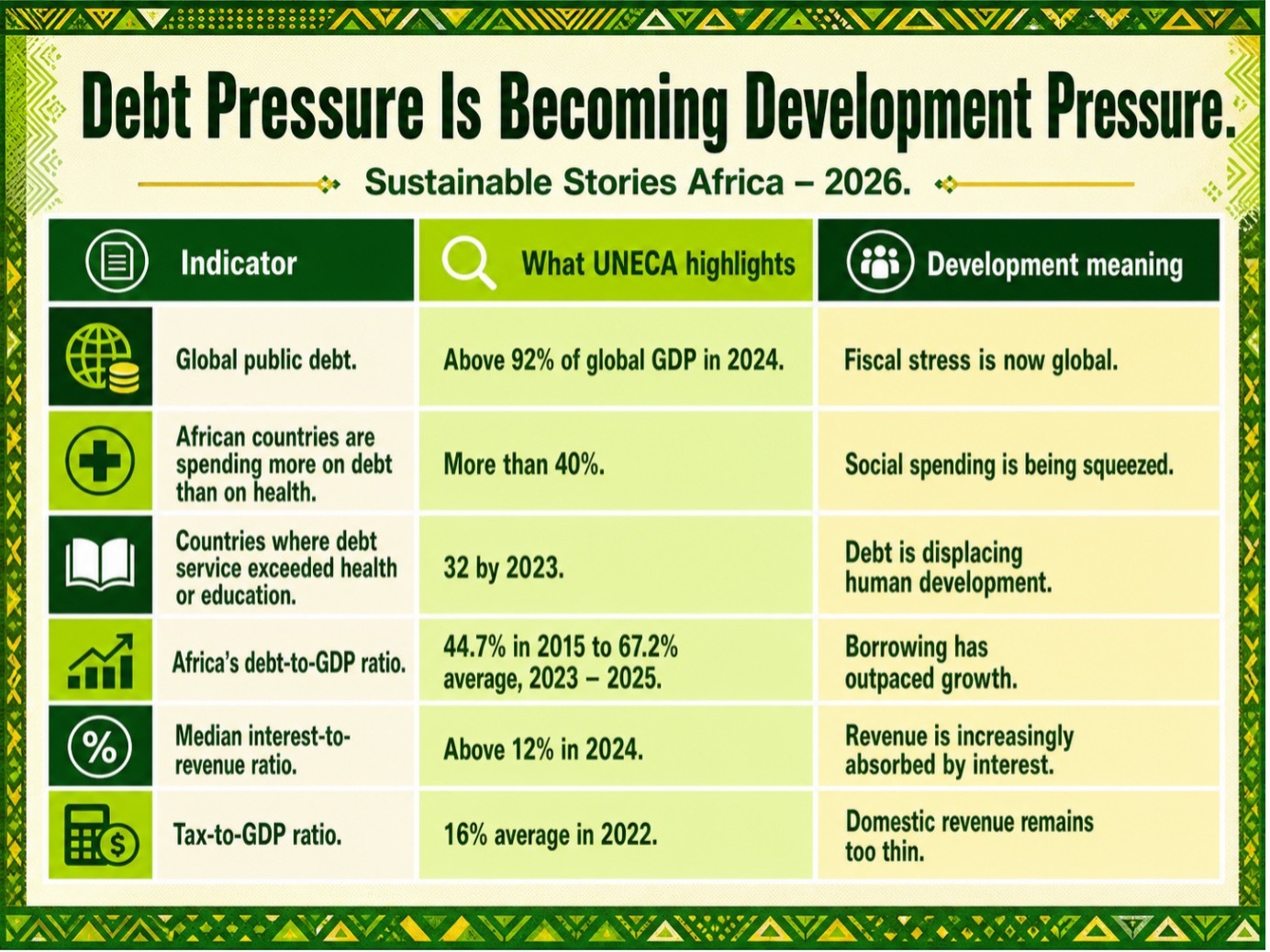
The report lands at a difficult moment. Global public debt exceeded 92% of GDP in 2024, while more than 40% of African countries now spend more on debt service than on health.
For households, that means fewer clinics, weaker schools, delayed infrastructure and governments with less room to respond to climate, food and energy shocks.
UNECA’s central message is clear: debt sustainability is not simply about repayment capacity.
It is about whether borrowed money strengthens productive capacity, protects public services and supports long-term transformation, or it leaves countries servicing obligations while development stalls.
Debt Pressure Is Becoming Development Pressure
The starkest finding is that debt service is crowding out the basics. By 2023, debt service exceeded spending on health or education in 32 African countries, while the median interest-to-revenue ratio across African countries surpassed 12% in 2024.
The report describes this as more than a liquidity issue; it is a “developmental default” when countries keep paying creditors but cannot adequately finance their people.
Debt Numbers Reveal A Governance Gap
UNECA’s report reframes the problem through what it calls a Growth-Enhancing Governance approach.
Unlike conventional models that focus heavily on solvency, repayment and market confidence, this lens asks whether debt is aligned with structural transformation, resilience and social development.
Its case studies, Cameroon, Comoros, Egypt, Ghana, Rwanda and Zambia, show that many countries are better at planning debt than executing, negotiating and monitoring it.
The Debt Sustainability Index found Egypt leading the six-country sample with a score of 3.6 out of 5, followed by Ghana at 2.6, Rwanda at 2.5, Cameroon and Zambia at 2.4 each, and Comoros at 1.3.
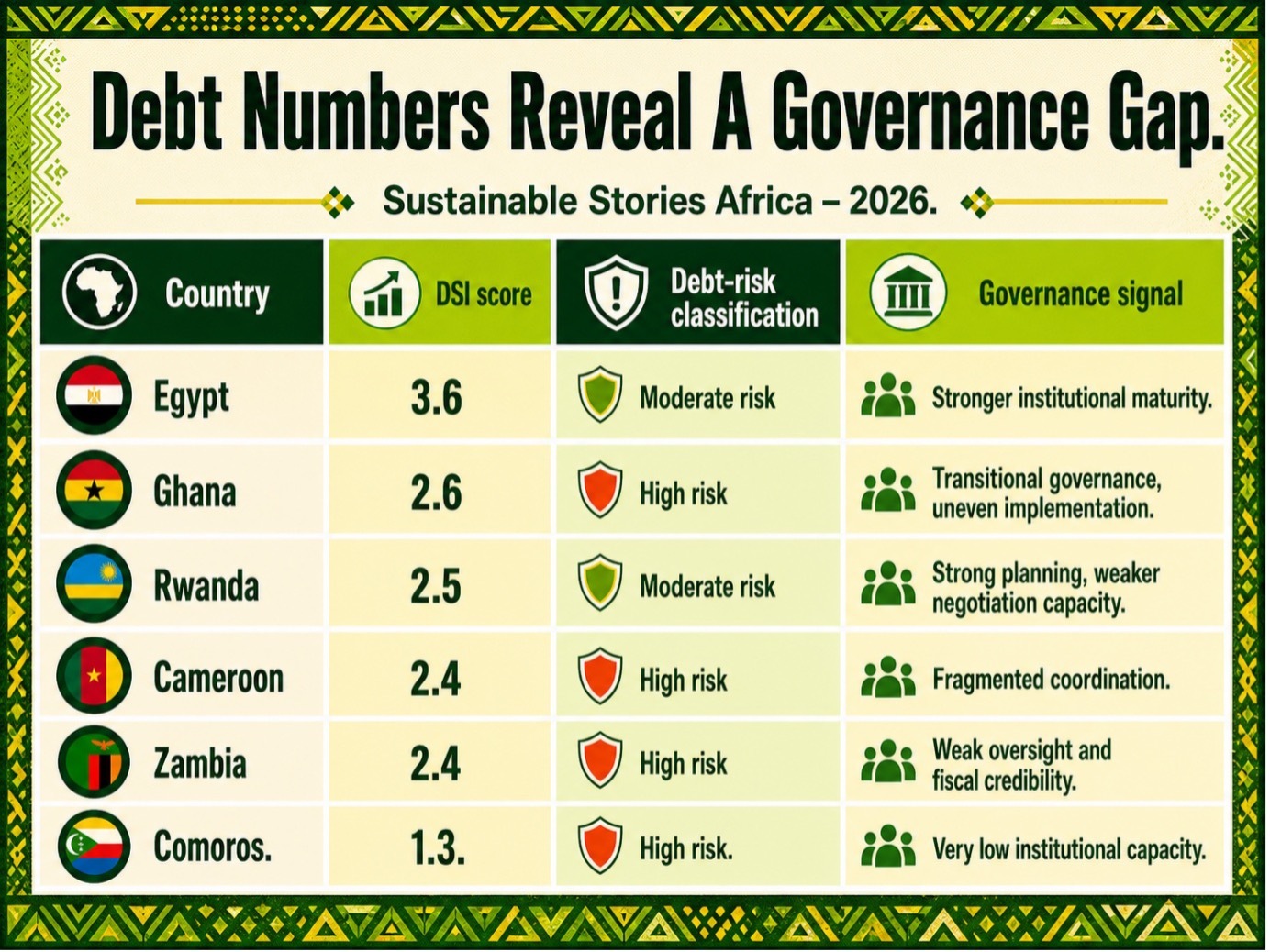
The pattern is revealing. Across the six countries, governance is strongest at the early stages, strategy and financing needs assessment, but weakest around financing terms and implementation.
In simpler terms, many governments know what they want debt to achieve, but the systems for negotiating value, tracking risk and enforcing accountability remain incomplete.
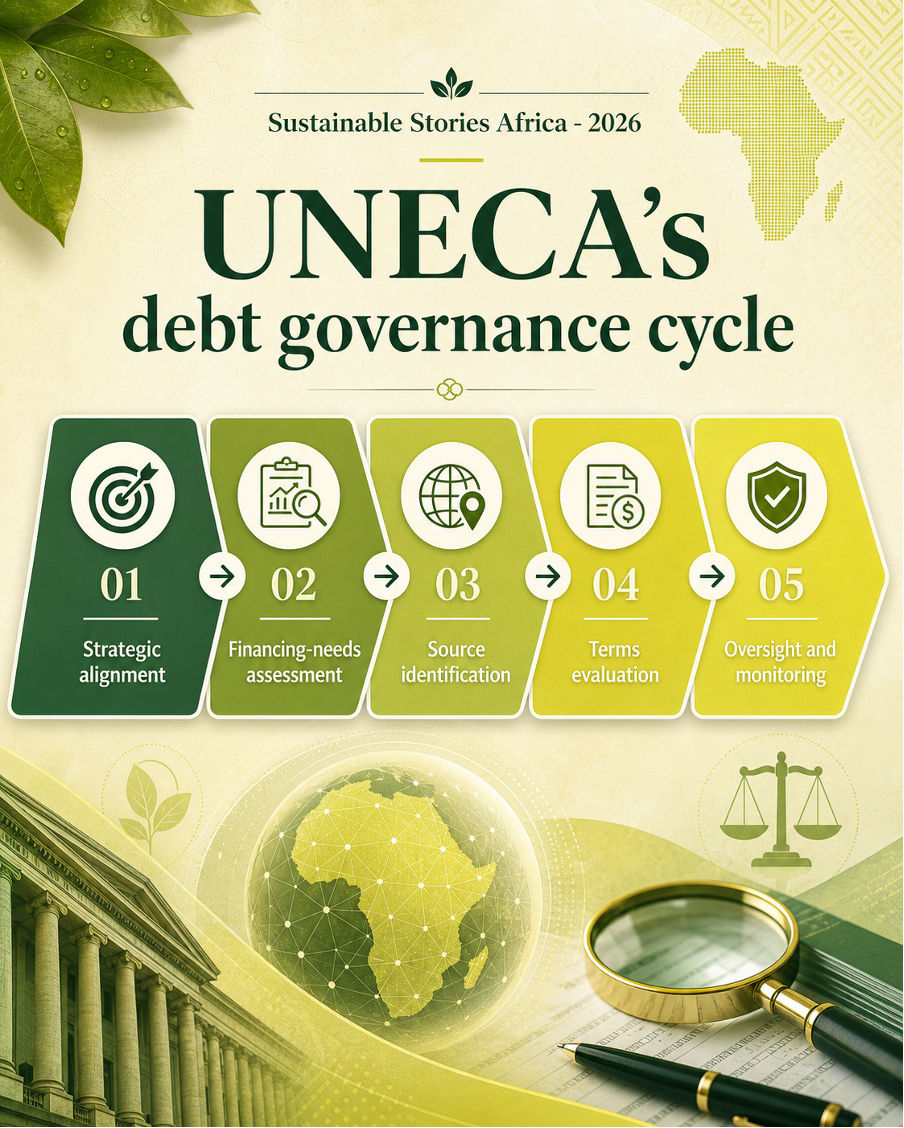
That cycle matters because hidden liabilities can become sudden public crises. Weak monitoring of state-owned enterprises, contingent liabilities and off-budget borrowing can distort the real debt picture and expose governments to fiscal shocks.
Better Rules Can Turn Debt Productive
The opportunity is not to stop borrowing. It is to make borrowing work harder for development.
UNECA argues that well-governed debt can finance productive infrastructure, expand public services, support climate resilience and strengthen long-term growth.
Rwanda and Egypt are presented as examples of stronger coordination: Rwanda links debt management to macro-fiscal frameworks and transformation objectives, while Egypt’s coordination between its Debt Management Unit and Central Bank improves data reliability and risk forecasting.
However, the upside depends on trust. Investors need credible data. Citizens need transparency. Parliaments need the capacity to question debt decisions before obligations become irreversible. Businesses need public borrowing that improves energy, transport and digital systems rather than crowding out private credit.
Countries Need Institutions Before New Borrowing
UNECA’s reform agenda is practical. It calls for national debt governance councils to coordinate institutions, comprehensive debt governance laws to close loopholes, stronger in-house analytical capacity, fiscal neutrality clauses to reduce political interference, integrated debt dashboards for transparency and Parliamentary Debt Review Panels to strengthen scrutiny.
The report also warns that domestic reform alone cannot solve the problem. African countries still operate in a global financial architecture where credit-rating practices, high risk premiums, fragmented creditor coordination and limited concessional finance can undermine even sound national strategies.
Debt governance, therefore, must be domestic and international.
- For governments, the next step is to professionalise debt offices, publish clearer debt data, monitor guarantees and SOE liabilities, and ensure every major borrowing decision is tied to measurable development returns.
- For financiers and development partners, the task is to support concessional refinancing, climate-resilient debt clauses, fairer restructuring processes, and technical assistance that is funded, not merely recommended.
Path Forward – Governance Must Anchor Africa’s Borrowing Future
Africa’s debt debate must move beyond emergency restructuring. The priority is prevention: stronger rules, better institutions, transparent dashboards and borrowing that clearly advances development.
If debt is governed well, it can finance resilience. If it is poorly governed, it will keep draining the very systems, health, education, infrastructure and climate adaptation that sustainable development depends on.