Africa’s minigrid industry says the continent’s electrification promise will not be met by ambition alone.
A Mission 300 position paper argues that solar minigrids could power more than 115 million people by 2030, but only if finance, regulation and delivery systems move at unprecedented speed.
The central warning is sharp: Africa needs gigawatts of distributed clean energy, not pilot projects, if energy access is to become inclusive growth.
Power Access Now Defines Development
Sub-Saharan Africa’s next electrification race may be won or lost in villages, peri-urban settlements, farms, markets and small businesses that are still waiting for reliable power.
A Mission 300 position paper, endorsed by minigrid industry leaders and the Africa Minigrid Developers Association, sets out 17 actions to ensure minigrids become a major engine of electrification across the region. Its message is direct: political will is increasing, but delivery systems remain too slow.
The paper estimates that minigrids could connect more than 115 million people by 2030, equivalent to more than 23 million connections.
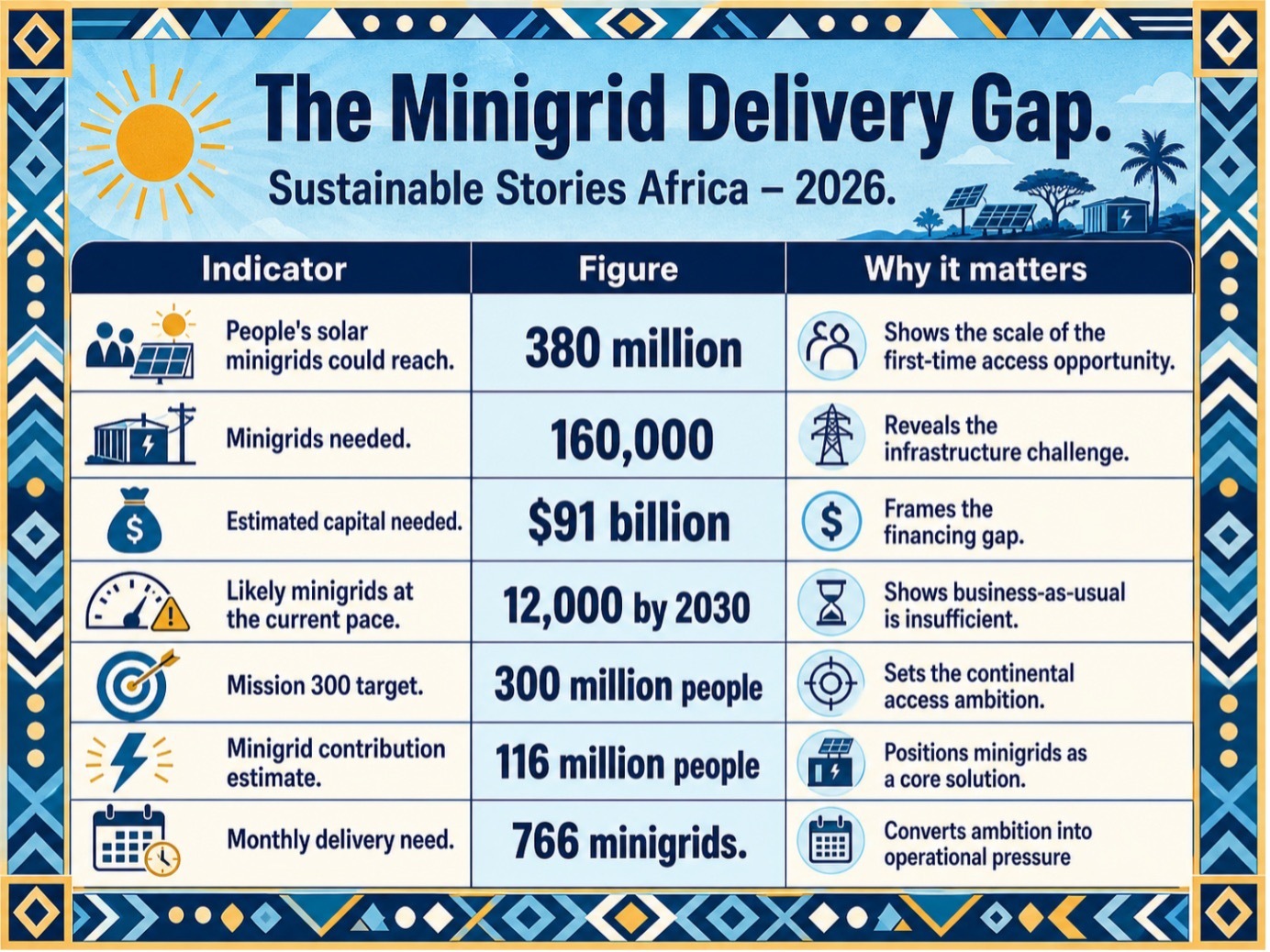
That would require more than 380,000 connections every month and about 766 minigrids monthly for five years, a dramatic leap from fewer than 600 minigrids delivered across the continent in 2024.
Africa’s Power Gap Has A Clock
The headline number is both promising and sobering: the World Bank has described solar minigrids as the most capital-efficient solution for first-time electricity access to 380 million people in Sub-Saharan Africa.
However, the scale required is immense, approximately 160,000 minigrids and $91 billion in investment. At current deployment rates, only around 12,000 new minigrids serving 46 million people are expected by 2030.
That gap sits at the heart of Mission 300, the World Bank and African Development Bank initiative launched in 2024 to provide electricity access to 300 million people in Sub-Saharan Africa by 2030. In practical terms, the target means electrifying about 4 million people every month to the end of the decade.
- For households, the issue is not abstract. It means whether children study under safe lighting, whether clinics preserve vaccines, whether small traders can extend business hours, and whether farmers can move from raw output to value-added production.
- For investors and governments, it is a test of whether Africa’s energy transition can also become an inclusion strategy.
Seventeen Actions, Three Pressure Points
A 17-step position paper organised around three core responsibilities, capital providers, private-sector industry players, and governments, sets out a clear agenda for scaling minigrid access across Africa, with development finance institutions and philanthropies expected to collaborate across the system.
The short-term priorities are direct:
- Expand corporate equity and local currency debt
- Standardise policy and technical rules, allow operators to earn viable returns
- Count connections to small businesses and social institutions, not just households.
The capital requirement is substantial. Delivering 23 million connections, at an estimated cost of $1,200 to $2,000 per connection, puts the total financing need at $28 billion to $46 billion.
Under a commercially viable structure, that translates to $17 billion to $28 billion in debt, $8.4 billion to $14 billion in equity, and $2.8 billion to $4.6 billion in subsidy.
For the first 24 months from 2026, however, the paper argues for a heavier weighting toward grants and subsidies to unlock early market momentum.
Critically, the paper calls for a shift from financing individual projects to financing the companies that build them, positioning corporate equity, local currency debt, concessional capital, risk insurance, and results-based financing as tools for turning minigrids into a credible, investable infrastructure class.
Nigeria's Electrification Project, which delivered 180 minigrids and reached more than 800,000 people, is cited as evidence of what is achievable at scale.
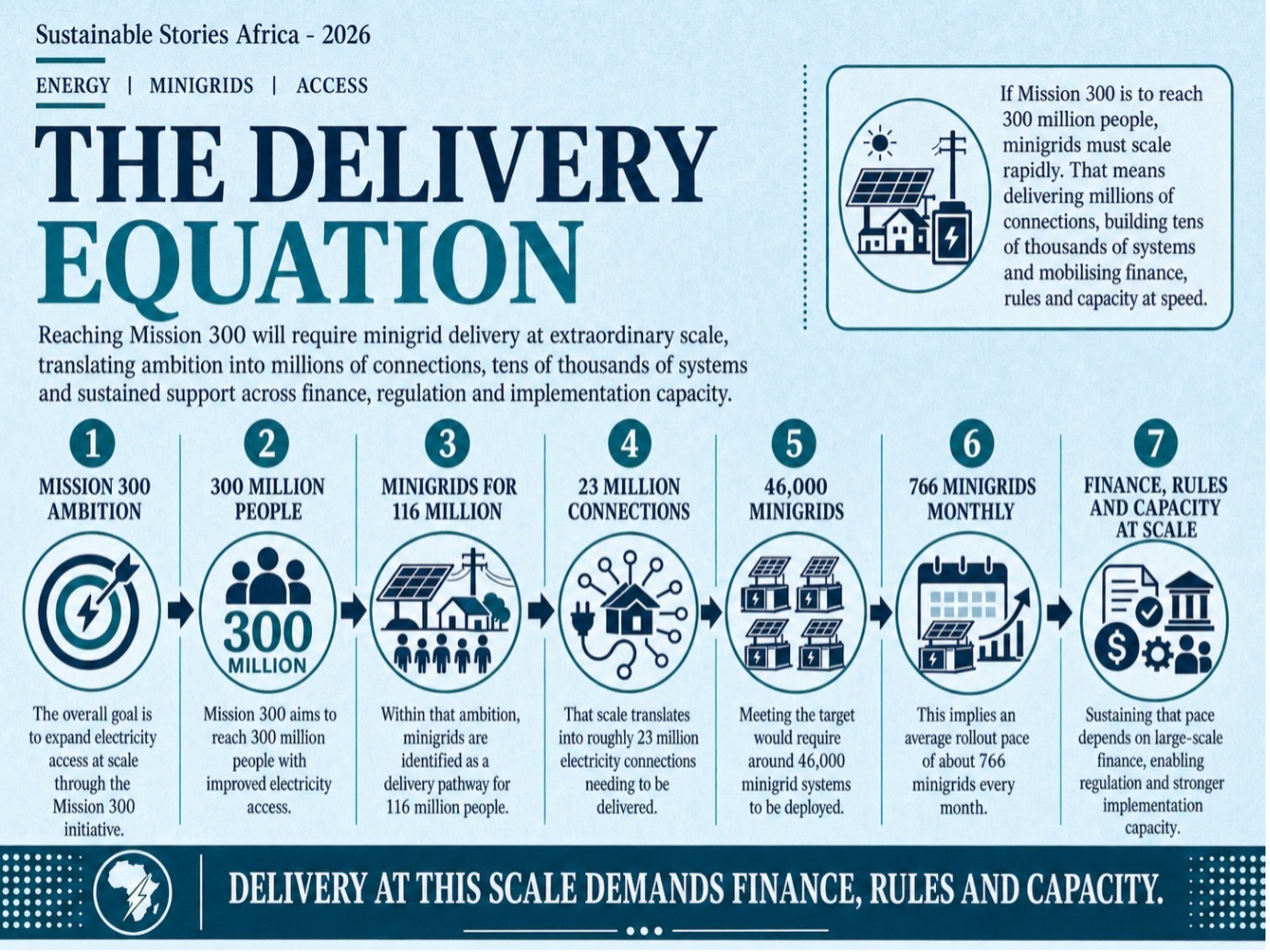
However, the delivery gap remains the sharpest challenge. Reaching the 2030 target demands approximately 9,200 new minigrids per year; benchmarking data shows only 39 were delivered annually between 2022 and 2024, a gap requiring the sector to expand capacity by roughly 235 times.
Africa needs not only more capital, but a trained workforce, standardised systems, and sharper demand planning.
Power That Builds Local Economies
The strongest case for minigrids extends well beyond electricity access; it is about economic transformation. When power reaches SMEs, cold-chain operators, clinics, schools, and agro-processors, it begins to reshape local productivity.
That is why the position paper places strong emphasis on Productive Use of Energy: minigrids become more commercially viable when demand is anchored by businesses and institutions, not only by evening household consumption.
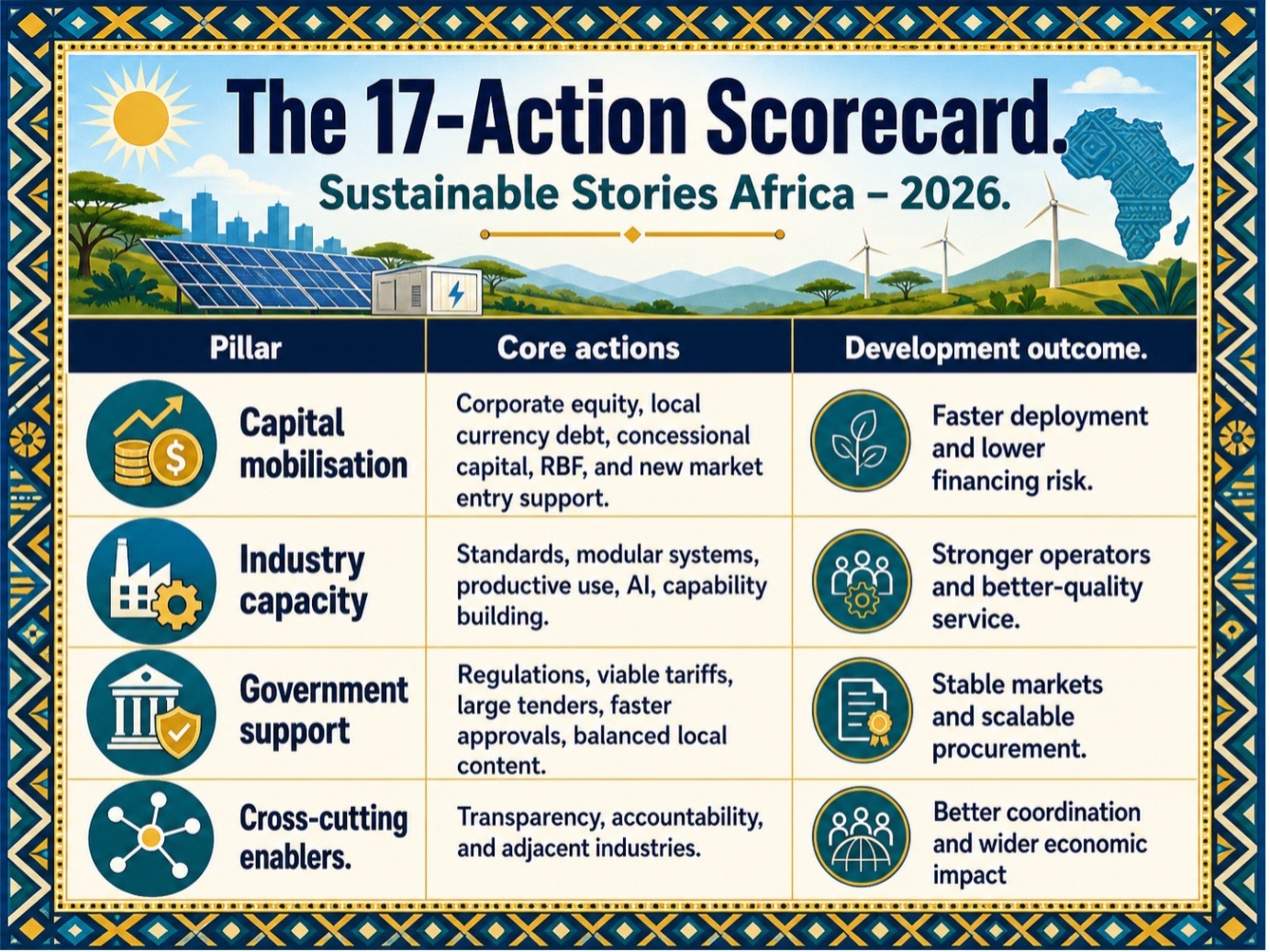
The benefits are multidimensional. Clean distributed energy reduces diesel dependence, improves climate resilience, supports local enterprise, and creates jobs, while strengthening accountability when delivery is tracked transparently across capital deployed, approvals accelerated, and communities connected.
The risk of inaction, however, is equally clear. Without faster capital deployment, clearer regulation, and commercially realistic tariffs, the sector risks remaining trapped in demonstration mode, while communities continue to wait, investors hesitate, and households stay dependent on costly, polluting, and unreliable alternatives.
From Pilot Projects To Portfolios
The paper's call to governments is unambiguous: finalise minigrid regulations by end of 2026, adopt standardised approaches, avoid constant policy changes, and allow operators to earn commercially viable returns.
Critically, it argues that minigrid tariffs should not be compared unfairly with heavily subsidised grid power unless those hidden subsidies are also counted, a politically sensitive but economically necessary position.
The policy answer is not to ignore the trade-off, but to deploy smart subsidies, concessional capital, local currency debt, and transparent tariff structures to lower costs without destroying the business model.
Governments are also urged to move from small procurement lots to larger concessions and tenders, enabling developers to spread overhead costs, improve bulk procurement, and reduce end-user prices.
Nigeria's compact targets 8 million connections, approximately 1,600 minigrids, while the Democratic Republic of Congo's ambition translates to approximately 800 minigrids.
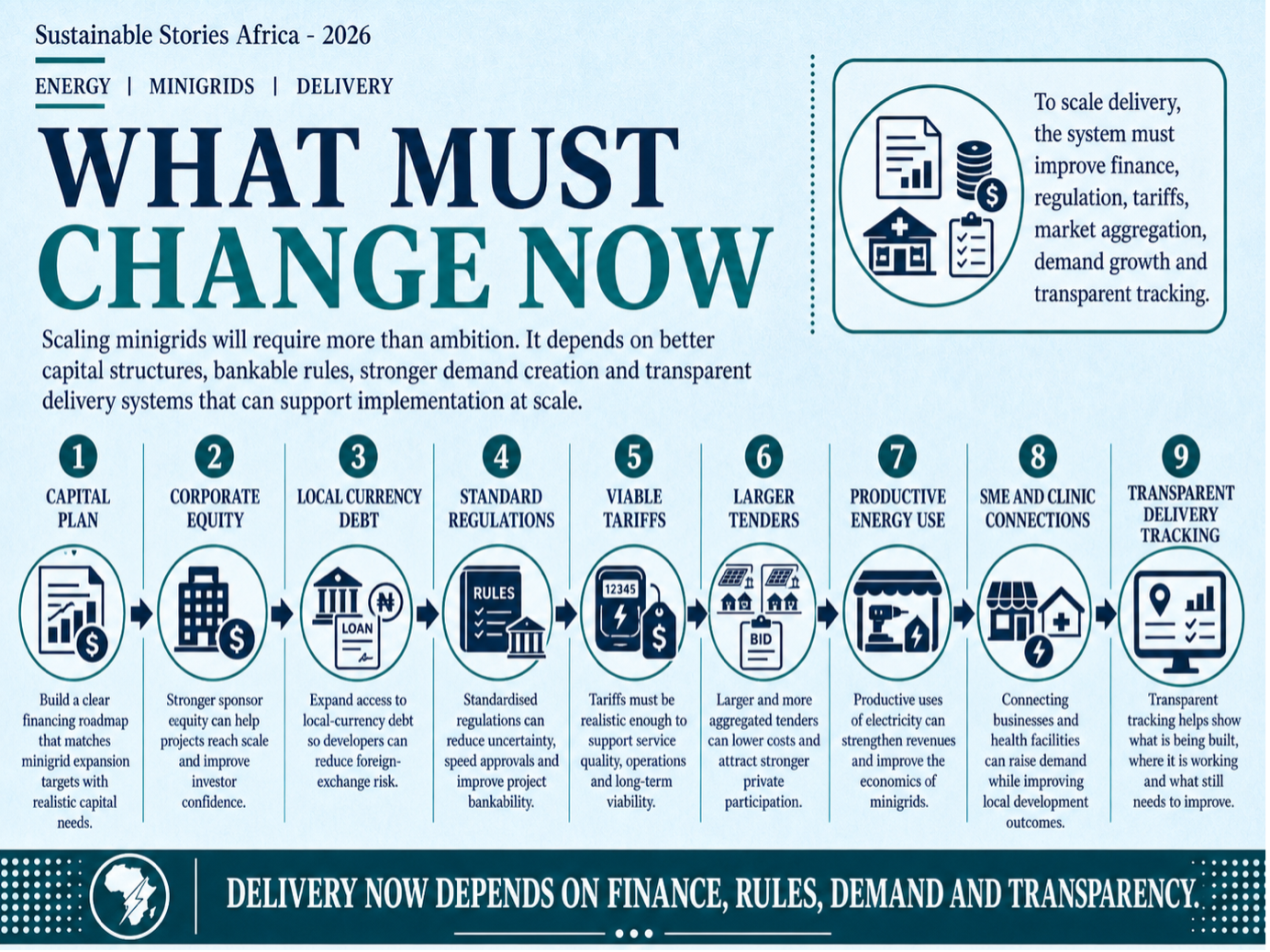
The private sector faces its own mandate: design modular systems, strengthen data reporting, and deploy AI and satellite tools for smarter site selection and demand forecasting.
Industry endorsers already represent 392 minigrid assets, $310 million in invested capital, and a pipeline exceeding 1GW.
For financiers, the immediate task is frontloading investment between 2026 and 2028, while DFIs and philanthropies must shift from fragmented facilities to coordinated blended-finance platforms.
Path Forward – Build Gigawatts, Not Pilots
Mission 300 can become a turning point if funders, governments and developers move together: capital before 2028, regulations by 2026, larger concessions, transparent monitoring, and SME connections counted alongside households.
The promise is bigger than electricity. Properly executed, minigrids can power clinics, farms, schools, digital services and local businesses, turning clean energy access into jobs, resilience and sustainable growth across African markets.