Global energy demand kept rising in 2025, but the story changed: solar PV became the largest single source of growth, while electricity expanded more than twice as fast as overall energy demand.
The IEA’s Global Energy Review 2026 shows a world moving faster into the Age of Electricity, with implications for Africa’s grids, investment planning, climate strategy and access to energy agenda.
Energy Growth Enters A Cleaner Test
The global energy system grew again in 2025, but at a slower and more revealing pace. According to the International Energy Agency, overall energy demand rose by 1.3%, below the previous decade’s average, as slower economic growth, weaker energy-intensive industrial activity in some regions, lower cooling demand and faster efficiency gains moderated consumption.
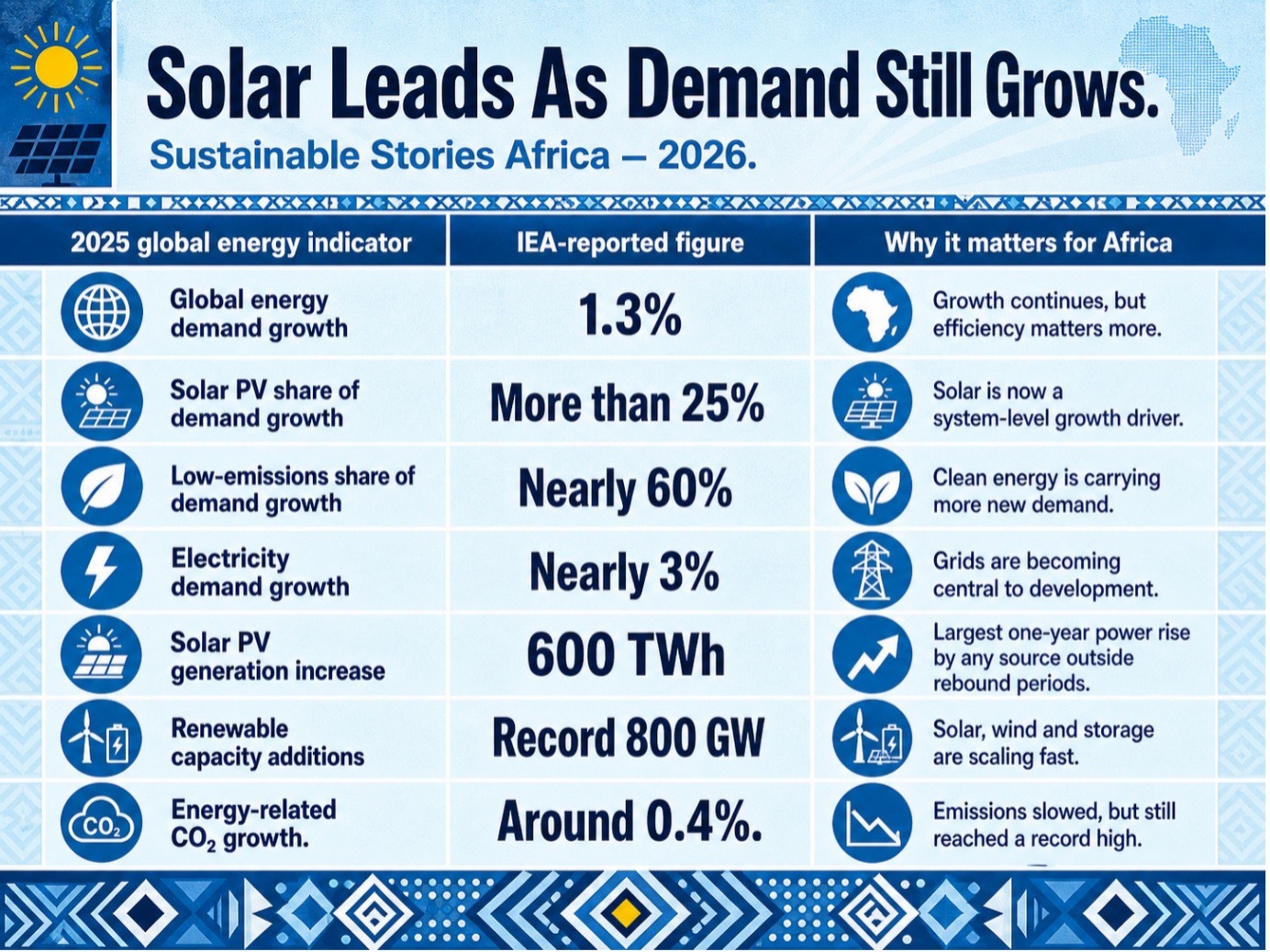
However, the deeper signal was not the slowdown. It was the source of growth. Solar PV met more than 25% of the increase in global energy demand, the first time on record that a modern renewable source contributed the largest share of global energy demand growth.
Low-emissions sources combined, including solar, wind, nuclear, hydropower and other renewables, supplied nearly 60% of new demand.
For Africa, this is a development story as well as an energy story. Electricity access, industrial competitiveness, data centres, clean cooking, cooling demand and climate resilience are now converging.
Countries that plan grids, renewables, storage and efficiency together will be better positioned for the next phase of growth.
Solar Leads As Demand Still Grows
The 2025 headline is a paradox: fossil fuel demand still grew, but clean energy carried more of the system’s expansion.
The IEA found that all major fuels and energy technologies grew in 2025, though at sharply different rates.
Oil, gas and coal demand all increased; however, more slowly than in 2024.
Solar PV led global energy demand growth, followed by natural gas, which contributed 17%.
Oil contributed around 15%, coal 9%, wind 9%, nuclear 5%, and other renewable sources added smaller shares.
This matters because energy growth is shaped by factors such as the weather, industry, prices and technology adoption.
The United States saw demand rise to its second-highest level since 2000, excluding rebound years, helped by data-centre electricity demand, industrial growth and colder temperatures.
China remained the largest contributor to global energy demand growth, but its growth rate slowed sharply to 1.7%, helped by renewables and efficiency improvements.
Electricity Becomes The World’s Growth Engine
The IEA’s strongest structural message is that the world has entered the Age of Electricity.
Global electricity demand grew by nearly 3% in 2025, adding around 800 terawatt-hours, and expanded at about 2.3 times the rate of total energy demand.
Electricity growth came from many directions: buildings, industry, data centres, electric vehicles, appliances and transport electrification.
Data centres and EVs grew rapidly, with data-centre power demand rising by about 17% and electric-vehicle electricity demand by 38%.
In the United States, data centres accounted for roughly half of the growth in electricity demand.
For Africa, this trend lands with urgency. The continent is still working to close electricity access gaps; however, future demand will not be driven only by households.
It will come from cold chains, irrigation, digital services, mini-grids, electric mobility, productive use of energy, manufacturing and climate adaptation.
Solar’s power-sector rise was extraordinary. Solar PV generation increased by 600 TWh in 2025, reaching nearly 2,700 TWh and accounting for around 70% of global electricity generation growth.
Renewables and nuclear together increased by more than the total rise in electricity supply, while fossil-fuel generation fell slightly.
Renewables now virtually match coal generation globally, and in the European Union, solar PV and wind reached 30% of electricity generation, surpassing fossil fuels for the first time.
Clean Technology Shows Avoided Emissions Value
The IEA’s report shows that clean energy is already changing the emissions equation, even though total emissions remain too high.
Energy-related CO₂ emissions rose by around 0.4% in 2025, reaching a new record of more than 38 billion tonnes.
Weather-related factors, including colder temperatures and weaker hydro and wind output in some regions, pushed emissions upward by increasing fossil-fuel combustion, particularly natural gas.
However, the avoided-demand numbers are equally important. The rollout of clean energy technologies since 2019 avoided more than 35 exajoules of annual fossil fuel demand in 2025, equivalent to around 7% of global fossil fuel use.
Deployment of solar PV, wind, nuclear, electric cars and heat pumps since 2019 also prevented about 3 billion tonnes of CO₂ annually, around 8% of global emissions.
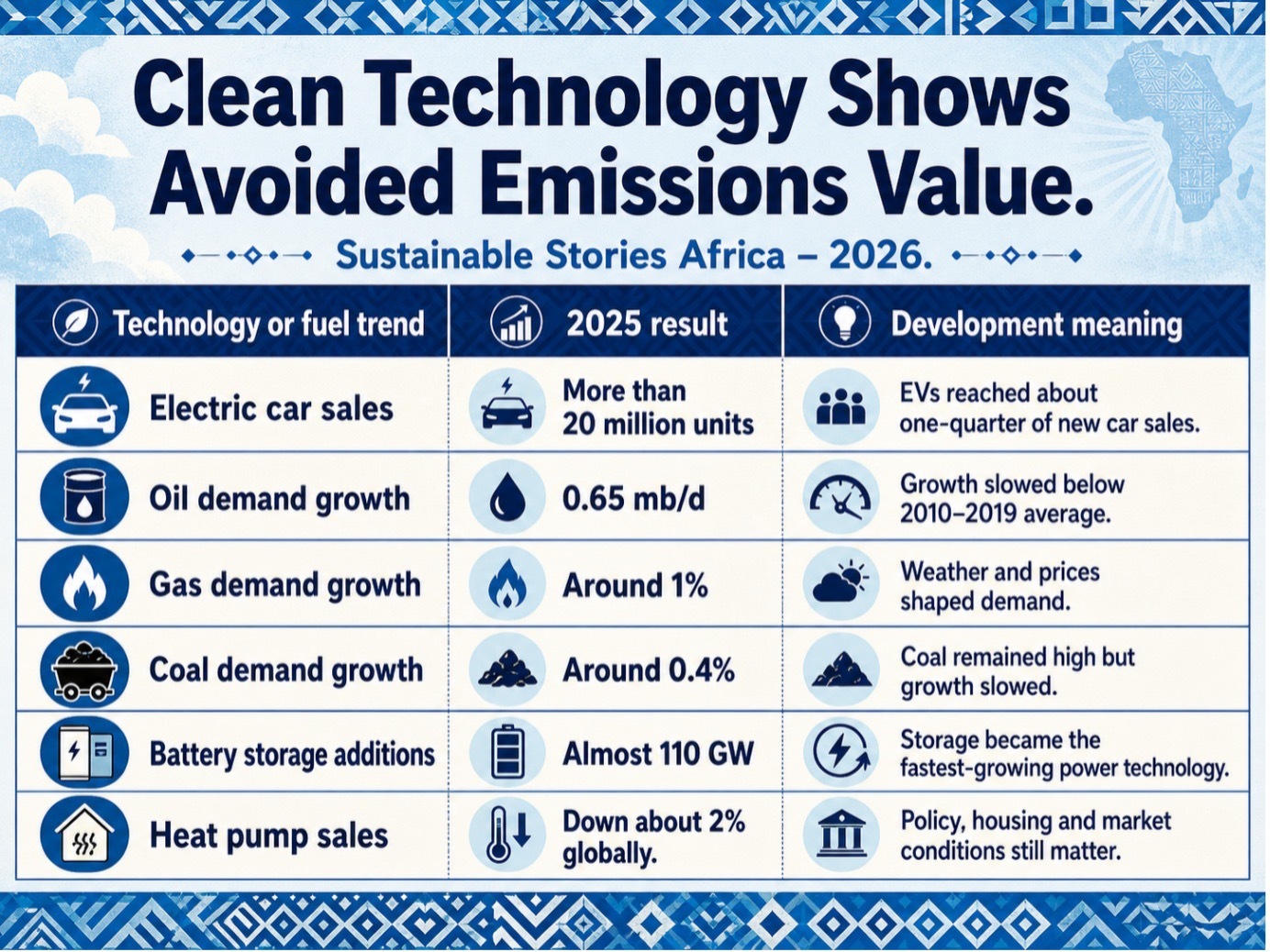
The transport story is also shifting. Oil demand growth slowed to 0.65 million barrels per day, well below the 2010 – 2019 average annual increase of 1.4 million barrels per day.
Electric car sales rose by more than 20% to over 20 million units, about one-quarter of new car sales in 2025.
For citizens, the benefits are tangible: cleaner air, exposure to fuel price shocks, more efficient mobility and better electricity services.
For governments, the question is whether policy can convert technology momentum into inclusive access and industrial opportunity.
Africa Must Build Flexible Clean Systems
Africa’s energy demand grew by about 2.9% in 2025, faster than the global average, according to the IEA’s regional demand chart.
That growth reflects the continent’s development needs: more electricity, more cooling, more mobility, more industry and more reliable services.
The policy lesson is that Africa cannot treat electricity as a narrow utility issue. It is now a competitiveness platform.
- Governments need to plan transmission, distribution, storage, mini-grids, regional power pools and clean-energy procurement together. Solar can reduce costs, but without grid investment and storage, countries risk curtailment, unreliable supply or dependence on expensive backup generation.
- Regulators should update market rules for distributed energy, battery storage and commercial power purchase agreements.
- Utilities need cost-reflective but socially sensitive tariffs.
- Development finance institutions should prioritise grid resilience, clean cooking, productive-use energy and local manufacturing.
- Businesses should treat energy efficiency as a balance-sheet issue, not a sustainability slogan.
Citizens also matter. Energy transitions work better when households, farmers, transport operators and small businesses can access reliable power, affordable appliances, clean cooking options and finance for efficient technologies.
Path Forward – Turning Energy Growth Into Shared Resilience
The IEA’s 2026 review shows a world where energy demand is still rising, but clean power is increasingly meeting the growth.
Africa’s priority is to turn that global shift into affordable electricity, resilient grids and productive economic use.
The path forward is practical: invest in grids, scale solar and storage, improve efficiency, expand access, and align energy planning with industry, climate and digital development.
That is how clean-energy momentum becomes shared prosperity.