Rare earth elements are no longer a specialist mining issue. They are now central to electric vehicles, wind turbines, artificial intelligence infrastructure, defence systems and the future of industrial competitiveness.
A new IEA report warns that concentrated rare earth supply chains have become a direct energy and economic security risk — and that diversification will require investment, recycling, technology, traceability and stronger international coordination.
Rare Earths Now Shape Energy Security
Rare earth elements have moved from the margins of industrial policy to the centre of global energy security. The International Energy Agency’s latest assessment frames them as strategic materials whose supply chains now sit behind electric mobility, wind power, advanced electronics, aerospace, defence, medical systems and data-centre growth.
The urgency is not due to rare earths being geologically scarce. The IEA notes that the 17 elements are relatively plentiful in the Earth’s crust; however, economically viable concentrations are uncommon, and separating them is technically difficult.
The true scarcity lies in processing, refining and magnet manufacturing capacity.
For Africa and other emerging markets, the question is no longer simply who has deposits.
It is about moving from raw material potential to responsible, bankable, and diversified supply chains, without repeating the extractive model that leaves value addition, technology and pricing power elsewhere.
One Bottleneck Can Slow Many Industries
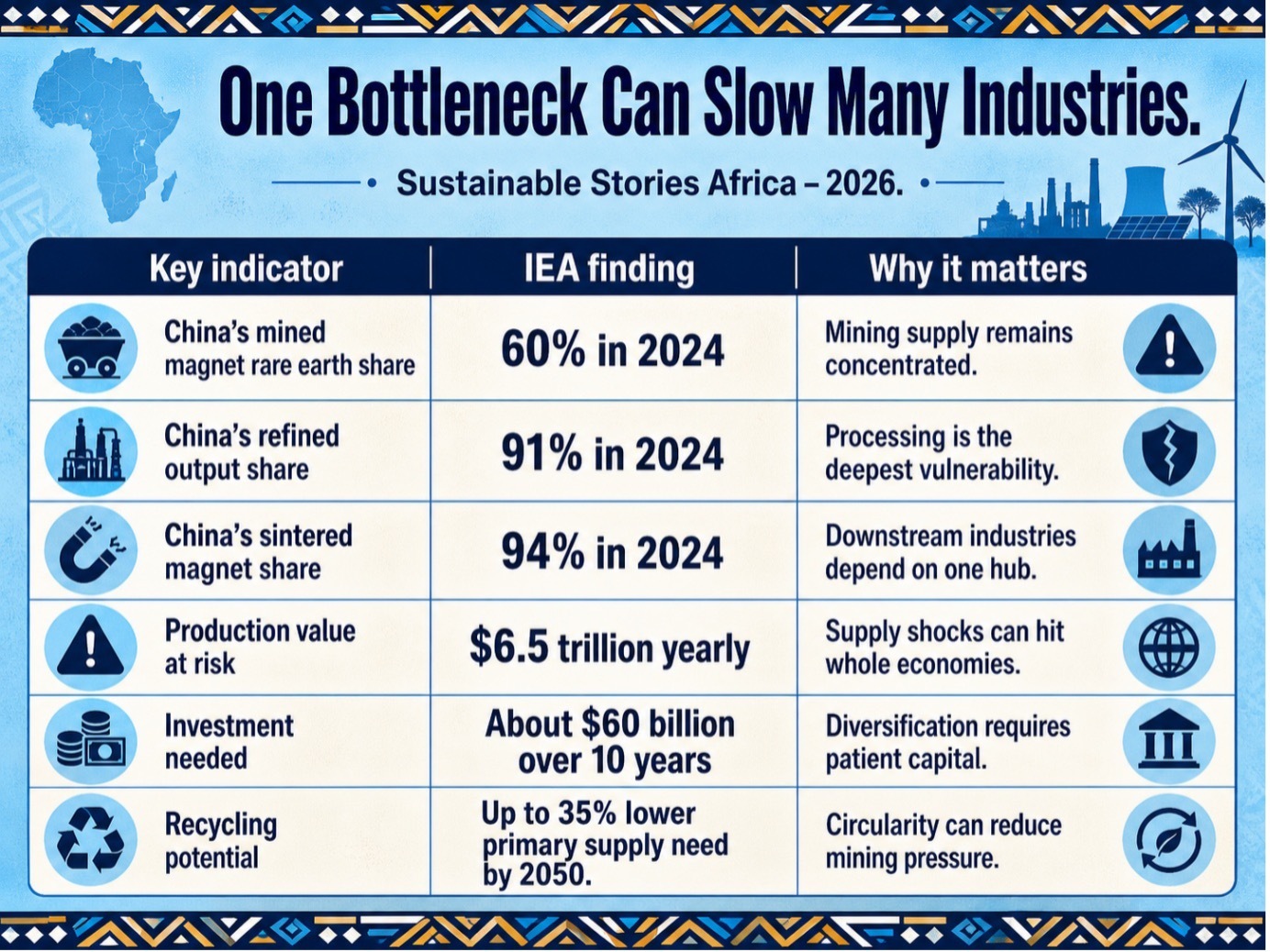
The sharpest warning in the IEA report is concentration. In 2024, China accounted for 60% of global mined production of magnet rare earths, 91% of refined output and 94% of sintered permanent magnet production.
In 2005, China’s share of sintered permanent magnet production was around 50%, showing how rapidly downstream dominance has deepened.
That concentration became a live risk in 2025. China introduced export controls in April on seven heavy rare earth elements, related compounds and magnets. Export volumes fell sharply in April and May, leaving automakers in the United States, Europe and beyond struggling to source permanent magnets. Some were forced to cut utilisation rates or temporarily shut down production.
The stakes are enormous. If rare earth export controls announced in October 2025 had been fully implemented, the IEA estimates that downstream production worth $6.5 trillion per year outside China would have been at risk.
The automotive sector alone faced more than $3 trillion in potential direct losses, followed by electronics and other transport sectors. Defence and data centres were also exposed.
Why Magnets Make Rare Earths Strategic
Rare earth elements matter because modern machines increasingly depend on permanent magnets.
High-performance neodymium-iron-boron magnets, made primarily with neodymium and praseodymium and strengthened with dysprosium and terbium, are among the strongest permanent magnets used in industry.
These magnets support electric vehicles, wind turbines, industrial motors, robotics, AI data centres, medical equipment, aerospace systems and defence applications. The IEA says permanent magnets account for around 95% of total rare earth consumption by value, making them the fastest-growing and most strategically important rare earth application.
Demand for rare earth magnets has doubled since 2015 and is projected to rise by another third by 2030 under current policy settings.
The supply chain is long and technically demanding. The page 27 mine-to-magnet diagram in the IEA report shows how rare earths move from ore extraction to beneficiation, chemical upgrading, separation into oxides, metal refining, alloying and magnet manufacturing.
Each stage requires specialised equipment, technical capability, environmental safeguards and capital discipline.
That is where African opportunity becomes more complex.
- Tanzania is listed among the smaller contributors to future diversified mining capacity
- Namibia appears in the IEA’s example of cross-border public-private partnerships through Japan’s investment in the dysprosium/terbium-rich Lofdal heavy rare earth project.
However, mining alone will not create supply security. The real development prize lies in linking geology to processing, skills, clean power, environmental governance and regional industrial strategy.
Diversification Could Create New Value
The upside is clear: countries that help build diversified rare earth supply chains can become strategic partners in the clean-energy economy, not just commodity exporters.
The IEA projects that demand for magnet rare earths outside China will rise by 50% by 2035, driven largely by electric vehicle deployment.
However, existing capacity outside China falls short across the value chain. Even with planned expansions, expected production from existing capacities meets only about 50% of projected mining demand, 25% of refining demand and well below 20% of magnet demand by 2035.
Closing the gap would require mining, refining and magnet production capacity to expand by factors of 2, 4 and 6, respectively, on top of planned expansions.
For African markets, this creates a policy opening. Countries with rare earth potential can position themselves through partnerships that diversify supply networks for mineral development by adopting credible permitting, responsible mining rules, community safeguards, infrastructure planning and partnerships with downstream manufacturers.
The environmental dimension cannot be ignored. The IEA warns that rare earth supply chains can generate acidic leachate, radioactive tailings, toxic sludge, air emissions and community health risks, particularly where thorium and uranium co-occur with rare earth ores.
That means “secure supply” must also mean safe, transparent and accountable supply.
Policy Must Move Beyond Mine Announcements
The IEA’s eight recommendations point to a practical roadmap:
- Understand national rare earth demand and risk exposure
- Build emergency preparedness and stockpiles
- Take a whole-supply-chain approach
- Strengthen financial and policy support
- Promote supply-side innovation
- Embrace demand-side innovation
- Unlock recycling
- Improve price transparency.
For African policymakers, five actions stand out.
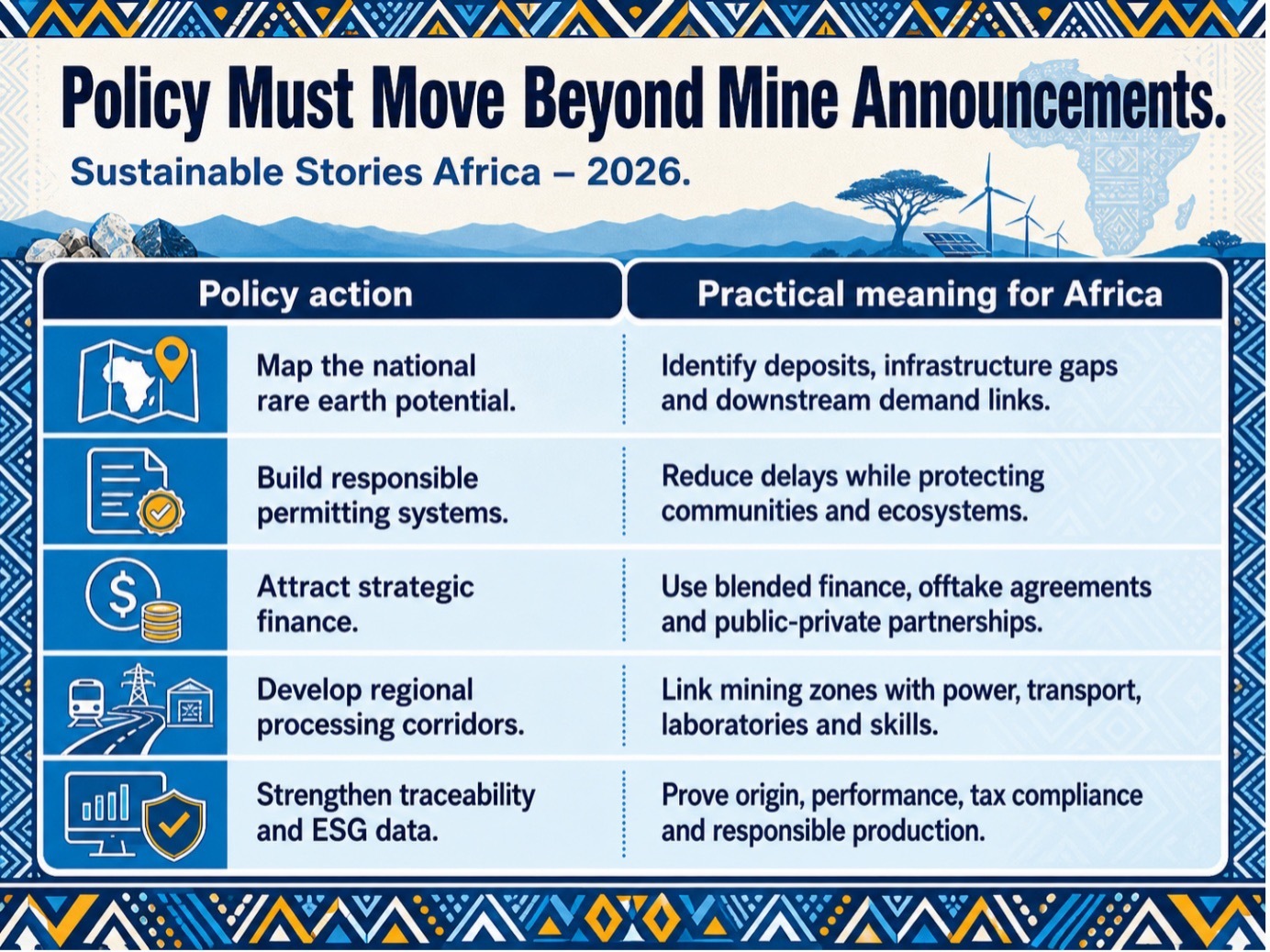
The investment case is significant but not impossible. The IEA estimates that meeting demand for rare earth magnets outside the dominant supplier requires around $60 billion over the next decade.
Refining accounts for nearly half of that need, while magnet manufacturing represents around one-third. In energy security terms, that price tag is small compared with the estimated $6.5 trillion economic value potentially at risk from a major supply disruption.
Recycling also matters. The IEA says secondary supply could reduce the need for primary mining by up to 35% by 2050, with manufacturing scrap and end-of-life products from EV motors, wind turbines and electronic waste becoming increasingly important.
For Africa, this points to another opportunity: circular economy systems that collect, sort and recover rare earth-bearing components before the continent becomes only an importer of waste and an exporter of raw minerals.
Path Forward – Build Resilience Before The Next Shock
Rare earth security now demands early action: responsible mining, regional processing, recycling systems, reliable data, strategic finance and partnerships that link African resources to global clean-energy demand.
The path forward is not isolation; however, coordinated diversification. African countries can gain more value by building credible supply chains that are cleaner, traceable, investment-ready and connected to downstream industries.
The next rare earth shock should find Africa prepared, not peripheral.