Critical minerals are no longer only a mining story. They are becoming a story of security, governance and market access for countries supplying batteries, grids, electric vehicles and digital infrastructure.
A new IEA report argues that traceability, knowing where minerals come from, how they move and who handles them, is becoming essential to protect energy transition supply chains and reward responsible producers.
Tracing Minerals Is Now a Security Policy
The global race for copper, lithium, nickel, cobalt, graphite and rare earth elements is entering a new phase: proof. It is no longer enough for countries and companies to say they have critical minerals.
They increasingly need to show where those minerals came from, how they moved, who handled them and whether they meet responsible production standards.
That shift matters deeply for Africa, home to some of the minerals powering the clean-energy economy.
In the Democratic Republic of the Congo, which supplies around 70% of global cobalt, traceability has already become linked to human rights scrutiny, investor confidence and market access.
The International Energy Agency’s message is direct: traceability is becoming a foundation for energy and economic security.
For African producers, the opportunity is not just compliance. It is stronger bargaining power, better public revenues, reduced illicit trade and a clearer path from extraction to value addition.
A Supply Shock Meets A Data Gap
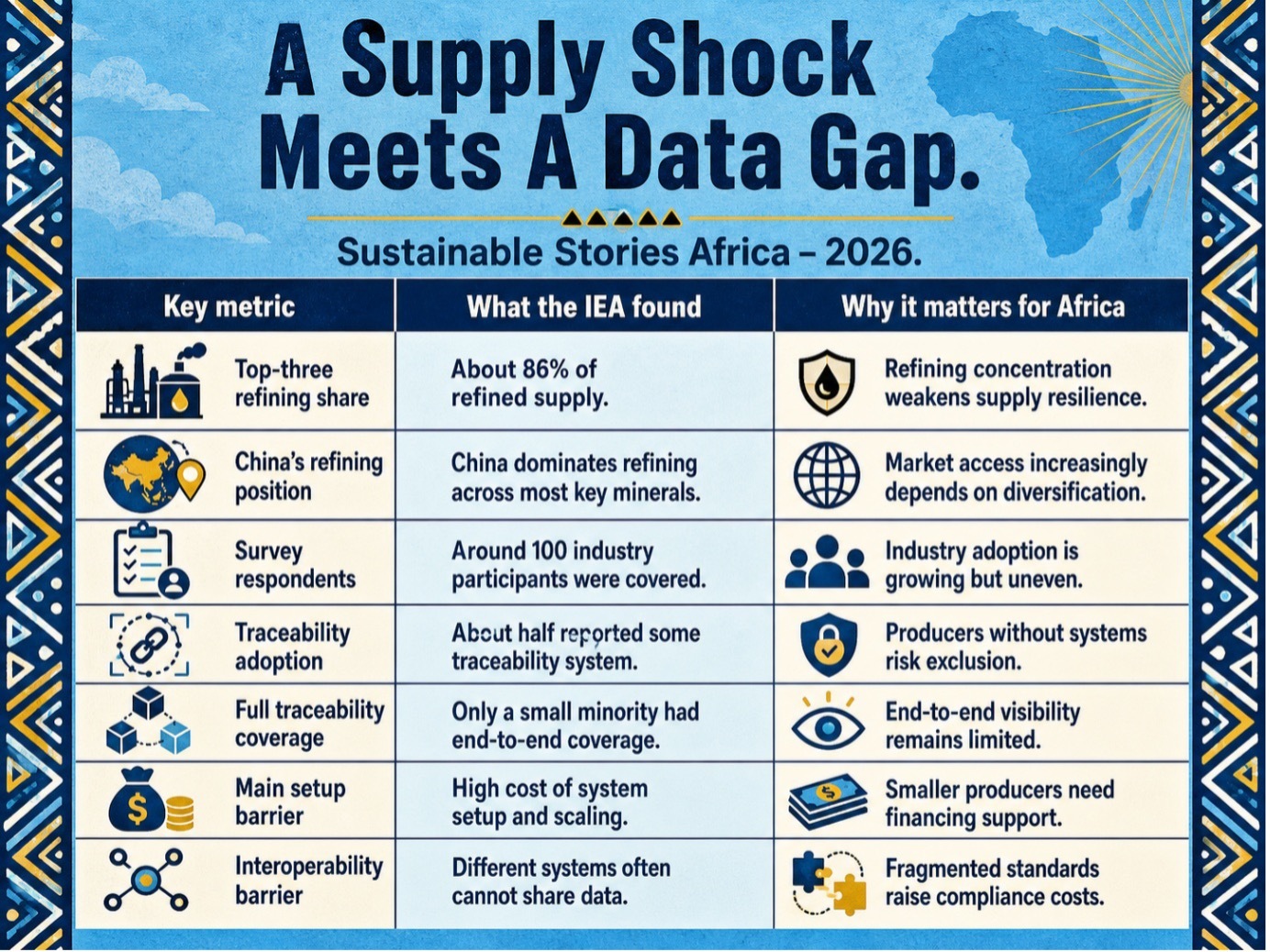
The warning sign is concentration. In 2024, the top three refining countries accounted for 86% of refining for key energy minerals, up from 82% in 2020.
China was the leading refiner for 19 of 20 strategic materials assessed by the IEA, with an average market share of 70%.
That concentration has moved from the risk model to the real economy. The IEA says export controls in 2025 turned the concentration of critical minerals into an immediate energy and economic security issue.
Half of the 20 strategic minerals are already subject to some form of export control, and rare earth export controls introduced in April 2025 forced some automotive factories to cut utilisation or temporarily shut down.
If later suspended controls announced in October 2025 had been fully enacted, downstream production worth $6.5 trillion annually outside China could have been at risk.
Why Provenance Now Shapes Mineral Power
Traceability sounds technical, but its politics are simple. It asks four questions:
- Where did the mineral originate
- What route did it take
- Who had custody of it
- How was it transformed?
The IEA adds that performance data, such as greenhouse gas emissions, labour standards, tax compliance, recycled content and product quality, can also be attached to traced materials.
- For governments, that data can support tax collection, anti-smuggling controls, export oversight and industrial planning.
- For companies, it can help prove compliance with sourcing rules, qualify for incentives, reassure customers and support sustainability claims.
The IEA-OECD survey shows that uptake is already underway, but uneven. Two-thirds of respondent companies reported having some form of traceability system: 30% with full coverage and 40% across selected minerals or supply chains.
Cobalt has the most advanced adoption, followed by graphite and copper, while rare earths show strong future intent because of growing geopolitical concerns.
Africa’s relevance is clear. The IEA notes that companies operating in Africa and Central Asia without traceability systems expressed the strongest intentions to develop the minerals.
That suggests traceability is being viewed not only as a compliance tool, but also as a way to attract investment, reduce mineral laundering and support local value addition.
What Africa Gains From Verified Minerals
For African mineral economies, traceability can shift the development story from “resource extraction” to “verified value.” A copper, cobalt, lithium or graphite supply chain that can demonstrate origin, custody, tax compliance and environmental performance is more bankable than one that cannot.
The IEA shows how producing countries are using traceability for three broad objectives:
- Preventing illegal mining and tax fraud
- Strengthening oversight of domestic mineral supplies
- Improving market access for high-performing producers.
Zambia’s Mineral Output Statistical Evaluation System, for example, is cited as a platform that is designed to monitor mineral flows from extraction to export.
This is where the economic-security case becomes practical. If mineral data are centralised and verified, governments can compare production volumes, refinery receipts, exports, royalties and taxes.
That can help detect under-reporting, smuggling and unpaid public revenues. Indonesia’s SIMBARA platform, according to the IEA, has reportedly helped authorities avoid about IDR 3.47 trillion, or roughly $200 million, in potential losses from unpaid taxes and royalties.
- For communities, the benefit is accountability.
- For investors, it is a reduced risk.
- For governments, it is fiscal visibility.
- For producers, it is market differentiation.
The Practical Moves Markets Now Need
The biggest obstacle is not whether traceability matters. It is whether countries and companies can make it affordable, interoperable and trusted.
The IEA survey found that 56% of companies ranked implementation cost among their top three barriers to setting up traceability systems. Another 55% cited lack of interoperability, while 41% pointed to limited leverage over suppliers.
Maintaining systems brings a second set of problems: confidentiality concerns, poor data quality and weak incentives to share information beyond direct suppliers.
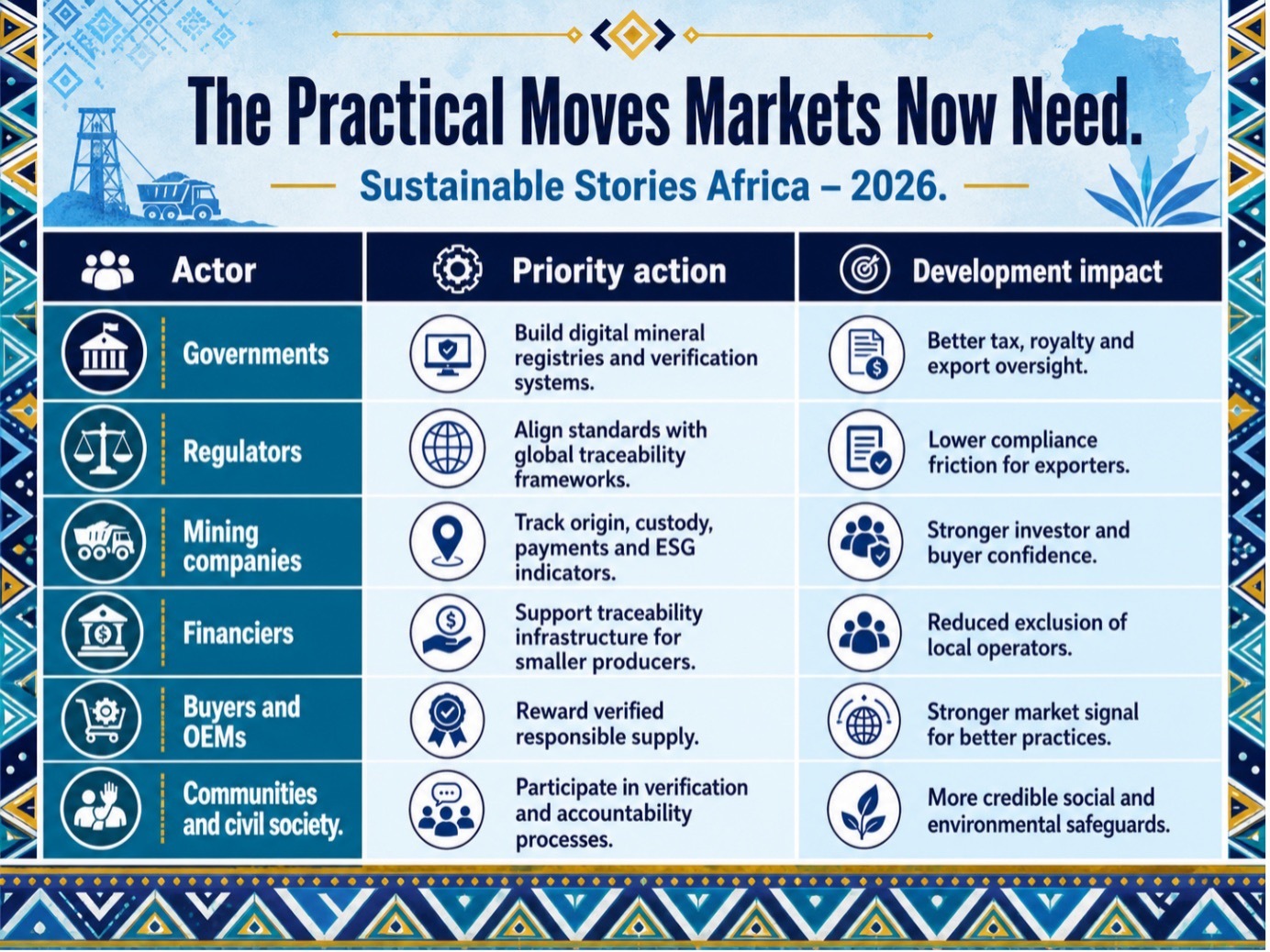
The IEA recommends five policy moves:
- Strengthen incentives for verified data collection and sharing
- Provide financial support for traceability infrastructure
- Harmonise standards internationally
- Deepen co-operation between upstream and downstream jurisdictions
- Begin pragmatically with less complex supply chains and core data fields before scaling up.
For Africa, the strategy should be sequenced.
- First, digitise production, export and royalty data.
- Second, connect mine-level data to refinery and trader records.
- Third, protect commercially sensitive information while ensuring regulators can verify public-interest data.
- Fourth, align national systems with global standards so African minerals do not become trapped in fragmented compliance regimes.
Path Forward – Building Trust Into Africa’s Mineral Future
Traceability should now move from pilot projects to the national mineral strategy. African governments need interoperable registries, trusted verification, producer incentives and safeguards for commercial confidentiality.
The prize is greater than compliance: cleaner supply chains, stronger public revenues, better investment signals and more bargaining power in the energy transition.
The next test is execution.