Africa’s immunisation story is one of life-saving progress and unfinished equity. Vaccines have saved millions of lives; however, coverage gaps, outbreaks and zero-dose children show the 2030 target is still at risk.
A new WHO African Region report says the continent is off track on most of the Immunisation Agenda 2030 impact goals, even as malaria, HPV, measles and pneumococcal vaccine rollouts create new opportunities for public health resilience.
Africa’s Vaccine Progress Faces 2030 Test
For millions of African families, a vaccination card is more than a clinic document. It is a record of survival, growth and contact with a health system that too often remains distant from the poorest communities.
The WHO African Region’s 2026 report, Towards Immunisation Agenda 2030 targets, shows the power and fragility of that system.
Immunisation is described as one of the most effective public health interventions, averting more than 4 million deaths globally each year.
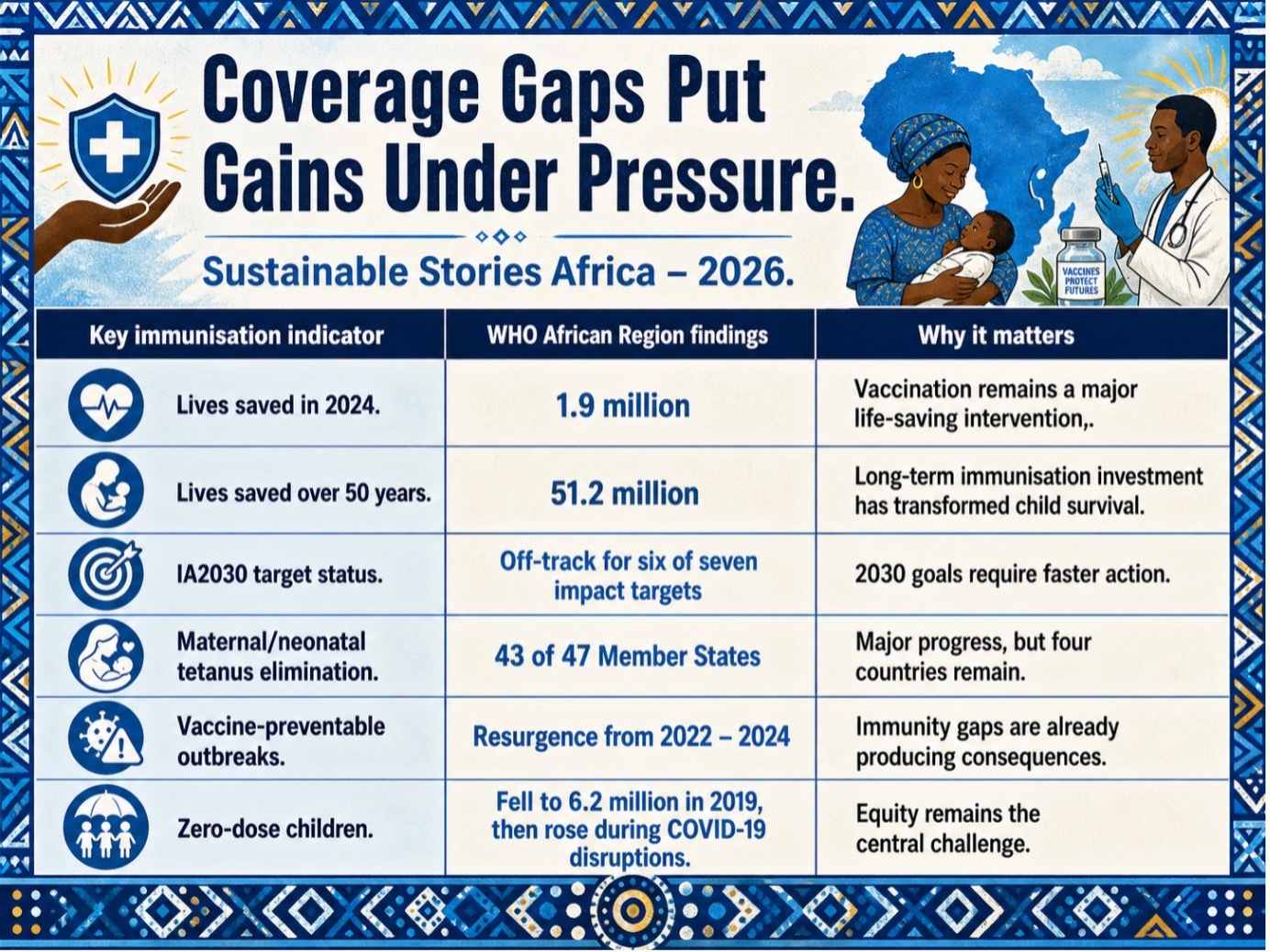
In Africa, vaccines have saved an estimated 51.2 million lives over the past 50 years.
However, the same report warns that the Region is currently off-track for six of seven IA2030 impact goal targets. Coverage for key tracer vaccines remains below the 90% target, and no vaccine recorded coverage above 90% in 2024. The data tell a clear story: Africa has achieved historic gains, but the next phase must be about closing the last-mile gaps.
Coverage Gaps Put Gains Under Pressure
In 2024, vaccination in the WHO African Region saved an estimated 1.9 million lives across 13 vaccine-preventable diseases. Five diseases, including measles, hepatitis B, human papillomavirus, pertussis and yellow fever, accounted for 85% of averted deaths, with measles alone responsible for the largest share.
That is the good news. The warning is that many of the systems that delivered those gains are under strain.
The Region has maintained its wild poliovirus-free status since 2020 and achieved elimination of maternal and neonatal tetanus in 43 of 47 Member States. However, between 2022 and 2024, Africa saw large or protracted outbreaks of cholera, measles, meningococcus and circulating vaccine-derived poliovirus.
The report links many outbreaks to delayed preventive campaigns and persistent gaps in routine immunisation, particularly in fragile and emergency-affected settings.
Two Decades Reveal Progress And Plateau
The African Region’s immunisation progress has been substantial, but uneven. Most Member States now provide antigens for 13 vaccine-preventable diseases, up from the initial six when the Expanded Programme on Immunisation was introduced.
Measles-related deaths have fallen sharply, with an estimated 19.5 million deaths averted since 2000. Meningitis deaths dropped by 39% in 2019 compared with 2000.
Still, the coverage charts on pages 11 and 12 of the WHO report show a pattern that policymakers cannot ignore: strong early gains, followed by stagnation.
As of 2024, four vaccines had very low coverage below 50%, 10 had low coverage between 50% and 79%, and only one vaccine reached the 80% – 89% range. No vaccine crossed the 90% threshold.
The routine coverage story is mixed. BCG coverage rose from 69% in 2000 to 83% in 2024. DTP3 coverage increased from 52% to 76% over the same period, but the Region still has the lowest DTP3 coverage globally.
Measles first-dose coverage has hovered around 70% for the past decade. The second-dose measles coverage reached 55% in 2024, progress, but still far below the ≥90% IA2030 target and the higher levels needed to interrupt transmission.
This is where the lived reality comes in. A child missing in a remote settlement, conflict zone or informal urban community is not only a statistic. That child is part of an immunity gap that can later become an outbreak.
New Vaccines Can Close Equity Gaps
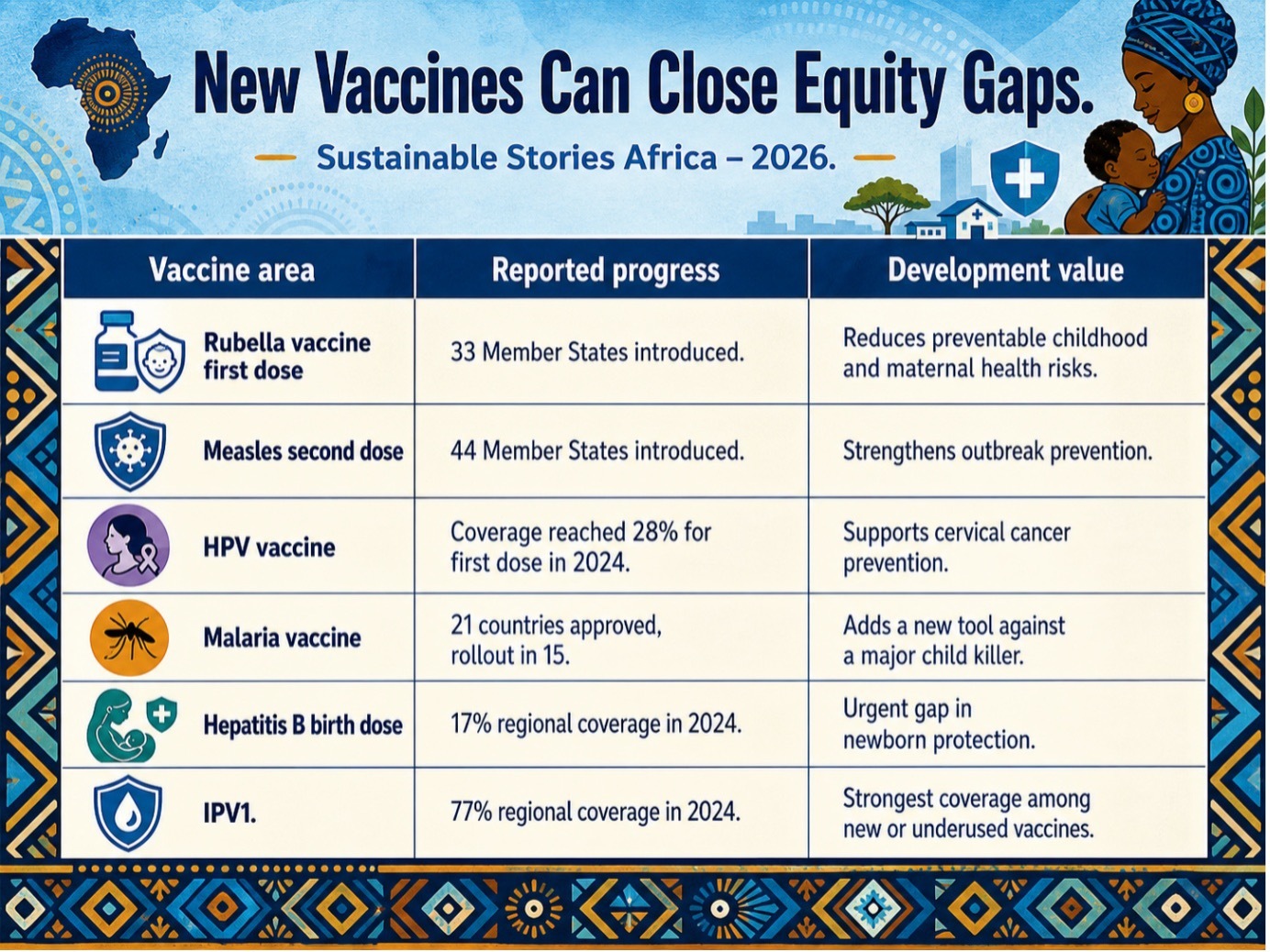
The most promising part of the WHO report is the expansion of new and underutilised vaccines. The Region is on track in view of the IA2030 target for new vaccine introductions, with 33 Member States introducing the first dose of rubella-containing vaccine, 44 introducing the second dose of measles-containing vaccine, and 29 or more introducing HPV vaccination into routine schedules.
Nearly all yellow fever high-risk countries have introduced routine yellow fever vaccination nationally.
The malaria vaccine may become one of the Region’s most consequential public health breakthroughs.
By September 2025, 21 Member States had received approval to introduce the malaria vaccine, with rollout ongoing in 15 countries. Under AMVIRA, at least 28 African countries plan to introduce malaria vaccines into childhood immunisation programmes and national malaria control strategies.
The pilot data are especially powerful. In Ghana, Kenya, and Malawi, the Malaria Vaccine Implementation Programme delivered more than 2.3 million RTS,S doses in its first two years.
Four years of follow-up showed a 39% reduction in malaria cases among vaccinated children, a 29% reduction in severe malaria hospital admissions, and a 29% decline in blood transfusions for life-threatening malaria anaemia.
Countries Must Rebuild Routine Immunisation Systems
The next phase is less about launching campaigns and more about rebuilding routine systems that do not leave children behind.
WHO’s report says the number of zero-dose children declined from 10.1 million in 2015 to 6.2 million in 2019, which increased again during COVID-19 disruptions.
Although recent data show renewed declines, the overall trend remains above the IA2030 target of a 50% reduction.
The “Big Catch-Up” initiative aims to reach children who missed essential vaccines between 2019 and 2022, while Regional Working Groups have supported priority countries with recovery planning, advocacy and resource mobilisation.
Governments need to treat immunisation as health infrastructure, not a stand-alone campaign. That means reliable financing, stronger cold chains, better data systems, trained health workers, community trust, school-linked adolescent vaccination, and integration with primary health care.
For fragile settings, it also means mobile delivery, conflict-sensitive planning and outbreak preparedness.
Financing will be decisive. Gavi’s foreword notes that since 2000, support has reached 41 African countries, disbursed more than $15 billion, reached more than 500 million children through routine immunisation, and averted more than 13.7 million future deaths on the continent.
However, the report also warns of disruption to the global health architecture and threats to sustainable funding.
Path Forward – Close Gaps Before Outbreaks Return Faster
Africa’s immunisation future depends on closing immunity gaps before they become outbreaks.
The priorities are clear: reach zero-dose children, restore routine coverage, scale new vaccines, strengthen surveillance and finance country-led delivery systems.
The 2030 target is still within reach, but only with urgency. Vaccines save lives; resilient systems make those gains permanent.