Africa is still making development gains, but the 2026 Africa Sustainable Development Report warns that current progress is not fast enough to meet the 2030 Agenda.
The report’s message is direct: Africa does not lack frameworks. It needs financing, implementation capacity, regional coordination and data systems that turn commitments into measurable change.
Growth Is Not Yet Transformation
Africa enters the final stretch to 2030 with a difficult contradiction: economies are growing, but development outcomes are not moving fast enough for millions of citizens still waiting for clean water, electricity, sanitation, decent housing, reliable transport and productive jobs.
The 2026 Africa Sustainable Development Report, jointly produced by the African Union, African Development Bank, UNDP and UNECA, tracks Africa’s performance against the 2030 Agenda and Agenda 2063, focusing on SDGs 6, 7, 9, 11 and 17.
Its central warning is sharp. Africa’s development problem is no longer mainly about vision. The continent has plans, frameworks and continental ambitions. What remains weak is execution: financing, institutional capacity, policy coherence, regional integration and resilience to shocks.
The Clock Is Now Closing
The report finds that Africa has recorded progress in 12 of the 17 SDGs, but the overall pace remains insufficient to meet the 2030 targets. That means the continent is moving, but not fast enough.
This matters now because the external environment has become harder. Climate shocks, debt pressures, food and energy volatility, weaker aid flows, fragmented trade rules and geopolitical instability are reshaping the development landscape. The report notes that Middle East instability has amplified energy and food price volatility, disrupted trade routes and increased uncertainty for African economies.
For households, this shows up in fuel prices, transport costs, food bills and unreliable services. For governments, it appears as tighter budgets, higher borrowing costs and difficult choices between debt service and development spending.
Five Goals Show The Gap
The 2026 report focuses on five SDGs that sit at the centre of Africa’s structural transformation: clean water and sanitation, affordable energy, infrastructure and industrialisation, sustainable cities, and partnerships.
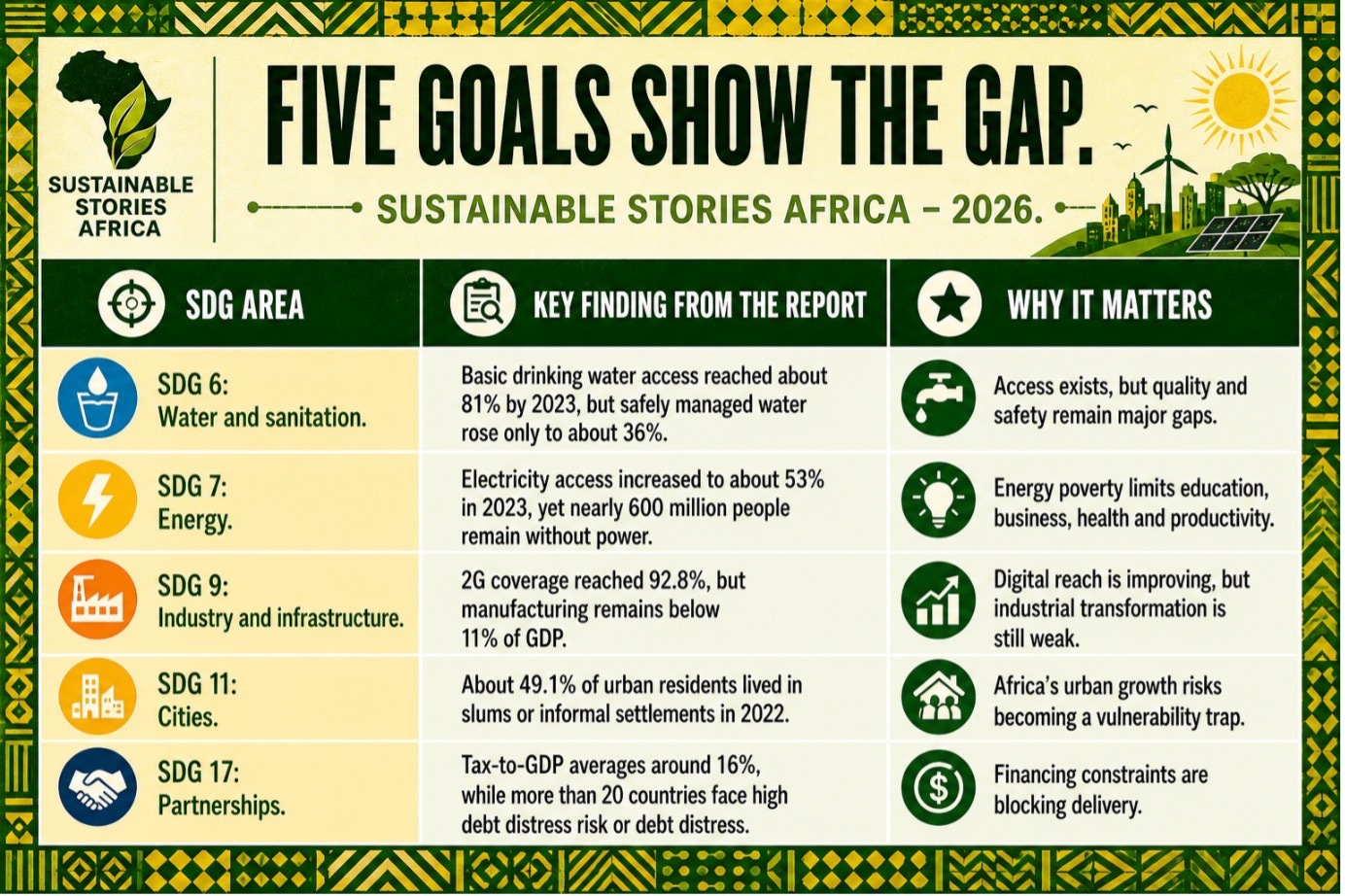
The human impact is clear.
- A child in a poorly serviced settlement may live near a mobile signal but lack clean water.
- A young entrepreneur may have a smartphone but no reliable electricity.
- A city may expand rapidly, but without drainage, public transport or affordable housing.
That is the report’s deeper insight: progress in one sector is not enough if systems remain disconnected.
What Faster Delivery Could Unlock
The upside is significant. Better water systems reduce disease and school absenteeism. Clean energy expands business hours, powers clinics and cuts dependence on polluting fuels. Stronger infrastructure lowers the cost of trade. Safer cities improve productivity and public health. Better partnerships give African countries the fiscal room to invest in people.
The report frames regional cooperation as a major accelerator. Through the African Continental Free Trade Area, cross-border infrastructure, regional energy markets and coordinated industrial policy, African countries can build scale that individual national markets often cannot achieve alone.
Digital transformation also offers a development bridge. But the report warns that technology will not automatically close inequality. Africa’s digital gains must be matched by affordable broadband, skills development, local innovation systems and stronger data governance.
What Must Change Now
The report’s recommendations point to five practical shifts.
First, governments must move from policy design to policy delivery. That means investing in project preparation, procurement, public investment management, monitoring and delivery units that can translate plans into roads, water systems, power projects and urban services.
Second, financing must be treated as a development system, not an annual budget struggle. Domestic resource mobilisation, tax reform, stronger public expenditure alignment, reduced illicit financial flows and better debt management are essential.
Third, international finance must better match Africa’s needs. Concessional finance, climate finance, debt relief and long-term development capital must be scaled and aligned with water, energy, infrastructure and urban resilience priorities.
Fourth, cities must become climate-resilient development platforms. Informal settlements, air pollution, disaster risk and weak public transport cannot be treated as side issues. They are now central to Africa’s SDG performance.
Fifth, data must become a delivery tool. The report notes improvements in statistical capacity, including 41 African countries with national statistical legislation compliant with official statistics principles and 39 implementing national statistical plans in 2024. But better data must translate into better targeting, accountability and public trust.
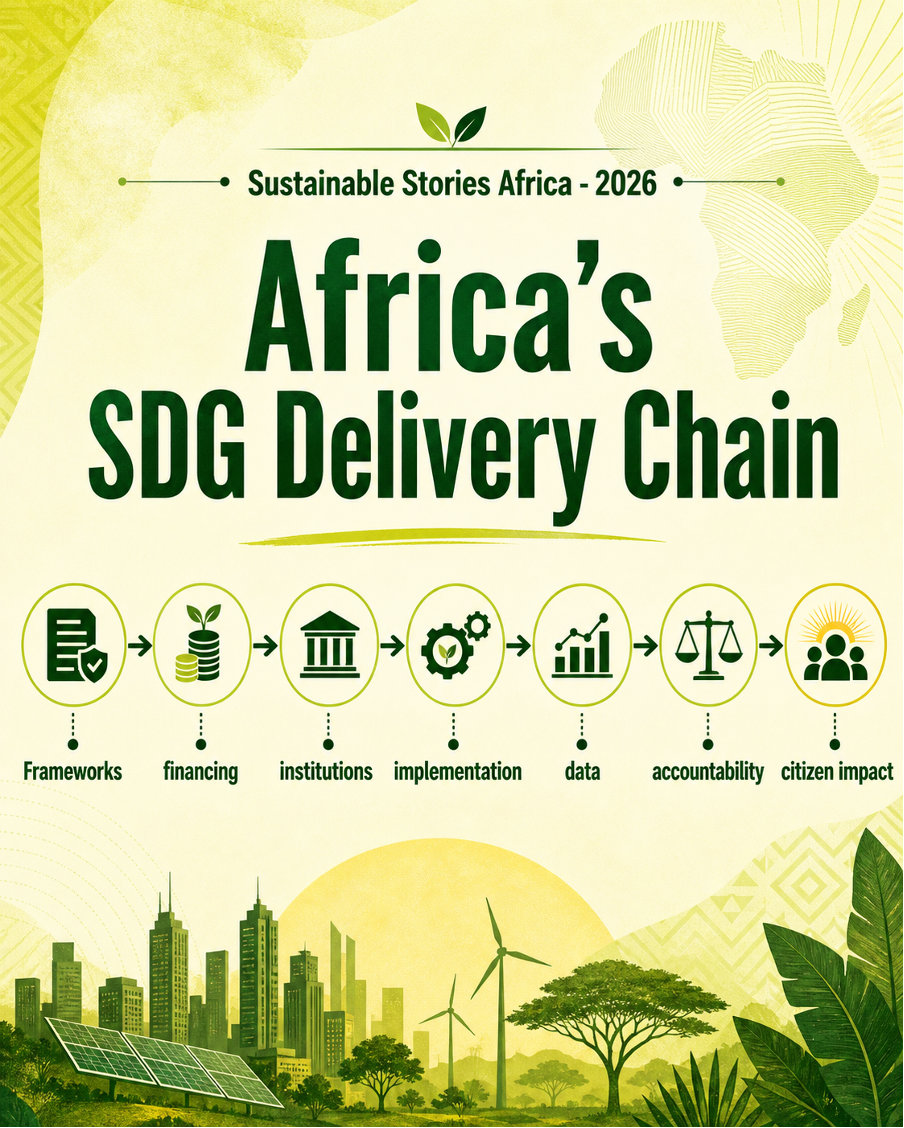
This is the report’s core logic. Africa’s development agenda will not be won by declarations alone. It will be won through the systems that connect capital, governance, infrastructure and people.
Path Forward – Delivery Must Become The Agenda
Africa’s SDG challenge is now an implementation race. The report calls for transformative, equitable, innovative and coordinated action, backed by financing, policy coherence and stronger institutions.
The priority is clear: turn continental ambition into measurable delivery. Water, energy, infrastructure, cities and partnerships must move together, or Africa risks reaching 2030 with progress made—but transformation unfinished.