
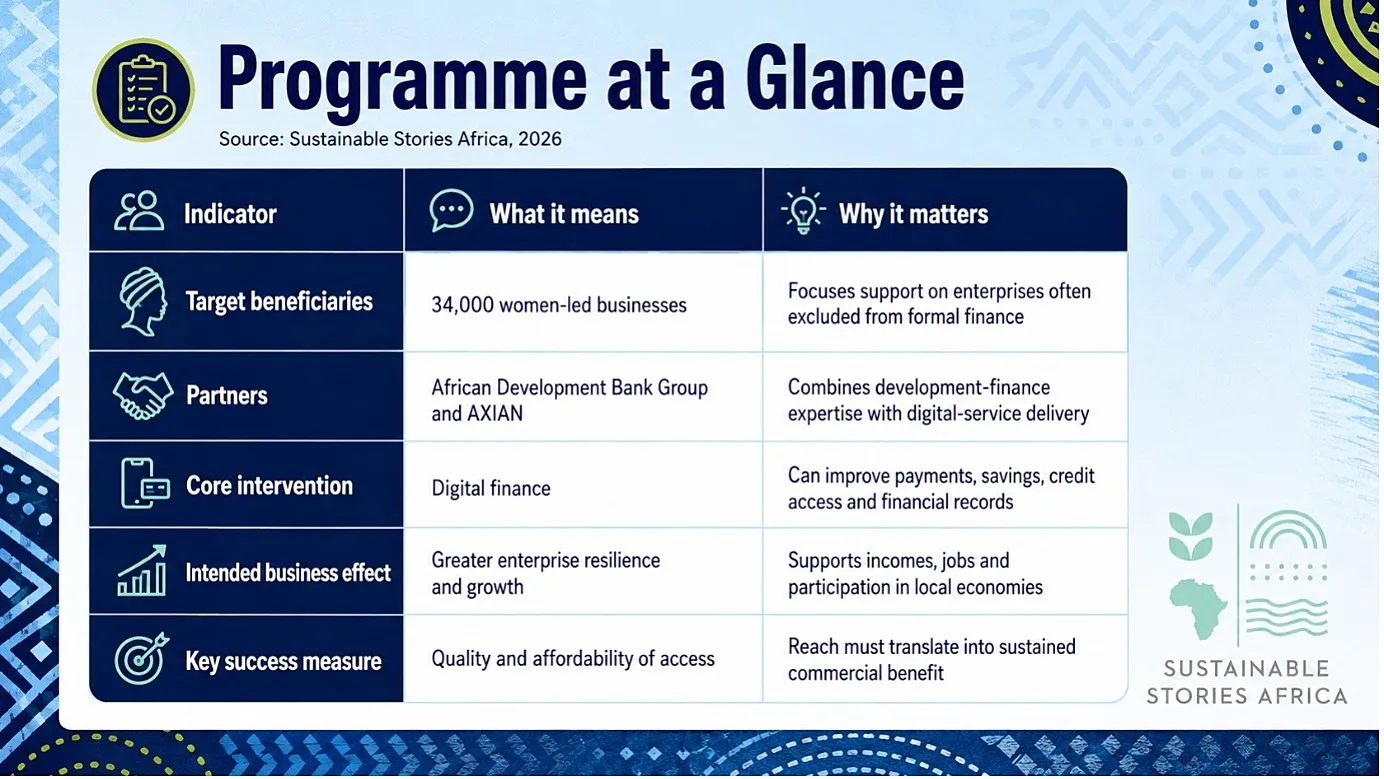
The African Development Bank and AXIAN have launched a digital-finance programme intended to support 34,000 women-led businesses across Africa.
The initiative places financial inclusion, enterprise resilience and technology-enabled services at the centre of women’s economic participation.
Its test will be whether digital access can translate into affordable finance, stronger businesses and decent jobs.
Finance Meets Enterprise
The African Development Bank Group and AXIAN have launched a digital-finance programme designed to support 34,000 women-led businesses in Africa, putting technology at the centre of a larger push to narrow the financing and market-access gaps facing female entrepreneurs.
The announcement signals a recognition that women-owned enterprises need more than goodwill: they need financial products, digital tools and business ecosystems designed around their realities.
For many women entrepreneurs, particularly those operating micro, small and medium-sized enterprises, the obstacle is not a shortage of ideas or customers.
- It is the inability to secure suitable credit, build a formal financial history, receive digital payments reliably or access the information needed to grow beyond subsistence-level trading.
The programme brings together the African Development Bank’s development-finance mandate and AXIAN’s digital and financial-services footprint.
- Its core proposition is straightforward: digital financial inclusion can help turn women-led businesses from overlooked economic actors into better-connected contributors to household incomes, employment and local value chains.
The Inclusion Gap
Women-owned businesses are central to Africa’s everyday economy, from food processing and retail to services, logistics and creative industries.
However, many still work outside formal financial systems or rely on savings groups, informal borrowing and irregular cash flows to keep their operations open.
Digital finance can change that equation when it is affordable, trusted and linked to practical business needs.
- Mobile wallets, merchant-payment systems, tailored savings products and digital credit assessments can reduce transaction costs while helping enterprises establish a usable record of activity.
However, technology alone does not guarantee inclusion.
- A woman running a small enterprise may still face high data costs, weak connectivity, low digital confidence, restrictive collateral requirements or social barriers that limit her control over assets and financial decisions.
The AfDB-AXIAN partnership will therefore be judged not only by the number of businesses reached, but by whether participants can access useful, responsible and appropriately priced services.
From Access to Agency
If the programme works as intended, women entrepreneurs could gain more than a payment channel or a loan application.
- They could obtain greater visibility in the formal economy, build transaction histories that strengthen their creditworthiness and make business decisions with more predictable cash flow.
The benefits could also extend beyond the enterprises themselves.
- Women’s businesses often sustain families and communities through employment, school fees, local procurement and essential services.
- Better access to finance can therefore support a wider cycle of resilience, especially in communities where formal jobs remain scarce.
There is also a strategic market opportunity.
- Financial institutions and telecom-linked platforms that design products around women’s business cycles, repayment capacities and growth ambitions can serve a large and commercially significant customer base that conventional banking models have too often missed.
Build Finance That Works
The next phase must focus on delivery.
- AfDB, AXIAN, financial-service providers and policymakers should ensure that supported businesses receive more than digital onboarding.
- Participants need clear product information, consumer protection, practical digital-literacy support and avenues to resolve complaints when systems fail.
Credit products should also avoid replicating traditional exclusion through opaque algorithms or unrealistic repayment schedules.
- Women entrepreneurs need finance that recognises seasonal income, informal business records and the realities of operating in volatile local markets.
Governments and regulators have a complementary role:
- Expand affordable connectivity, strengthen digital-payment infrastructure and enforce data-protection and consumer-rights standards.
Inclusion is not simply about placing people on a platform; it is about giving them meaningful control, choice and economic value.
Path Forward – Turning Digital Access Into Opportunity
The partnership should publish clear targets for active users, business survival, credit quality, revenue growth and jobs supported, not merely registrations.
Gender-disaggregated reporting will show whether women entrepreneurs are gaining durable financial agency.
For African markets, the broader lesson is that inclusive digital finance must be designed as enterprise infrastructure.
When accessible technology is paired with responsible capital and skills support, women-led businesses can become stronger engines of employment and resilient growth.
Culled from: African Development Bank and AXIAN Launch Digital Finance Programme to Support 34,000 Women-led Businesses in Africa