
Quantum technology is moving towards commercial adoption, with potential applications across finance, healthcare, energy and industrial production.
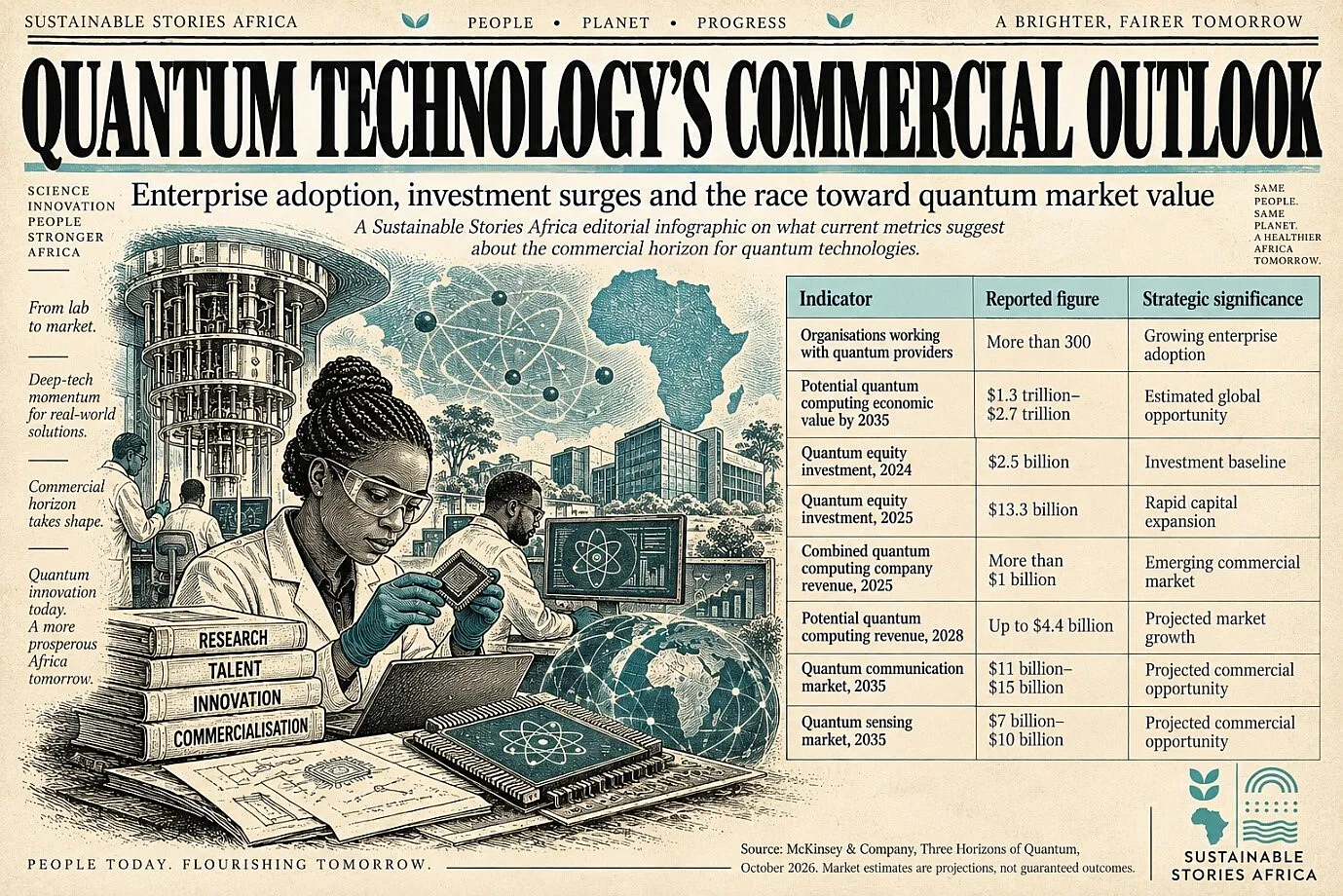
McKinsey estimates that quantum computing could generate $1.3 trillion to $2.7 trillion in economic value globally by 2035.
The emerging industry also poses cybersecurity risks, requiring organisations to prepare for technologies that could challenge existing encryption systems.
Quantum Technology Enters New Commercial Phase
Quantum technology is moving beyond laboratory research towards commercial applications, creating significant opportunities for businesses while introducing potential risks to digital security.
McKinsey & Company's October 2026 review suggests quantum computing could generate between $1.3 trillion and $2.7 trillion in global economic value by 2035.
The report, Three Horizons of Quantum: A Business Road Map to the Future Computing Economy, examines the progression of quantum computing, quantum communication and quantum sensing.
McKinsey reports that more than 300 organisations worldwide are already working with quantum technology providers.
- These partnerships reflect growing commercial interest in technologies that could eventually enable new approaches to complex scientific and industrial problems.
However, the report cautions that quantum computing remains an evolving field, with uncertainty surrounding technological readiness, commercial deployment and the timing of major breakthroughs.
Three Development Horizons Shape Investment Decisions
McKinsey identifies three broad horizons of quantum technology development.
The first involves early commercialisation, including partnerships, specialised services, hybrid computing and initial applications.
- Quantum processors are increasingly being connected to existing high-performance computing systems rather than replacing conventional computing infrastructure.
The second horizon concerns the development of broader commercial applications and more capable systems.
The third focuses on the potential emergence of large-scale, fault-tolerant quantum computing capable of performing certain complex calculations reliably.
Such systems could eventually support advances in pharmaceutical development, industrial materials, financial modelling and scientific research.
The report also highlights substantial growth in investment.
- Equity investment in quantum technology reportedly increased from $2.5 billion in 2024 to $13.3 billion in 2025.
Combined revenue among quantum computing companies exceeded $1 billion in 2025, with McKinsey projecting revenue could rise to as much as $4.4 billion by 2028.
Quantum Innovation Could Support African Development
Quantum technologies could eventually contribute to important development challenges across African economies.
- Potential applications include financial risk analysis, pharmaceutical research, energy-system optimisation and advanced materials development.
- Quantum sensing could also support applications involving navigation, geological measurement and mineral exploration.
However, these opportunities remain at different stages of technological maturity.
Large-scale commercial quantum computing is not yet a routine capability available to most organisations.
For African economies, the opportunity is therefore not simply to acquire expensive hardware, but to develop the research expertise, digital infrastructure and institutional partnerships needed to participate in emerging technology markets.
- Universities, research institutes, financial institutions and technology businesses could benefit from building knowledge and identifying relevant use cases.
Cybersecurity preparedness is another immediate concern.
- The eventual development of sufficiently powerful quantum computers could compromise some widely used public-key encryption methods.
This potential threat is often referred to as Q-Day.
Although its arrival remains uncertain, the possibility creates a reason for organisations to assess their existing cryptographic systems.
Organisations Must Prepare For Quantum Risks
Businesses and public institutions should begin developing strategies for quantum technology and related cybersecurity risks.
- The initial priority is to identify where quantum technologies might create meaningful operational or scientific value.
Organisations should also review cryptographic dependencies, protect sensitive data and develop transition plans for post-quantum security standards.
Financial institutions, telecommunications operators and government agencies may need particular attention because of the sensitivity and long-term value of the information they manage.
African governments can support readiness through research partnerships, technical training and digital infrastructure investment.
However, investment should remain proportionate to realistic commercial needs and the maturity of available technologies.
Quantum preparedness requires informed planning rather than speculative spending.
Path Forward – Building Quantum Readiness Before Market Transformation
Quantum technology presents both an emerging economic opportunity and a long-term security challenge.
For African economies, the most practical response is to strengthen research capacity, cybersecurity readiness and international technology partnerships.
Early preparation could improve participation in future commercial opportunities while reducing exposure to technological disruption as quantum systems become more capable.