
Financial market scores improved in 21 of the 29 economies assessed by the Absa Africa Financial Markets Index 2026.
South Africa remains first, while Nigeria’s score falls and Ghana makes a notable advance in the ranking.
The report points to stronger market infrastructure and broader reform, but its new methodology means comparisons must use the recalculated historical figures supplied in this edition.
Index records broad financial market improvements
Twenty-one of the 29 economies in the Absa Africa Financial Markets Index 2026 improved their scores, according to the report produced by OMFIF in association with Absa.
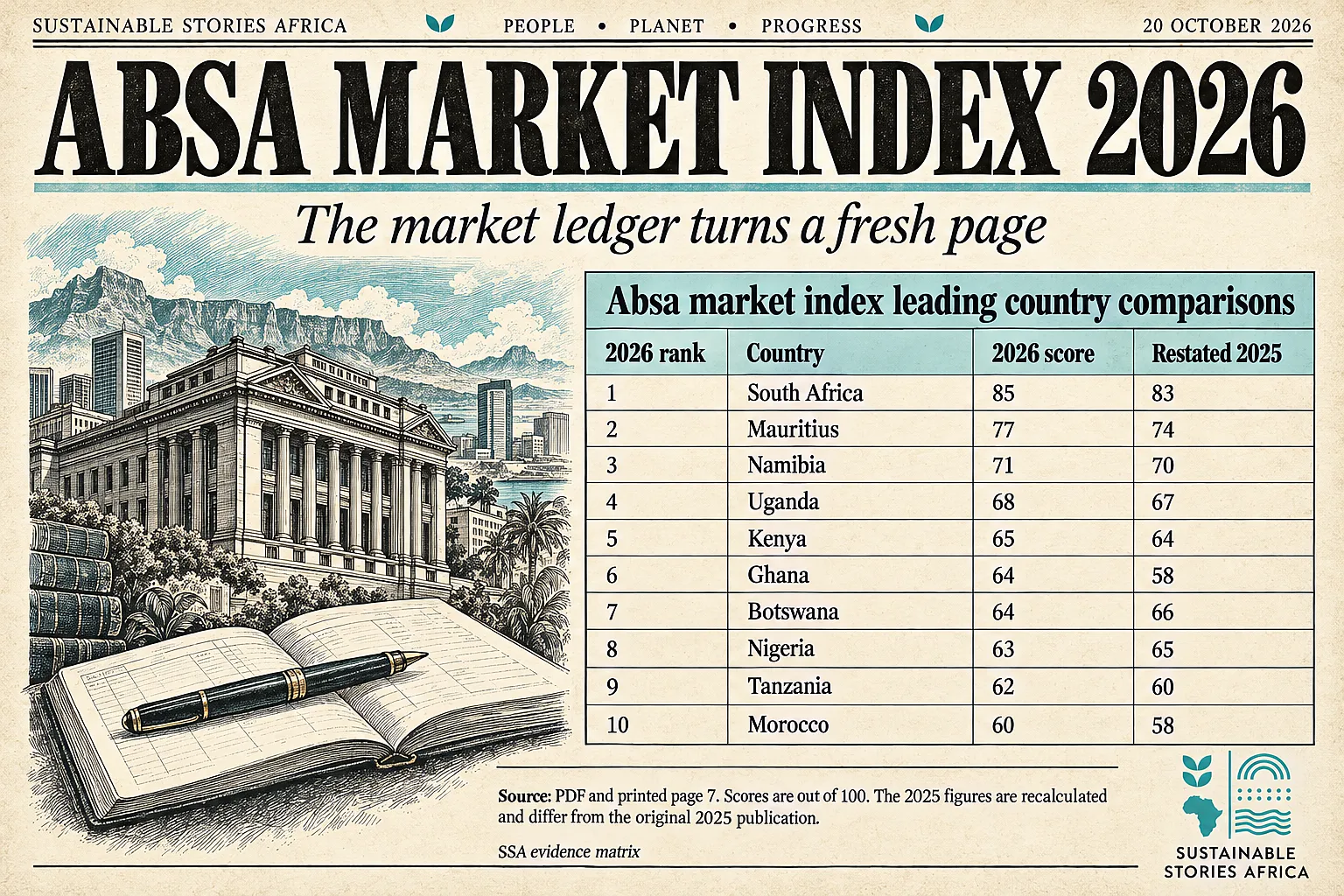
- South Africa leads with 85 points, followed by Mauritius on 77 and Namibia on 71. Nigeria ranks eighth with 63.
The index assesses market development through transparency, accessibility and openness.
- Its six pillars cover depth, foreign exchange, transparency, pension fund development, the macroeconomic environment and the legal, tax and regulatory framework.
The findings suggest progress across many of the institutions needed to support investment.
- They do not rank every aspect of national development, establish the returns an investor will earn or directly measure whether finance reached underserved businesses and households.
Those questions require evidence beyond a composite score.
Recalculated comparisons reveal different country trajectories
Nigeria’s score falls from a recalculated 65 in 2025 to 63 in 2026, while its rank moves from sixth to eighth.
- Ghana rises from tenth to sixth, with its score increasing from 58 to 64.
- Cabo Verde gained 7 points to move from 19th to 13th.
The report introduces a fixed-reference scoring approach and recalculates the prior-year figures.
- These figures differ from the scores originally published in the 2025 edition.
- A comparison made against the old publication without adjustment could therefore give a misleading impression of change.
The table presents the leading ten countries using the restated comparison in the supplied report.
- Rounded scores can be equal while countries occupy different ranks, so the published ordering is retained.
- This avoids inventing a tie-breaking rule or assuming that countries with the same displayed score have identical underlying performance.
Market reforms can support wider opportunity
The report identifies improvements in reserve adequacy in 16 economies and stronger transparency scores in 13.
- It records 19 countries reporting ESG initiatives and 11 implementing climate stress testing.
- Initiatives to expand mobile wallets and payment services are under way in 26 of the 29 countries.
Those developments can strengthen the infrastructure through which savings and investment move.
- More accessible information may help market participants assess risk, while a broader range of products can give issuers and investors additional options.
- The report nevertheless distinguishes transparency from liquidity: published rules alone do not ensure an active foreign exchange market.
SSA assesses that the next test is practical use.
- A new product should be examined for uptake, cost and suitability.
- A digital access initiative should be judged through functioning services, not its launch alone.
- Likewise, a sustainable finance framework creates a basis for better decisions but does not independently establish that the projects financed deliver environmental or social benefits.
Use benchmarks to guide targeted reform
For Nigeria, the lower score should prompt a pillar-level examination rather than a claim that every part of the financial system deteriorated.
- Composite results can conceal progress in one area and weakness in another.
- Officials and market institutions should explain which indicators changed and how the evidence informs their priorities.
Other countries can use the index to identify reform experiences worth investigating.
- Replication still requires attention to legal systems, institutional capacity and market size.
- A measure associated with improvement elsewhere should not be assumed to produce the same result automatically.
The report’s methodology provides communication carefully.
- Published comparisons should specify the edition, score basis and period used.
- Analysts should separate changes in rank from changes in score, since relative positions also depend on other countries' performance.
SSA recommends linking reform plans to observable outcomes: more reliable settlement, usable information, wider appropriate participation and finance that supports viable activity.
- These measures would help citizens and businesses understand what an improved market framework means in practice.
- Index progress is most valuable when it informs decisions and accountability, rather than becoming a substitute for them.
Market authorities should also explain how they will review implementation after a reform takes effect.
- A clear review process makes it easier to identify unintended barriers and adjust practical arrangements while preserving predictable rules for participants.
Path Forward – Convert market reforms into useful finance
African market institutions should build on the progress while examining remaining barriers to liquidity and participation.
Nigeria’s result warrants an explanation based on the underlying indicators.
Transparent comparisons and measurable reform outcomes can help the index support better decisions, with sustainable finance judged by its real economic and public benefits.