
The European Banking Authority has released the first technical phase of reporting framework 4.4, covering updated disclosures and supervisory reporting components.
The package includes ESG-related Pillar 3 changes and financial reporting work connected to IFRS 18.
For African banking groups with relevant European operations or counterparties, the development highlights the importance of traceable data and carefully assessed regulatory scope.
European reporting changes reach implementation stage
The European Banking Authority released the final technical package for the first phase of reporting framework 4.4 on 12 October 2026.
The release brings ESG-related Pillar 3 disclosures and other banking reporting changes into the technical work of preparing structured information for regulators and markets.
For institutions within scope, the immediate task is to establish which reporting components affect their operations and when.
The African relevance is selective.
- An African bank may need to assess a European subsidiary’s obligations or respond to information requests from counterparties.
The announcement does not create a blanket requirement for all African financial institutions to adopt an EU reporting framework.
Technical specifications organise different reporting obligations
OneStop ESG reports that the package updates Data Point Models and XBRL taxonomies, covering ESG, equity and shadow-banking disclosures as well as selected trading-book templates.
- It also includes a FINREP module aligned with IFRS 18.
- Validation rules in this release apply to reporting requirements rather than indiscriminately to every disclosure element.
The EBA describes a second phase, 4.4.1, covering remaining elements of its supervisory reporting simplification consultation.
- The distinction between phases matters: releasing the present package does not mean every planned simplification is already implemented.
The practical difference between FINREP and Pillar 3 should also remain visible.
- FINREP concerns supervisory financial information; Pillar 3 supports public disclosures.
- IFRS 18 deals with the presentation and disclosure of financial statements and should not be described as a sustainability reporting standard.
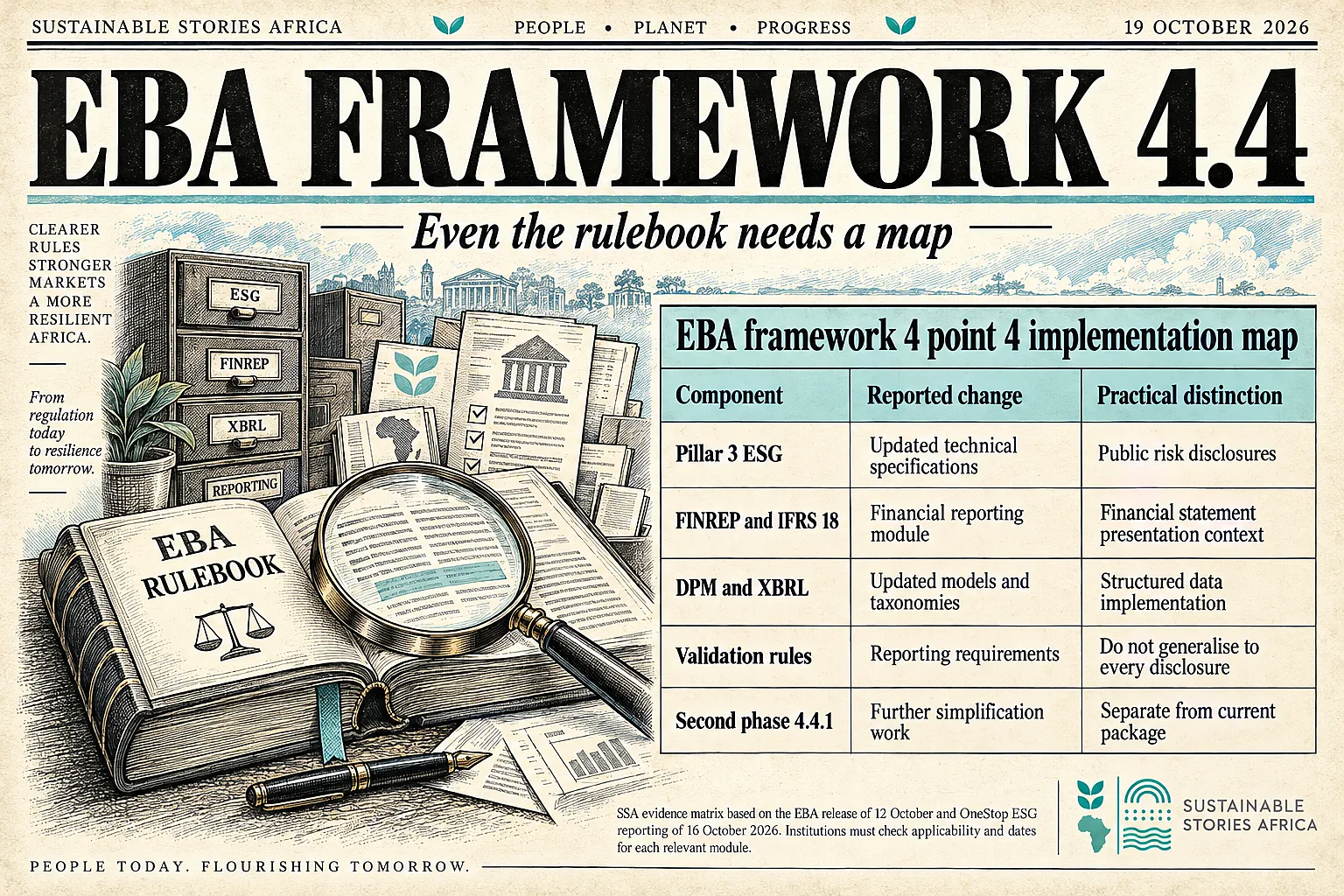
SSA assesses that these parallel changes require coordination without blurring their purposes.
- A bank can share data infrastructure across reporting functions while retaining separate responsibility for the rules governing each output.
Reliable reporting begins with traceable evidence
The opportunity is to improve the information beneath the published report.
- A disclosure becomes more useful when a reviewer can identify the underlying record, understand the calculation and explain the judgment applied.
- This is particularly relevant where financial and sustainability teams use different definitions or reporting boundaries.
A hypothetical banking group illustrates the issue.
- If one team classifies an exposure differently from another, a technically valid submission can still present an inconsistent picture.
- Reconciliation should therefore test whether the reported information has the intended meaning, alongside whether a file passes system checks.
Better coordination could also reduce repeated manual requests to business units.
- A controlled source of information may support several outputs, provided they assess each output’s specific requirements.
- Test efficiency through implementation rather than assume it from the existence of a new taxonomy.
For African institutions watching the change, the transferable lesson is disciplined data ownership.
- Copying templates without understanding their scope would add work without necessarily producing more decision-useful information.
Institutions should map scope before implementation
Affected groups should begin with a module-level applicability assessment agreed by regulatory reporting, finance and risk teams.
- It should identify the responsible entity, reporting period and technical changes required.
- Resolve scope uncertainties before systems are configured around an assumption.
Implementation testing should follow a sample data point from its source to the final output.
- Reviewers should check the calculation, approval evidence and handling of revisions.
- This would show whether a reported number can be reproduced and corrected when underlying information changes.
Boards should ask whether the change improves consistency and accountability as well as submission capability.
- For groups operating in several jurisdictions, local and consolidated reporting teams should agree how to manage differences rather than forcing all requirements into an apparently uniform template.
African regulators and institutions can use the development to examine their own data practices while maintaining reporting arrangements suited to their mandates and markets.
Path Forward – Strengthen reporting through clear data ownership
Banks within scope should confirm module requirements, assign accountable data owners and test the evidence behind disclosures.
Publication of a technical package should trigger a focused implementation assessment.
African groups should evaluate relevant European exposures while improving their own reporting controls.
Reliable information requires consistent definitions and reviewable judgments.
Culled from: EBA Releases Reporting Framework 4.4 Covering Pillar 3 ESG Disclosures and IFRS 18 | OneStop ESG