China’s scientific rise is reshaping the context for international research cooperation, Nature reports.
Separate publication data place it first in the 2026 Nature Index country table, based on 2025 output.
African institutions have opportunities to pursue partnerships that strengthen their own priorities, skills and research systems.
Scientific influence is becoming more widely distributed
China’s expanding scientific strength is set to influence technological innovation and the international balance of power, according to a Nature news feature by Xiaoying You.
The accessible introduction describes a renewed emphasis on fundamental research.
For African universities and research agencies, the development raises a strategic question:
- How should international partnerships build durable capacity at home?
The answer depends on the terms of cooperation, not simply on which foreign institution produces the largest number of papers.
SSA’s analysis is that a more diverse global research landscape can widen the range of potential collaborators.
Turning that possibility into public value requires institutions to define the problems they want to solve and the capabilities they want to retain.
Publication indicators need careful interpretation and context
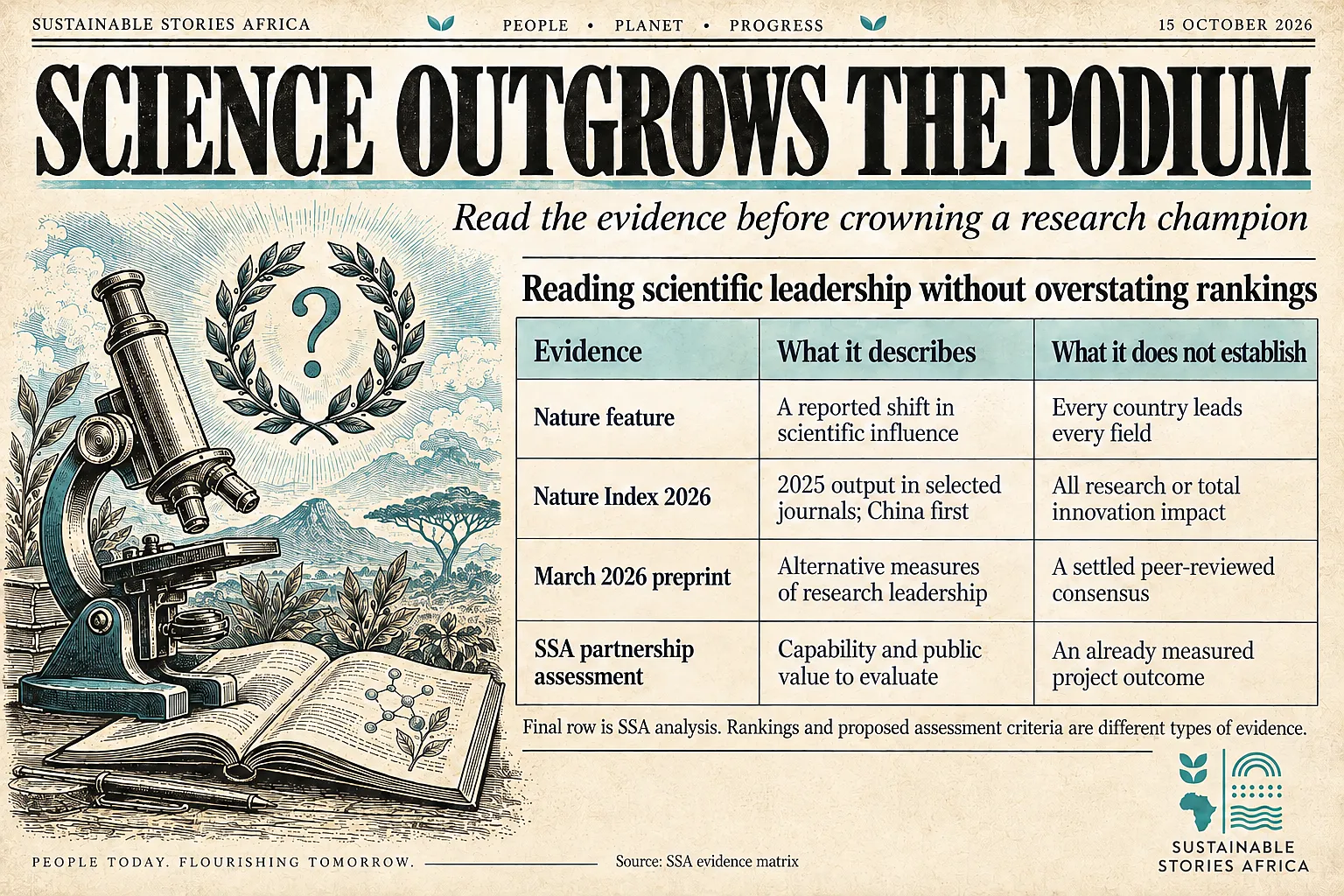
A separate source, the Nature Index 2026 Research Leaders country table, places China first.
- The listing uses research published during 2025 in its selected journal set.
- It is therefore a publication indicator, rather than a complete measure of scientific leadership or social benefit.
An additional March 2026 preprint by Jeffrey Lockhart and colleagues distinguishes leadership in emerging research areas from the creation of surprising new directions.
- The difference, authors argue, depends on national strengths and the measure used.
- The work should be treated as a preprint, not an established policy verdict.
These distinctions matter because an institution choosing collaborators needs more than a ranking.
- Relevant expertise, research integrity, training quality and the ability to sustain joint work may be more useful selection criteria.
African priorities should shape partnership design
Consider a university seeking support for research on agricultural resilience.
- Access to advanced equipment or specialist training could be valuable.
- However, the partnership should also address who selects the research questions, where samples are analysed and how results reach the people expected to use them.
This is an illustrative scenario, not a project announced in the Nature feature.
SSA assesses that the best agreements should leave a usable capability behind.
- This may include trained technicians, functioning equipment, stronger research management or a team able to secure its next grant.
- A completed publication alone cannot demonstrate all of those outcomes.
Partnerships should also find space for findings that challenge an initial assumption.
- Research is less useful when commercial or diplomatic expectations determine which results can be discussed.
- Transparent methods, ethical review and clear publication arrangements help protect the credibility of both institutions.
Governance determines whether cooperation builds lasting capability
African research leaders should set out their objectives before negotiating access to finance or facilities.
- An agreement must clarify responsibilities for maintenance, training, data stewardship and costs after the initial funding ends.
- These practical details determine whether an impressive launch becomes an enduring programme.
SSA recommends assessing partnerships through outcomes that institutions can verify.
- Relevant measures could include completion of agreed training, retention of specialist skills, reliable operation of facilities and use of findings in a defined public service or productive activity.
- Institutions should avoid claiming impacts that have not yet occurred.
Governments can support this approach through predictable domestic research commitments and transparent selection of priority programmes.
International finance can complement those commitments, but dependence on a single partner may leave work exposed to changes in external policy.
China’s rise has broader implications than a choice between competing research powers.
- African institutions have a reason to strengthen their ability to negotiate, evaluate and coordinate cooperation.
- Scientific sovereignty in this context means having the capacity to set priorities and judge evidence while participating constructively in international networks.
Path Forward – Build partnerships around African research priorities
African institutions should use the expanding range of scientific partners to strengthen locally chosen research programmes.
Agreements must have clear provisions on skills, data, publication and long-term operating responsibilities.
Success should be judged by capability and retained useful knowledge, alongside publication performance, with research integrity remaining central to cooperation.
Culled from: China’s extraordinary rise in science and how it will change the world | Nature