
WhatsApp has announced guest calling for people without an account.
A shared link allows participation through a browser, with admission controlled by the host.
For African organisations, the feature could simplify some conversations, although connectivity, accessibility and participants' needs still determine whether it is useful.
Guest access removes an account participation requirement
WhatsApp announced on October 14 that people without an account can join calls through an invitation link.
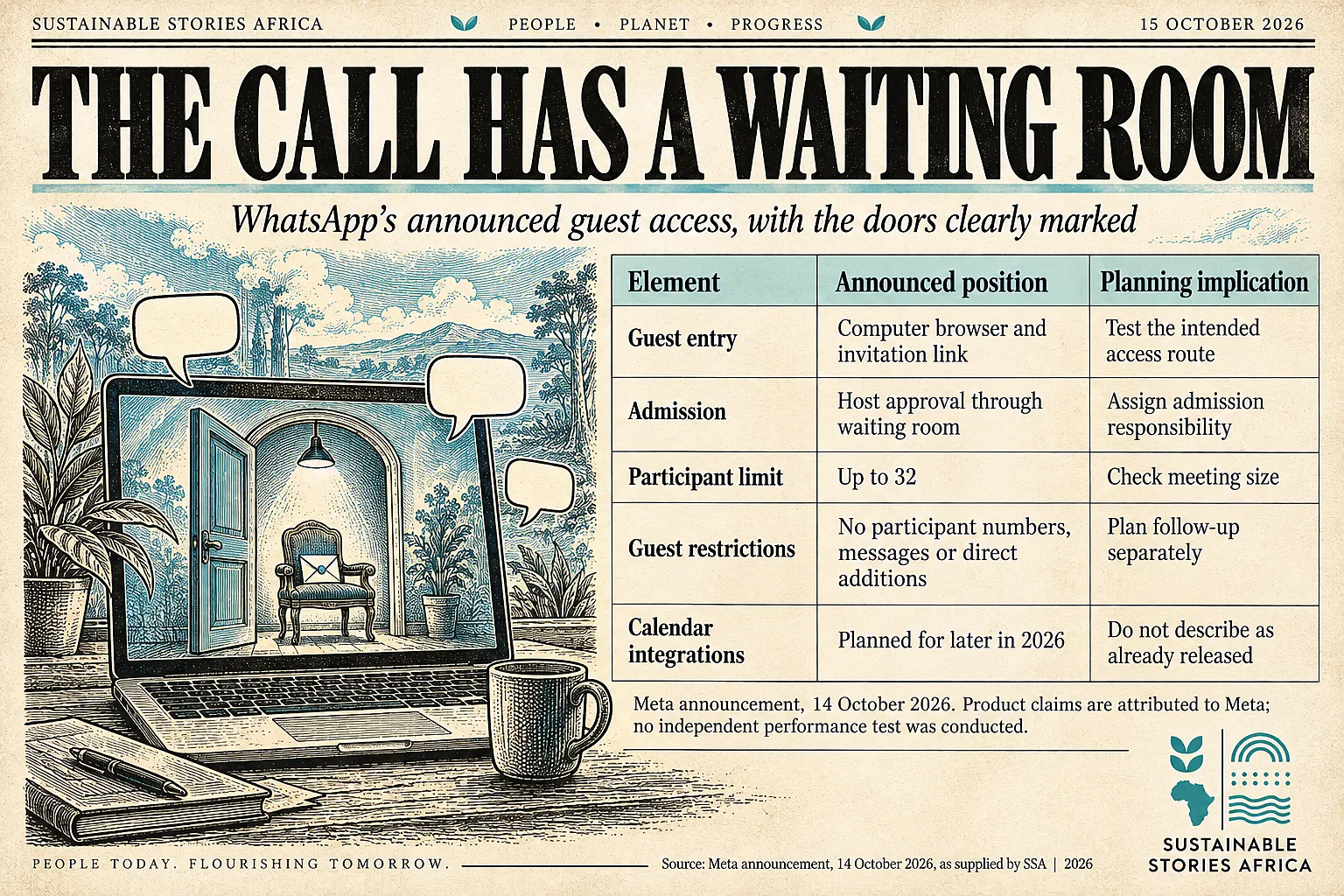
Meta says guests can enter through a computer browser, while an account holder remains responsible for creating the link and admitting them.
The change could make it easier to organise a conversation across people who use different communication services.
- It does not establish that every intended participant has the equipment, connectivity or skills needed to join.
SSA’s analysis is that the feature’s value should be assessed through the experience of the people invited.
- Removing an account requirement can reduce one barrier while leaving others in place.
Organisations therefore need to test access in the setting where they expect to use it.
Host controls define the participation model
Meta says guest participants enter a waiting room and require host approval.
- They cannot see other participants’ phone numbers, send messages or add people directly.
- Calls support up to 32 participants and are described by the company as end-to-end encrypted, without a time limit.
The announcement also identifies Google and Outlook calendar integrations as planned for later in 2026.
SSA assesses that access controls need to be understood before a meeting starts.
- A familiar service can still create uncertainty when guests join differently from registered users.
Practical benefits depend on participant circumstances
An organisation arranging a short briefing with a supplier could potentially avoid asking that person to create another account.
- A training coordinator might also find it easier to invite an occasional external contributor.
- These are possible uses, rather than adoption results reported by Meta.
For African users, the practical test includes whether the invited person can access a suitable computer and maintain a stable connection.
- A convenient link for one participant may be unsuitable for another.
- Public-facing services should preserve an alternative route where participation is essential.
SSA’s view is that accessibility should be considered at the planning stage.
- Organisers should ask about communication needs, provide a clear agenda and share necessary materials in an accessible format.
- The ability to enter a call does not by itself ensure that a person can follow the discussion, contribute meaningfully or act on the outcome.
Organisers need clear procedures for guest participation
Hosts should tell invitees what to expect and allow time to resolve access problems.
- Where participants do not know one another, the organiser should decide how to check identity before admission.
- A typed display name is not a substitute for a process appropriate to the sensitivity of the meeting.
SSA recommends limiting circulation of invitation links and assigning responsibility for admission during larger calls.
- Organisers should also explain whether notes will be taken and how any materials shared during the discussion will be handled.
- These are recommended operating practices, not additional product features announced by Meta.
For sensitive matters, organisations should assess service suitability within their existing policies and obligations.
- Encryption is one element of a communication arrangement; participant behaviour, device security and consent remain relevant to the overall experience.
The broader sustainability implication is modest but practical.
- Easier remote collaboration could reduce friction in some activities, but this announcement provides no measured evidence of travel avoided, emissions reduced, or productivity improved.
These outcomes should be evaluated where the feature is used.
- Clear reporting of actual benefits would be more credible than treating a new calling option as an automatic inclusion or climate achievement.
Path Forward – Make easier calling support meaningful participation
Organisations should test guest access, explain host controls and preserve alternatives for people who cannot join.
Planned calendar features should remain labelled as forthcoming until released.
Measuring success includes usefulness, accessible conversation with appropriate safeguards, not the number of links sent or accounts avoided.
Culled from: WhatsApp brings guest calling, lets people without an account join calls through a link