More than half of Nigeria’s cocoa could fall short of EU traceability requirements, the Lagos Chamber of Commerce and Industry has warned.
The assessment increases pressure to map farms and link production records to export consignments before the principal December application date.
For farmers and exporters, protecting market access will require evidence of origin alongside the beans themselves.
Cocoa exporters face an evidence deadline
Nigeria needs faster cocoa farm mapping and supply-chain traceability to protect access to European buyers, according to the Lagos Chamber of Commerce and Industry.
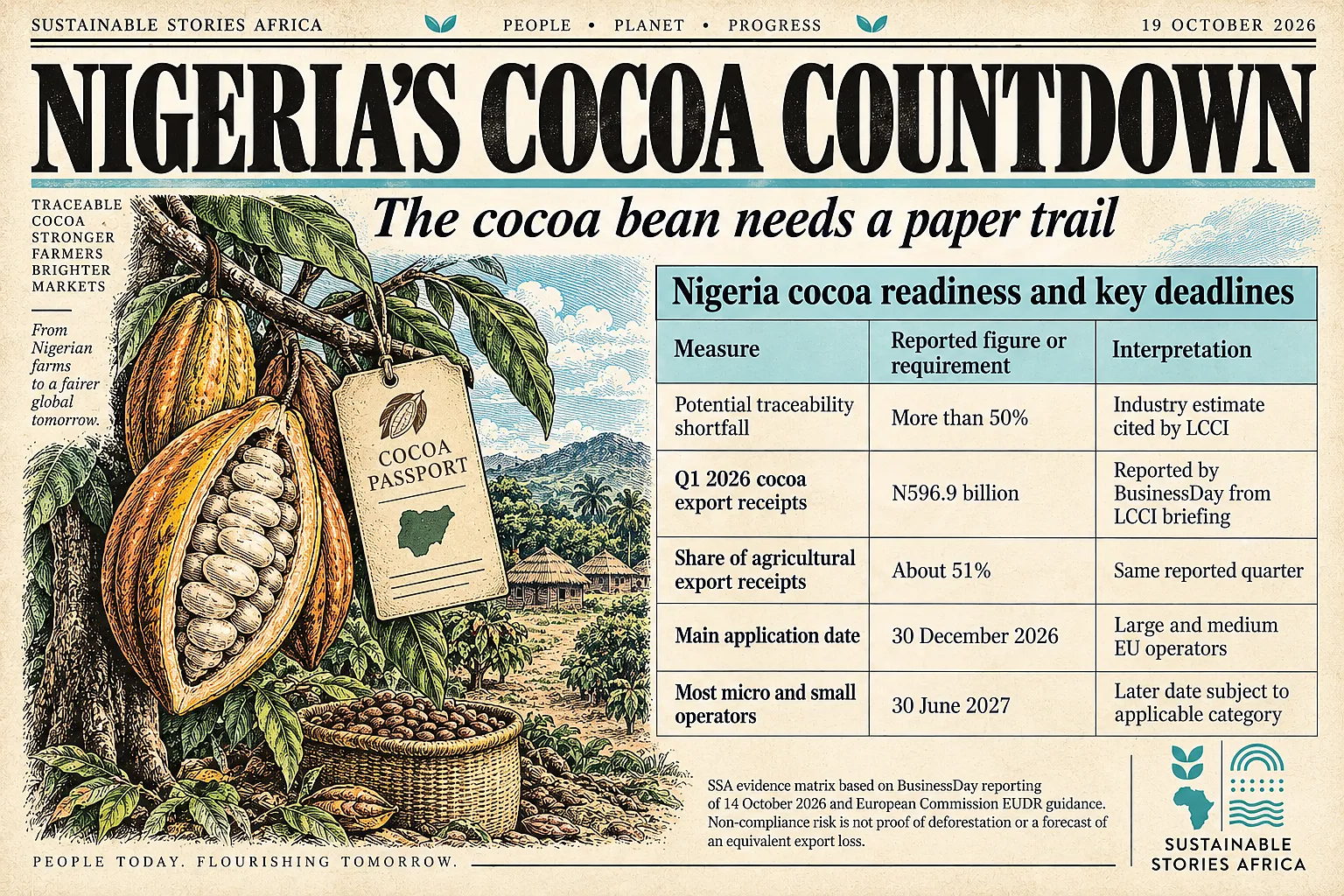
BusinessDay reported on 14 October that chamber president Leye Kupoluyi cited industry estimates suggesting more than 50% of Nigerian cocoa may not meet the EU Deforestation Regulation’s traceability requirements.
- The figure warns of possible non-compliance, not a finding that half the country’s cocoa has caused deforestation.
This distinction matters to farmers whose production may meet environmental requirements, but whose records are incomplete.
The immediate challenge is to demonstrate shipment origin.
- A buyer needs to connect the beans to the farms that produced them and to evidence relevant to the regulation.
Missing records can therefore become a commercial barrier even where a producer believes the underlying farming practices are acceptable.
Farm records underpin access and assurance
The European Commission confirms that the regulation applies from 30 December 2026 to large and medium-sized operators, with a later date of 30 June 2027 for most micro and small operators.
- Certain small timber operators follow the earlier date.
- These are operator categories; an African farmer’s size alone does not determine an EU buyer’s compliance date.
Cocoa is among seven covered commodities.
- The regulation seeks to keep deforestation-related products out of the EU market and requires compliance with relevant production-country legislation.
- Its forest conversion cut-off is 31 December 2020.
BusinessDay reports that cocoa generated N596.9 billion in agricultural export receipts in the first quarter of 2026, about 51% of the agricultural total.
- It also reports the LCCI’s call for funded geolocation mapping and a national platform connecting farmer identity, farm coordinates and supply-chain movements.
These figures and proposals are attributed to the chamber’s briefing.
A national platform would still need a practical connection to individual consignments.
- Mapping a farm once does not, by itself, establish the origin of every subsequent delivery.
Traceability can strengthen farmer market participation
SSA assesses that a useful traceability programme should give farmers a durable record they can understand and use.
- Repeated requests for similar information from different buyers could otherwise turn compliance into an avoidable cost.
- Shared data standards should be considered alongside safeguards governing who can access personal and commercial information.
For cooperatives and aggregators, consistent identifiers could help keep deliveries connected to their source as beans move between collection points.
- The environmental benefit depends on whether that information supports credible checks, including the investigation of questionable locations or mixed consignments.
The commercial aim should be continued participation for producers who can demonstrate compliance.
- A system that is technically sophisticated but inaccessible to smallholders could make exclusion easier without improving the quality of environmental evidence.
- Training and field support therefore belong in the programme’s budget.
Fund mapping and test shipment evidence
The agriculture ministry, export promotion authorities and producing states should respond to the chamber’s request with a coordinated delivery plan.
- That plan should distinguish farms mapped from farms verified and from consignments supported by complete records. Publishing those measures would make progress easier to assess.
Exporters should work backwards from buyer requirements and test representative shipments before the applicable deadline.
- A trial should show whether farm information remains usable through aggregation, storage and export documentation.
- Problems discovered in that exercise would be more actionable than a general declaration of readiness.
Public support should prioritise producers least able to finance mapping and documentation themselves.
Buyers should also explain what evidence they will accept.
Shared responsibility would give farmers a clearer route to compliance while preserving the environmental purpose rule.
Path Forward – Protect cocoa livelihoods through credible traceability
Nigeria should accelerate farm mapping while testing the records that connect producers to export consignments.
Support must reach smallholders and major exporters.
Authorities and buyers should publish clear responsibilities and measure verified readiness. The objective is to protect compliant trade while reducing deforestation risk.
Culled from: Over half of Nigeria’s cocoa may fail EU deforestation rule – LCCI – Businessday NG