
Expert perceptions of sustainability backlash are rising beyond North America, according to GlobeScan research.
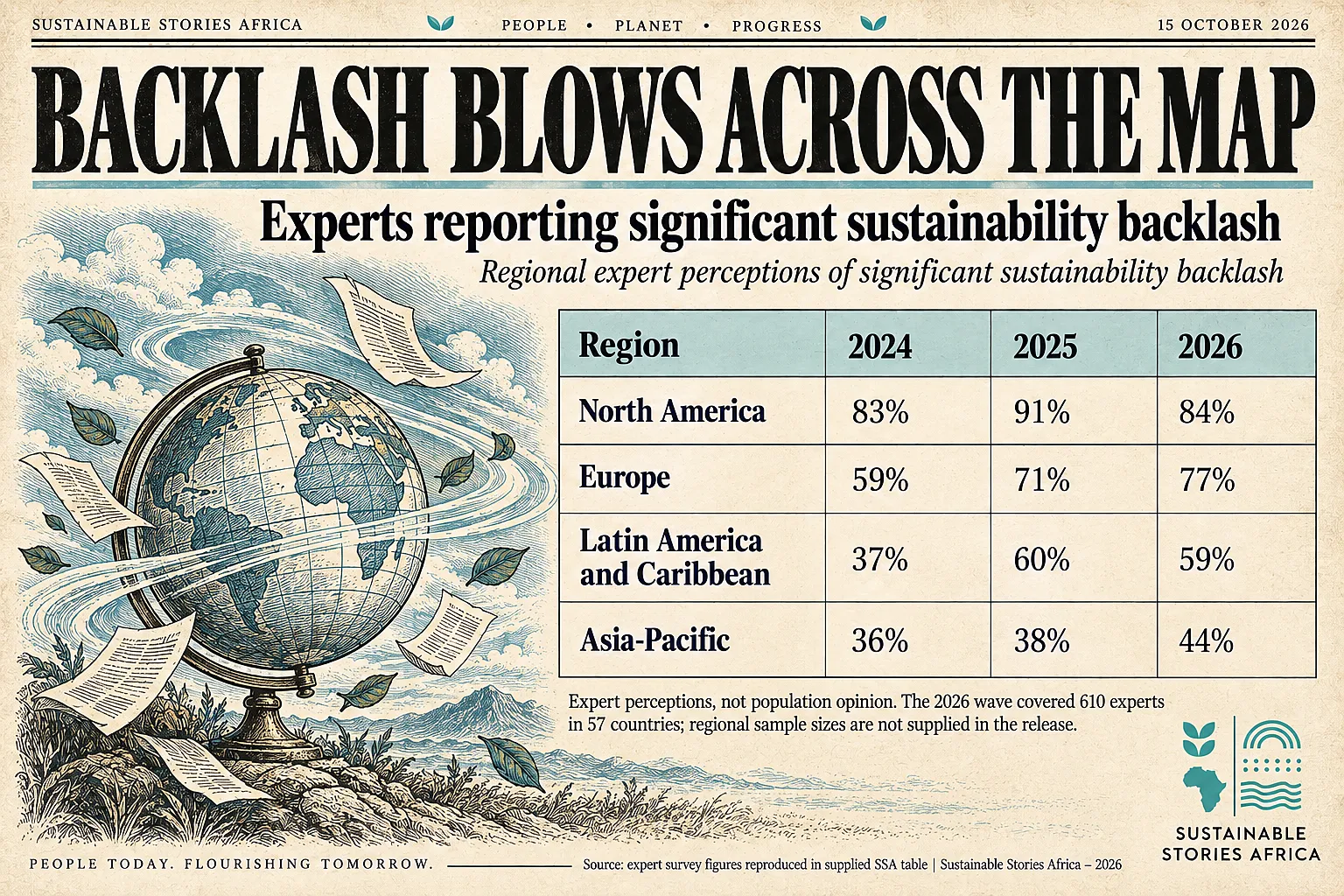
Europe shows a sustained increase between 2024 and 2026, while other regions differ in patterns.
African organisations should examine their own stakeholder concerns rather than assume the survey describes local public opinion.
Expert survey maps a changing debate
Continued resistance to the sustainability agenda is being reported more widely beyond North America, according to research published by GlobeScan on October 14.
Its survey, alongside ERM and Volans, gathered responses from 610 sustainability experts in 57 countries between June and August 2026.
The findings concern experts’ perceptions of significant backlash in their own countries.
- They do not measure the proportion of citizens opposed to sustainability, and the published regional comparison does not provide an Africa-specific result.
SSA’s analysis is that the changing geography of resistance matters to African organisations connected to international markets.
It creates a reason to examine how sustainability decisions are understood, without assuming that a contested debate abroad will follow the same course locally.
Regional results resist a single narrative
The results show different regional paths, as summarised in the table.
- North America remains highes.
- Europe has risen in each survey year
- Asia-Pacific remains lowest among the regions shown.
That pattern requires a more specific interpretation than assuming that resistance is moving uniformly everywhere.
The table presents the regional series without combining it into a global estimate.
- Differences in regional composition and the absence of subgroup sample sizes limit conclusions about precision.
An expert perception survey can flag an issue for investigation.
- It cannot, on its own, explain what caused the change, show customer behaviours, nor highlight whether a specific corporate policy has gained or lost support.
Local relevance can strengthen stakeholder understanding
For an African business, the practical response should begin with the decisions stakeholders actually face.
- Workers may want to understand how an operational change affects jobs.
- Customers may ask whether a claimed environmental benefit changes price or reliability.
- Communities may care about access to water or whether a complaint receives a response.
These are illustrative concerns, not findings of the GlobeScan survey.
- They show why sustainability language should link identifiable effects and responsibilities.
- A broad label can become difficult to defend if the organisation cannot explain what it is doing and why.
SSA assesses that clearer communication should include costs, limits and uneven effects.
- A transition programme may create opportunities while placing pressure on particular groups.
- Acknowledging those trade-offs allows a more useful discussion about how to manage them.
- Presenting only favourable outcomes can leave legitimate questions unanswered.
Evidence must guide communication and decisions
Boards should distinguish disagreement about objectives from concern about delivery.
- A stakeholder who questions an unsupported claim is not necessarily rejecting environmental or social progress.
- The response should address the substance of the question rather than assign a political motive.
SSA recommends reviewing major public claims against the underlying evidence.
Organisations should identify which results are measured, which remain targets and which depend on external conditions.
- Missed milestones require clear explanations similar to those for achievements.
Listening also needs a decision process.
- If consultation identifies a material concern, management should record who will assess it, when a response is due and how outcomes are communicated.
- Engagement without a route to action can deepen frustration.
For African policymakers, the regional findings should prompt a careful study of local attitudes.
- Public consultations and sector-specific research could reveal where costs, credibility or trust shape disagreement.
- Such evidence would support better policy design than importing a general story about a global backlash.
The central issue is how institutions demonstrate public value while remaining accountable for their promises.
Path Forward – Keep sustainability accountable to lived realities
African organisations should respond to contested sustainability debates with clearer evidence and meaningful local engagement.
The regional survey is a warning to investigate, rather than a substitute for that work.
Explaining trade-offs, reporting delivery and responding to legitimate concerns can help sustain trust when the wider political environment becomes more difficult.
Culled from: The Sustainability Backlash Has Spread Beyond North America