
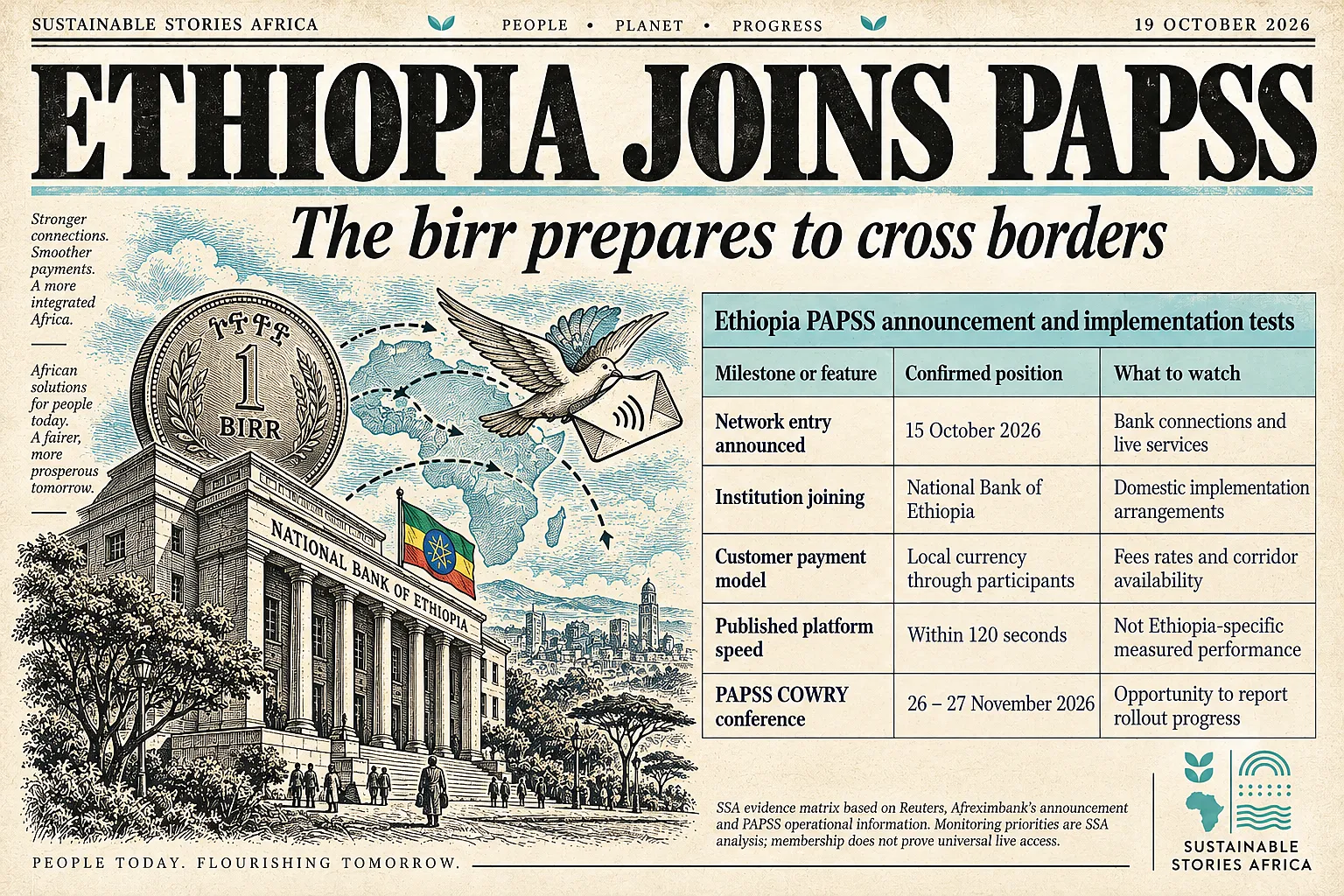
Ethiopia’s central bank has joined the Pan-African Payment and Settlement System, opening a route for domestic financial institutions to connect with the continental network.
The announcement was made in Addis Ababa on 15 October.
Its development value will depend on how quickly banks turn membership into accessible services with clear pricing, reliable settlement and practical support for traders.
Ethiopia joins continental payments integration effort
The National Bank of Ethiopia has joined the Pan-African Payment and Settlement System, expanding the country’s connection to an African payments infrastructure intended to support trade across borders.
Reuters reported the development on 15 October 2026, attributing the announcement to the platform.
For businesses, the significance lies in whether a new institutional connection becomes a payment option they can actually use.
An exporter needs to know which bank can process a transaction, what it will cost and when the customer’s payment will arrive.
Membership advances the infrastructure agenda, not evidence that all Ethiopian banks or every African trade corridor is already available to customers.
That distinction should guide expectations as institutions explain the next steps.
Local currency payments require connected institutions
An Afreximbank announcement says Governor Eyob Tekalign and PAPSS chief executive Mike Ogbalu III presented the development during the Ethiopia Finance Forum in Addis Ababa.
- It says participation enables Ethiopian financial institutions to connect to the network. The announcement also confirms that Addis Ababa will host PAPSS COWRY on 26 – 27 November 2026.
PAPSS describes its core model as allowing customers to initiate and receive payments in local currencies through participating institutions.
- Its published architecture combines rapid payment messaging, pre-funding and net settlement.
- It describes payment processing within 120 seconds, subject to the system’s operational arrangements.
- That is a platform description, not a measured performance result for Ethiopian customers.
The underlying settlement model also includes Afreximbank hard-currency accounts.
- It would therefore be inaccurate to infer that joining PAPSS eliminates every foreign-currency need or changes Ethiopia’s foreign-exchange rules.
For a trader, practical experience depends on the participating institutions at both ends.
A functioning payment route needs more than a central platform.
Traders need predictable costs and access
SSA assesses that easier payment arrangements could make regional trade more manageable for smaller firms.
- Consider a hypothetical supplier selling to a buyer elsewhere in Africa: a clear fee and dependable payment confirmation would make it easier to decide when goods can be released.
The benefits should be evaluated against the complete transaction cost.
- A lower visible transfer charge may offer limited relief if the currency conversion price is difficult to understand.
- Banks should therefore make both components visible before a customer approves payment.
Inclusion also depends on access requirements.
- Smaller businesses need proportionate onboarding, understandable documentation and support when a payment is delayed.
- A system designed around institutions can still leave customers struggling unless these service details receive attention.
None of these potential improvements follows automatically from accession.
- They are the outcomes against which implementation should be judged, alongside security and compliance.
Banks should publish practical rollout evidence
Ethiopian institutions preparing services should publish supported corridors, customer eligibility and the terms governing transactions.
- Where access is still being tested, communications should say so.
- Customers should be able to distinguish a forthcoming service from one already processing payments.
Supervisors and providers should agree how failed, delayed or disputed transfers will be handled.
- Clear responsibility matters when several institutions are involved.
- A business needs a contact that can trace its payment through the process rather than simply redirecting the complaint abroad.
The November conference offers an opportunity to report concrete implementation progress.
- Useful measures would include live connections, successful transactions and the costs customers actually pay.
- These figures would give the public a firmer basis for assessing integration than membership totals alone.
A credible rollout should also test operational resilience.
- Providers should show they can detect, communicate and resolve disruptions without leaving users uncertain about whether money has moved.
Path Forward – Turn continental connectivity into dependable payments
Ethiopia and participating institutions should translate network entry into clearly priced, accessible services.
Published rollout information should distinguish live corridors from plans.
Assess implementation through customer access, transaction reliability and effective dispute handling, to ensure useful regional integration for the businesses expected to benefit.
Culled from: Ethiopia's central bank joins African payments system PAPSS | Reuters